[pageLogInLogOut]

#Raw Materials

Newest edition of the review asks: How well do you know your cottons?

It's almost certain that even many cotton professionals don't know all of the various 'identity cottons' that are for sale around the world, and that's understandable because there are a lot of them. To try to clear things up, the current issue of 'Cotton: Review of the World Situation' takes a look at some of the major players.

Executive Summary

Highlights from the current issue of the ‘Review’ include:

An update of the current cotton market

A wide-ranging look at the many types of branded sustainable cotton programmes from around the world: Argentina; Australia; BASF; Brazil; China; Cotton made in Africa; CottonConnect; Textile Exchange; and the USA


Many of them are branded and promoted by the countries producing the fibre:

  • Africa's Cotton made in Africa,
  • Argentina's Responsible Cotton,
  • Australia's myBMP,
  • Brazil's Responsible Cotton,
  • China's Sustainable Development, and
  • The USA's Cotton Trust Protocol.


The others are championed by businesses (BASF's e3; the CottonConnect programme) and nonprofits (Textile Exchange's Climate+ Strategy).


Although cotton is a natural fibre and inherently more sustainable than synthetic fibres like polyester, the ICAC estimates that only about 30% of the cotton fibre produced in the world is done so under sustainable conditions, so the efforts of these countries and organisations are going a long way toward addressing one of cotton's greatest challenges.

The opening article, 'A Rare Period of Stability in an Up-and-Down Year', highlights how a crazy, unpredictable season came to a quiet and steady close, with little changed in the final two months of the 2021/22 season.

To view this FREE, 31-page edition of ‘Cotton: Review of the World Situation’, please click here:

https://www.icac.org/Content/PublicationsPdf%20Files/5ca11d70_07a9_4e66_b5f3_747ded5290ce/Cotton-Review4-2022.pdf.pdf.pdf

More News from International Cotton Advisory Committee (ICAC)

#Raw Materials

China projected to increase cotton production, yields, and imports in 2026/27

World cotton production in the 2026/27 season is projected at 25.9 million tonnes, exceeding global consumption of 25.2 million tonnes, according to the May 2026 issue of Cotton This Month. That means both production and consumption are expected to remain close to current season levels, while global cotton trade is projected to decline by 2.7% to approximately 9.6-9.7 million tonnes.

#Raw Materials

ICAC launches Carbon Credits Initiative to deliver new income streams to cotton farmers

The International Cotton Advisory Committee (ICAC) has announced a new initiative designed to unlock additional income streams for cotton farmers through participation in carbon credit markets, linking sustainable production practices directly to financial returns.

#Raw Materials

Global production expected to decline in 2026/27 as policy shifts and weak demand reshape trade

Early projections for the 2026/27 season indicate that global cotton lint production will decline by 4% to 24.9 million tonnes, while world consumption is expected to remain stable at approximately 25 million tonnes, according to the April 2026 issue of Cotton This Month.

#Raw Materials

The 83rd Plenary Meeting: Reports from the ICAC Secretariat

Every year, one of the most anticipated sessions at the International Cotton Advisory Committee's (ICAC) Plenary Meeting is the Reports from the Secretariat — and the 83rd edition in Bremen, Germany, did not disappoint.

More News on Raw Materials

#Raw Materials

ECCO introduces first shoe featuring innovative protein-based fibre

ECCO, in partnership with Spinnova, announces the launch of the limited edition ECCO BIOM® 720, a first-of-its-kind shoe utilising an often overlooked leather by-product, transformed into a protein-based fibre. The fibres are produced using patented technology that advances material innovation while reducing waste and supporting full resource use across the leather and textile industry.

#Raw Materials

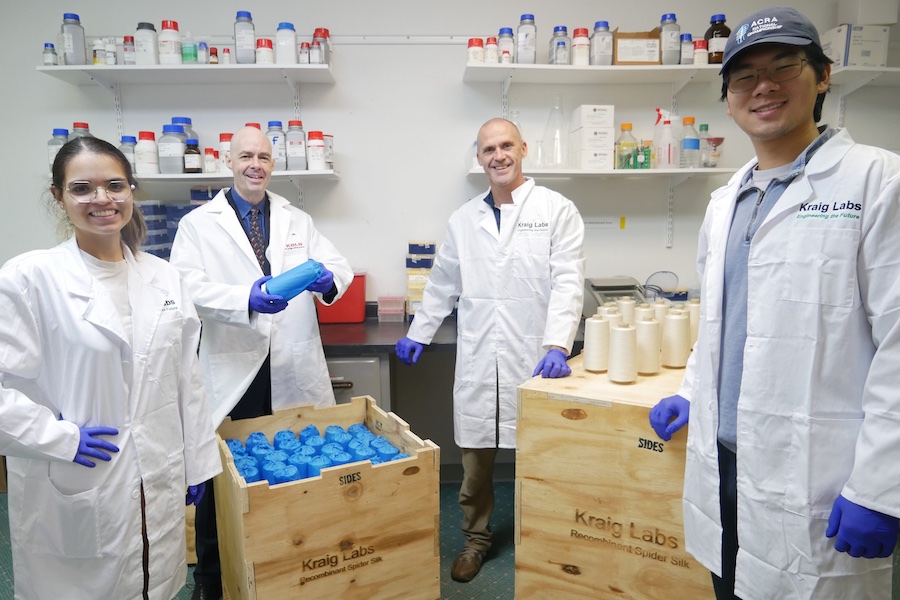
Kraig Biocraft Laboratories reports major progress converting record-setting spider silk cocoon production into reeled silk

Kraig Biocraft Laboratories, Inc. (OTCQB: KBLB) (“the Company”, “Kraig Labs”, or “Kraig’s”), a world leader in spider silk technology*, today announced significant progress in the processing of its recently produced recombinant spider silk cocoons into reeled silk.

#Textile processing

trinamiX mobile NIR spectroscopy: New applications for the footwear and textile industry

trinamiX GmbH expands its solution portfolio for the circular economy, now enabling the identification of materials used in the footwear and textile industries. With its mobile near-infrared (NIR) spectroscopy solutions, trinamiX supports manufacturers, sorters, recyclers, and brand owners in reliably identifying materials and improving transparency across increasingly complex value chains.

#Raw Materials

Fiber traceability - A vehicle to ensure sustainability or injustice?

The Bremen Cotton Exchange is making a new paper available for download. In this paper, analyst Veronica Bates Kassatly and statistician Terry Townsend examine the justifications behind this approach and assess the consequences for textile and apparel sustainability claims and global legislation.

Latest News

#Recycling / Circular Economy

Europe’s textile future at a turning point: New 2030 Circularity Blueprint aims to scale recycling and unlock investment opportunities

The EU textile system is at a critical crossroads. Today, less than 1% of discarded garments are recycled into new garments, despite EU-wide obligations for separate collection. In response, Global Fashion Agenda (GFA) is launching the 2030 Circularity Blueprint, in partnership with ReHubs. This ambitious initiative is designed to support the transformation of the EU textile ecosystem to advance textile-to-textile recycling and drive the transition to a circular economy.

#Research & Development

Regional hemp bast for lightweight construction profiles

The cultivation of fibre hemp for the production of ropes and clothing has a long tradition in Saxony. Due to its excellent fibre properties, it is also suitable as a renewable raw material for reinforcement in fibre composites. At the STFI and IWU in Chemnitz, the CannaPul project is cur- rently investigating how a regional value chain for hemp-based lightweight construction profiles can be established. To this end, the technical processing of hemp fibres into continuous fibre strands and their embedding in a suitable bio-based matrix are being investigated.

#Digital Printing

Kornit Digital launches Konnections 365

Kornit Digital (NASDAQ: KRNT) (“Kornit” or the “Company”), a global pioneer in sustainable, on-demand digital fashion and textile production today announced the launch of Konnections 365 - a year-round movement designed for the people moving the apparel, print, and retail industries forward. The strategy is built on the overwhelming success of Konnections 2026 held in Hollywood, Florida, featuring more than 500 customers, partners, and collaborators who together are driving the future of apparel and textiles.

#Techtextil 2026

Techtextil 2026: KARL MAYER impresses as an innovative sector partner

KARL MAYER looks back with satisfaction on its participation in Techtextil 2026. From April 21 to 24, the international industry leader used the trade show in Frankfurt to meet with numerous key customers at its booth and, at the same time, establish many new contacts. Most visitors came from Germany, followed by major markets such as Poland, the United Kingdom, Turkey, France, and Portugal.

TOP