[pageLogInLogOut]
CONNECTED BY NARROW FABRICS.

#Weaving

Marton Mills installs WeaveMaster

Established in 1931, family business Marton Mills are weavers of high quality apparel and furnishings with a focus on wool and tartan in their bespoke designs.

The mill, nestled by the River Wharfe near Otley in West Yorkshire is home to a weaving operation that has seen further investment in the latest high speed looms, providing a higher output from the same floor space in the weave room. For the sales, manufacturing and design team at Marton Mills, such an operation lends itself to having real-time information to assist with scheduling customer orders, forecasting deliveries and keeping logistics on the most efficient track.

Managing Director Laura Watts explains: “Whilst our larger customers tend to buy in bulk, we can also weave orders for as little as 13 metres, so the ability to see progress in real-time will be invaluable.”

Laura added: “Following an initial trial with another system, we decided to go with WeaveMaster from BMSvision (formerly Barco). WeaveMaster is a proven solution able to connect directly to our latest Dornier looms via a simple Ethernet connection. For our existing machines BMSvision also have suitable hardware designed specifically for the job, so we only have to plug in each loom and information will be received on screen in the office.”


In addition to the PC based production reporting, Marton Mills have selected a web based management dashboard which can provide live information for picks, metres, efficiency and planning on a large display in the weave room. This can also be used with mobile devices such as tablets & smart phones connected to the company network.

“BMSvision can support us from their local office nearby which is important for us as a busy family business. As well as providing installation advice and user training, BMSvision can connect remotely so there are no delays if we need to ask for support.” said Laura.

WeaveMaster will also be linked with the TMS manufacturing system at Marton Mills to receive works orders for planning each loom and timely updates to forecast the end of each job, providing faster responses to customer enquiries.



More News from BMSvision

More News on Weaving

#Techtextil 2026

Groz-Beckert showcases cross-segment innovations for technical textiles in Frankfurt

From April 21 to 24, 2026, Groz-Beckert will present its latest innovations and solutions across the product areas of knitting, weaving, nonwovens and sewing at Techtextil 2026 in Frankfurt (Hall 12, Booth B90).

#Techtextil 2026

Crealet to showcase electronic warp feeding solutions at techtextil 2026

Crealet AG will present its latest developments in electronic warp yarn feeding at Techtextil 2026 in Frankfurt. The company will exhibit at the Swiss Pavilion (Hall 12.0, Booth B01), organised by Swiss Textile Machinery.

#Techtextil 2026

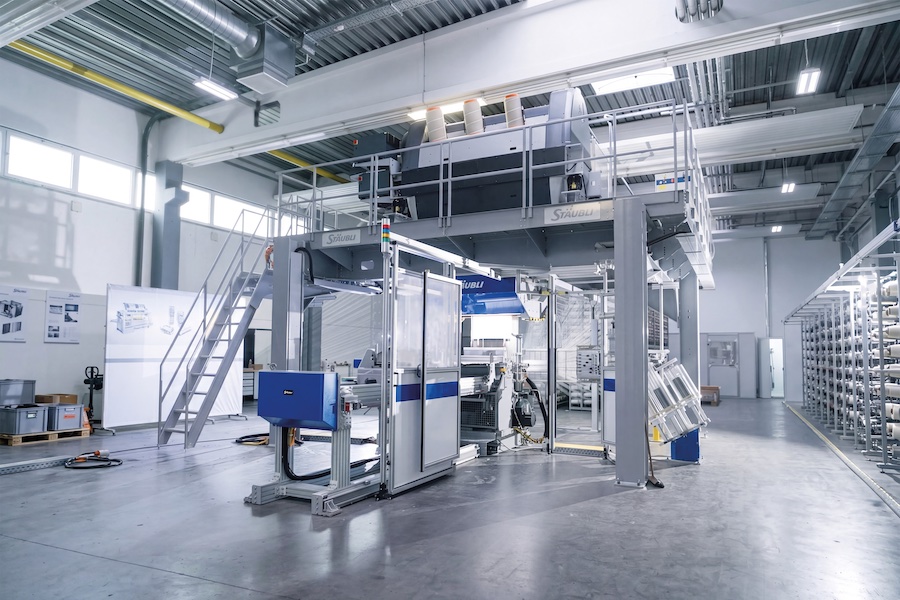
From preparation to 3D weaving: Stäubli’s solutions at Techtextil 2026

Stäubli, a global leader in high performance weaving technologies, is pleased to announce its participation at Techtextil 2026 in Frankfurt, Germany, the leading international trade fair for technical textiles and nonwovens. As technical textiles continue their rapid expansion across demanding markets such as defense, mobility, aerospace, construction, energy… Stäubli will showcase innovative solutions designed to empower mills to produce the next generation of advanced fabrics. Stäubli will exhibit its trend-setting technologies at the Swiss Pavilion Booth B01.6 in Hall 12.0.

#Weaving

Itema America acquires Palmetto Loom Reed, strengthening local manufacturing and service in the U.S.

Itema America, the U.S. subsidiary of Italy-based Itema Group, has acquired – through an Assets Purchase Agreement – Palmetto Loom Reed, a Greenville, South Carolina-based manufacturer of weaving reeds and one of the last remaining domestic producers of these precision components in the United States.

Latest News

#Techtextil 2026

AI, Start-ups, Research: Techtextil and Texprocess bring together players in the textile industry

From start-ups to universities and research institutes: at Techtextil and Texprocess, the world’s leading innovation trade fairs in Frankfurt am Main, exhibitors present future-oriented concepts for the global textile industry. With the international Campus & Research area, a strong participation from start-ups and the latest AI applications for textile processing, both trade fairs showcase current developments in the textile industry. By bringing together innovation, research and application, they enable new partnerships across the textile value chain.

#Techtextil 2026

IVGT joint stand brings innovation and networking to Techtextil 2026

At Techtextil 2026 and the parallel Texprocess 2026, key transformation topics such as artificial intelligence, digitalisation, sustainability, recycling and the circular economy will be reflected across the show. Against this backdrop, the IVGT, together with 16 member companies, will present its joint stand in Hall 12.1 (Stand D62) as a platform for exchange and networking.

#Man-Made Fibers

Indorama Ventures supports Southeast Asia’s textile customers with reliable regional supply and global innovative portfolio

Indorama Ventures, one of the leading global polyester fiber and filament yarn suppliers globally, will participate in Indo Intertex 2026 in Jakarta this April, making its diverse global portfolio available to apparel, home textile, and hygiene customers across Southeast Asia.

#Raw Materials

New study shows low environmental impact by Cotton made in Africa Organic Cotton from Tanzania

Today, the Aid by Trade Foundation (AbTF) is announcing the results of a comprehensive life-cycle analysis (LCA) for cotton produced in Tanzania under the Cotton made in Africa Organic (CmiA Organic) standard. The study emphasises the small ecological footprint of CmiA Organic verified cotton. This can largely be traced back to the absence of synthetic pesticides, artificial fertilisers, and artificial irrigation. Consequently, CmiA Organic cotton can help the textile industry meet regulatory requirements as well as science-based targets. The results also show that the consequences of climate change threaten the livelihoods of these cotton farmers, even though the type of agriculture they practise barely contributes to climate change.

TOP