[pageLogInLogOut]

#Nonwovens / Technical Textiles

New cost-benefit champion in glass processing
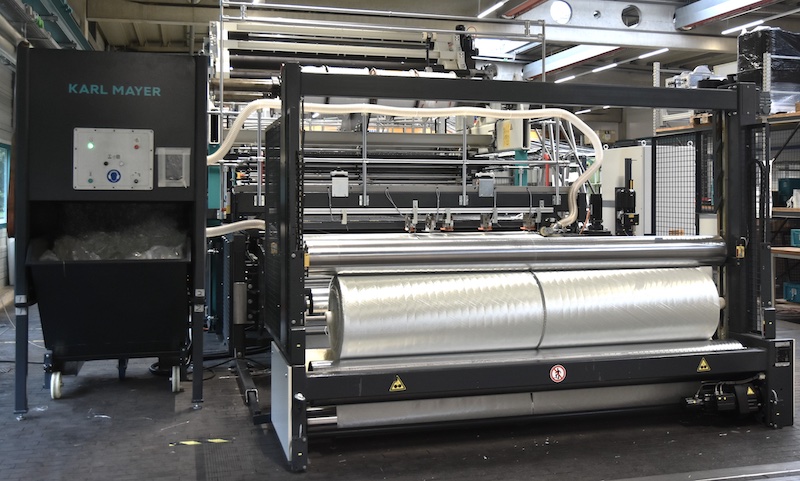
KARL MAYER Technische Textilien launches the new MAX GLASS ECO, a highly economical composite machine with a focus on standard non-crimp fabrics made of glass fibers.
MAX GLASS ECO © 2024 KARL MAYER


The wind power sector is a key industry for the climate-important energy transition, but it needs efficient value creation processes to realize its potential. KARL MAYER Technische Textilien makes an important contribution to this.

The innovative company based in Chemnitz develops, among other things, multiaxial warp knitting machines on which glass non-crimp fabrics are produced to reinforce the composites for rotor blades. A new machine will be launched this spring. The newcomer is called MAX GLASS ECO and impresses with its perfect price-performance ratio.

It is a true best-of-all-products. The MAX GLASS ECO incorporates proven solutions from the KARL MAYER GROUP's range of multiaxial machines, including features from its predecessor, the MAXTRONIC®, and combines these with sophisticated new technical developments. The result is a production machine for the extremely economical manufacture of standard glass fiber articles, especially non-crimp fabrics for the wind power industry.

An economical machine with a focus on standard applications for glass fiber use

With the MAX GLASS ECO, KARL MAYER Technische Textilien is optimizing its product portfolio for glass processing and thus its market approach: every customer receives the right product for their business strategy. When it comes to demanding applications with a wide range of technical adaptations, the COP MAX 4 is in demand. The performance spectrum of this proven machine can be modified with numerous options to suit market requirements.

If the focus is on the highly productive manufacture of goods for standard applications made exclusively from glass fibers, the new MAX GLASS ECO comes into play. The multiaxial warp knitting machine is extremely efficient, affordable and, unlike the previous MAXTRONIC®, sufficiently flexible thanks to various optional functions. At a rotational speed of up to 1,800 min-1, a maximum output of 410 m/h is achieved.
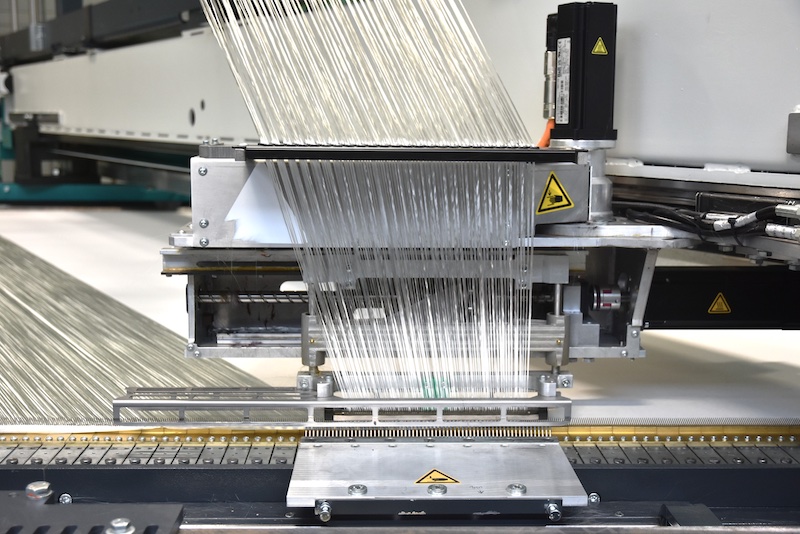
MAX GLASS ECO laying system © 2024 KARL MAYER


Best-of-all product consisting of proven solutions and new developments

The MAX GLASS ECO is available with a working width of 101? and is suitable for laying angles of +/-45°. A complementary layering system ensures a uniform take-up speed and therefore gentle processing of the fiber material. This sophisticated weft tension compensation device is one of a whole series of tried and tested features of KARL MAYER multiaxial technology that have been integrated into the new machine. Other adopted solutions include the Fiber Chopping Unit, which allows glass fiber chips to be introduced into the laying process and thus cover more fields of application, and a single pin transport chain for a processing method with less waste.

Newly developed innovations also ensure even better performance, including the fixed layer system, which ensures extremely high placement precision at all laying angles.

Other equipment details with added value for the customer include a conveyor belt across the full working width, the walking needle system, which prevents the formation of lanes even with long stitch lengths, and the fitting of single compound needles, which can be changed efficiently.

Very good response on the market

The new machine has been very well received on the market. The MAX GLASS ECO was presented at JEC World from March 5 to 7, 2024 in Paris with presentation material and was a crowd puller. The feedback from numerous customer visits in Eastern Europe and India was also very promising.

“Customers are particularly impressed by the short amortization times. The high performance of the machine is combined with an extremely attractive price. We are sensing a great deal of interest on the market,” says Ralf Schramm. The Sales Manager at KARL MAYER Technische Textilien had already registered numerous customers for a presentation of the machine at the company's development center in April. The MAX GLASS ECO was also an important topic of discussion at Techtextil from April 23 to 26, 2024 in Frankfurt am Main.

For Asian customers, a MAX GLASS ECO is available for performance demonstrations at KARL MAYER (CHINA) in Changzhou.


More News from KARL MAYER Textilmaschinenfabrik GmbH

#Knitting & Hosiery

The new RE 6 EL from KARL MAYER shows what it can do

KARL MAYER’s new RE 6 EL from KARL MAYER brings a breath of fresh air to raschel fabric production. The latest samples from the textile product development department of this innovative textile machine manufacturer demonstrate the extensive design possibilities on offer.

#Knitting & Hosiery

KARL MAYER and Lenzing partner to advance warp knitting with scalable cellulose fiber solutions

The Lenzing Group, a leading supplier of regenerated cellulosic fibers for the textile and nonwovens industries, together with KARL MAYER, the global market leader in warp knitting machines and warp preparation systems, debut a joint innovation project during Premiere Vision, Paris.

#Knitting & Hosiery

KARL MAYER opens a new TEXTILE INNOVATION CENTRE – a new era of textile innovation begins

KARL MAYER is opening its new TEXTILE INNOVATION CENTRE (TIC), sending a strong signal that it is driving textile innovation forward and opening up new perspectives for the textile industry. The TIC brings together the latest developments in Warp Knitting, Technical Textiles and Warp Preparation – KARL MAYER’s core areas of expertise.

#Knitting & Hosiery

Proven performance, optimised costs – the new RE 6 EL

Nowadays textile companies increasingly need to produce small production runs and respond to market changes with instantaneous pattern changes in order to operate profitably – meaning they require machines that offer maximum flexibility, reliability and cost efficiency. KARL MAYER understands the challenges of the market and is launching its new RE 6 EL. The Raschel machine offers the core strengths of the classic RSE 6 EL and essentially the same performance parameters, but has been further cost-optimised largely due to local production advantages. This makes the newcomer an efficiency champion in production, especially when it comes to frequent pattern changes.

More News on Nonwovens / Technical Textiles

#ITMA Asia + CITME Singapore 2025

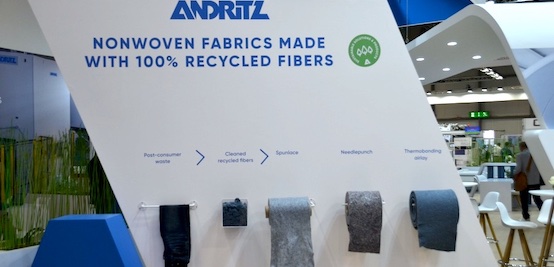
ANDRITZ sets focus on textile recycling and durable nonwoven production technologies at ITMA Asia 2025

International technology Group ANDRITZ will be presenting its innovative nonwovens production and textile solutions at ITMA ASIA + CITME 2025 in Singapore, from October 28 to 31, 2025 (Hall 2, D106). ANDRITZ will showcase its MMCF production plants, textile sorting and recycling, bast fiber processing, needlepunch, airlay, and life-cycle service technologies, with a focus on sustainable solutions. Discover how these innovations can grow your business opportunities and support a greener future.

#ITMA Asia + CITME Singapore 2025

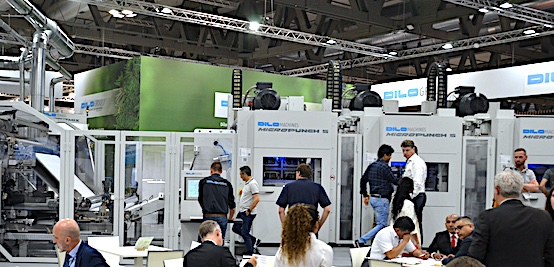
Dilo Group at ITMA ASIA Singapore 2025

At ITMA ASIA Singapore, the Dilo Group will exhibit at Booth No. H2 – D202. Together with Kansan Materials, Izmir, the company will present its latest developments and looks forward to welcoming visitors to exchange ideas and explore innovations in needling technology.

#Nonwovens

OUTLOOK™ 2025: Charting a sustainable and innovative future for the Nonwovens Industry

EDANA concluded its flagship event, OUTLOOK™ 2025, last week, marking it as a major success and addressing the biggest questions facing the industry. The three-day conference highlighted the urgent need for a unified approach to sustainability, regulation, and innovation in the absorbent hygiene and wipes sectors.

#Nonwovens

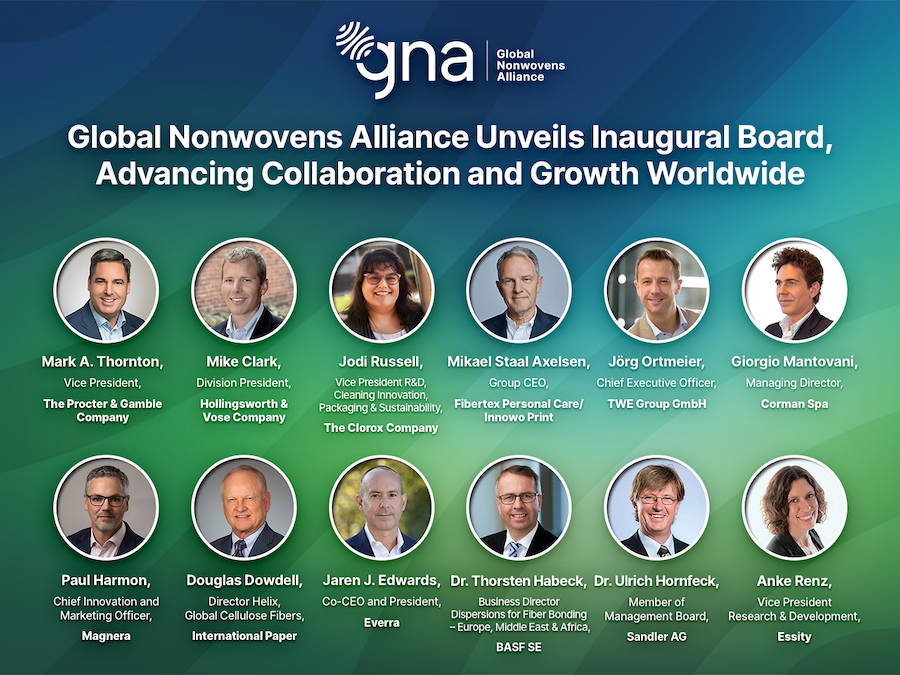
Global Nonwovens Alliance unveils Inaugural Board, advancing collaboration and growth worldwide

The Global Nonwovens Alliance (GNA), a tax-exempt federation jointly founded by INDA, the Association of the Nonwoven Fabrics Industry, and EDANA, the Voice of Nonwovens, announces the appointment of its founding Board of Directors. This group of leaders represents some of the most influential executives across the nonwovens value chain and reflects GNA’s mission to foster global collaboration, innovation, and growth in the industry.

Latest News

#Sustainability

Ying McGuire becomes new CEO of Cascale

Cascale today announced the appointment of Ying McGuire as Chief Executive Officer, effective June 1, 2026.

#Technical Textiles

Sustainable, lightweight, and sound absorbing: Polyester-based front trunk solution for BEVs

As car manufacturers look to further reduce their carbon footprint, Autoneum has developed an innovative front trunk solution for battery electric vehicles (BEVs), made entirely from polyester-based textile. The Ultra-Silent Frunk offers significant weight reduction, improved acoustic and thermal insulation, and uses up to 70 percent recycled material, supporting sustainable and efficient vehicle design. Autoneum, global technology leader in acoustic and thermal management for vehicles, has already received orders for the new frunk from three major OEMs in Asia and Europe to be built in three BEV models. Series production for two BEVs has been underway in China and Germany since last year.

#Raw Materials

Modern testing methods for raw cotton

The 38th International Cotton Conference Bremen will take place from 25 to 27 March 2026 at the Bremen Parliament. This conference has traditionally stood for in-depth expertise and international exchange. The program will focus on technical innovations, market trends, and regulatory frameworks across the entire value chain – from agriculture to the circular economy. With high-profile speakers, the conference is regarded as the key meeting point for the global cotton industry. Today’s focus: Cotton quality and testing methods.

#Spinning

Rieter responds to higher raw material prices

Global political and economic developments have been leading to rising raw material and energy costs for some time. The textile machinery industry is also affected by this trend. Rieter machines and components consist to a large extent of steel, copper, aluminum and electronics. These materials in particular have seen higher demand and higher prices in recent months.

TOP