[pageLogInLogOut]

#Nonwovens / Technical Textiles

Airy cellulose from a 3D printer
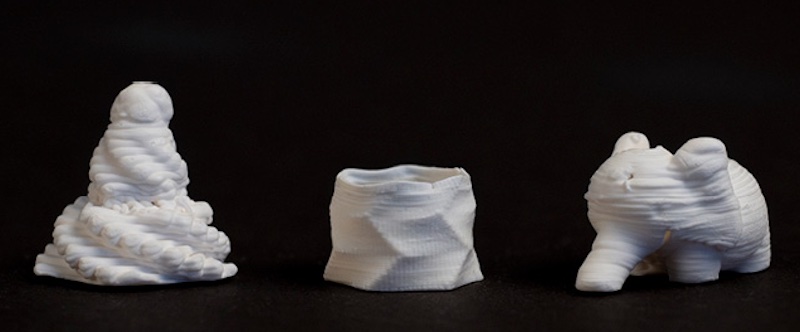
Ultra-light, thermally insulating and biodegradable: Cellulose-based aerogels are versatile. Empa researchers have succeeded in 3D printing the natural material into complex shapes that could one day serve as precision insulation in microelectronics or as personalized medical implants.
Complexity and lightness: Empa researchers have developed a 3D printing process for biodegradable cellulose aerogel. Image: Empa


At first glance, biodegradable materials, inks for 3D printing and aerogels don't seem to have much in common. All three have great potential for the future, however: "green" materials do not pollute the environment, 3D printing can produce complex structures without waste, and ultra-light aerogels are excellent heat insulators. Empa researchers have now succeeded in combining all these advantages in a single material. And their cellulose-based, 3D-printable aerogel can do even more.

The miracle material was created under the leadership of Deeptanshu Sivaraman, Wim Malfait and Shanyu Zhao from Empa's Building Energy Materials and Components laboratory, in collaboration with the Cellulose & Wood Materials and Advanced Analytical Technologies laboratories as well as the Center for X-ray Analytics. Together with other researchers, Zhao and Malfait had already developed a process for printing silica aerogels in 2020. No trivial task: Silica aerogels are foam-like materials, highly open porous and brittle. Before the Empa development, shaping them into complex forms had been pretty much impossible. "It was the logical next step to apply our printing technology to mechanically more robust bio-based aerogels," says Zhao.

The researchers chose the most common biopolymer on Earth as their starting material: cellulose. Various nanoparticles can be obtained from this plant-based material using simple processing steps. Doctoral student Deeptanshu Sivaraman used two types of such nanoparticles – cellulose nanocrystals and cellulose nanofibers – to produce the "ink" for printing the bio-aerogel.

Over 80 percent water

The flow characteristics of the ink are crucial in 3D printing: Tt must be viscous enough in order to hold a three-dimensional shape before solidification. At the same time, however, it should liquefy under pressure so that it can flow through the nozzle. With the combination of nanocrystals and nanofibers, Sivaraman succeeded in doing just that: The long nanofibers give the ink a high viscosity, while the rather short crystals ensure that it has shear thinning effect so that it flows more easily during extrusion.
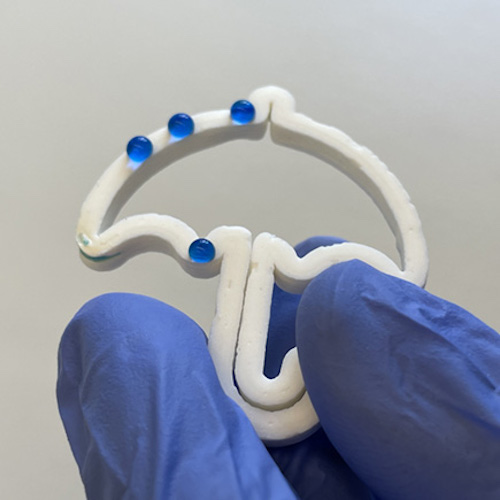
The printed objects can be rehydrated and dried multiple times without losing their shape – or they can be made hydrophobic. Image: Empa


In total, the ink contains around twelve percent cellulose – and 88 percent water. "We were able to achieve the required properties with cellulose alone, without any additives or fillers," says Sivaraman. This is not only good news for the biodegradability of the final aerogel products, but also for its heat-insulating properties. To turn the ink into an aerogel after printing, the researchers replace the pore solvent water first with ethanol and then with air, all while maintaining shape fidelity. "The less solid matter the ink contains, the more porous the resulting aerogel," explains Zhao.

This high porosity and the small size of the pores make all aerogels extremely effective heat insulators. However, the researchers have identified a unique property in the printed cellulose aerogel: It is anisotropic. This means its strength and thermal conductivity are direction-dependent. "The anisotropy is partly due to the orientation of the nanocellulose fibers and partly due to the printing process itself," says Malfait. This allows the researchers to control in which axis the printed aerogel piece should be particularly stable or particularly insulating. Such precisely crafted insulating components could be used in microelectronics, where heat should only be conducted in a certain direction.

A lot of potential applications in medicine

Although the original research project, which was funded by the Swiss National Science Foundation (SNSF), was primarily interested in thermal insulation, the researchers quickly saw another area of application for their printable bio-aerogel: medicine. As it consists of pure cellulose, the new aerogel is biocompatible with living tissues and cells. Its porous structure is able to absorb drugs and then release them into the body over a long period of time. And 3D printing offers the possibility of producing precise shapes that could, for instance, serve as scaffolds for cell growth or as implants.

A particular advantage is that the printed aerogel can be rehydrated and re-dried several times after the initial drying process without losing its shape or porous structure. In practical applications, this would make the material easier to handle: It could be stored and transported in dry form and only be soaked in water shortly before use. When dry, it is not only light and convenient to handle, but also less susceptible to bacteria – and does not have to be elaborately protected from drying out. "If you want to add active ingredients to the aerogel, this can be done in the final rehydration step immediately before use," says Sivaraman. "Then you don't run the risk of the medication losing its effectiveness over time or if it is stored incorrectly."

The researchers are also working on drug delivery from aerogels in a follow-up project – with less focus on 3D printing for now. Shanyu Zhao is collaborating with researchers from Germany and Spain on aerogels made from other biopolymers, such as alginate and chitosan, derived from algae and chitin respectively. Meanwhile, Wim Malfait wants to further improve the thermal insulation of cellulose aerogels. And Deeptanshu Sivaraman has completed his doctorate and has since joined the Empa spin-off Siloxene AG, which creates new hybrid molecules based on silicon.
More News from TEXDATA International

#Recycling / Circular Economy

textile.4U publishes special edition “Top 100 Textile Recycling Companies 2025”

With a comprehensive 176-page special edition, textile.4U is dedicating its latest issue entirely to one of the most dynamic and influential topics in today’s textile industry: textile recycling. The new issue, published exclusively in high-quality print, presents the Top 100 textile recycling companies researched and selected by TexData – organizations that already play a key role in the transition to circular textiles or are expected to have a significant impact in the near future.

#Recycling / Circular Economy

Responsible Textile Recovery Act of 2024 signed by Governor

Senator Josh Newman (D-Fullerton) is proud to announce that Senate Bill 707 (SB 707), the Responsible Textile Recovery Act of 2024, has been signed into law by the Governor of California, Gavin Newsom. This groundbreaking legislation establishes the country’s first Extended Producer Responsibility (EPR) textile recycling program, marking a significant step forward in the state’s efforts to combat waste and promote sustainability.

#Textiles & Apparel / Garment

Modtissimo promotes sustainability with 28 coordinates in the Green Circle

Modtissimo is proving more and more to be a textile and clothing show that delivers the latest innovations in the area of sustainability, with the iTechStyle Green Circle being the main showcase for companies' creations. In this 60+4 edition, taking place on 12 and 13 September, 28 coordinates will be exhibited in a section organised by CITEVE and curated by Paulo Gomes.

#Europe

The EU and Egypt team up to mobilise private sector investments at Investment Conference and sign a Memorandum of Understanding underpinning €1 billion in macro-financial assistance for Egypt

At the EU-Egypt Investment Conference, co-organised by the EU and the Government of Egypt on 29-30 June, the EU and Egypt are teaming up to intensify private sector investments in Egypt. They are also signing a Memorandum of Understanding (MoU) for the disbursement to Egypt of up to €1 billion in Macro-Financial Assistance.

More News on Nonwovens / Technical Textiles

#ITMA Asia + CITME Singapore 2025

ANDRITZ sets focus on textile recycling and durable nonwoven production technologies at ITMA Asia 2025

International technology Group ANDRITZ will be presenting its innovative nonwovens production and textile solutions at ITMA ASIA + CITME 2025 in Singapore, from October 28 to 31, 2025 (Hall 2, D106). ANDRITZ will showcase its MMCF production plants, textile sorting and recycling, bast fiber processing, needlepunch, airlay, and life-cycle service technologies, with a focus on sustainable solutions. Discover how these innovations can grow your business opportunities and support a greener future.

#ITMA Asia + CITME Singapore 2025

Dilo Group at ITMA ASIA Singapore 2025

At ITMA ASIA Singapore, the Dilo Group will exhibit at Booth No. H2 – D202. Together with Kansan Materials, Izmir, the company will present its latest developments and looks forward to welcoming visitors to exchange ideas and explore innovations in needling technology.

#Nonwovens

OUTLOOK™ 2025: Charting a sustainable and innovative future for the Nonwovens Industry

EDANA concluded its flagship event, OUTLOOK™ 2025, last week, marking it as a major success and addressing the biggest questions facing the industry. The three-day conference highlighted the urgent need for a unified approach to sustainability, regulation, and innovation in the absorbent hygiene and wipes sectors.

#Nonwovens

Global Nonwovens Alliance unveils Inaugural Board, advancing collaboration and growth worldwide

The Global Nonwovens Alliance (GNA), a tax-exempt federation jointly founded by INDA, the Association of the Nonwoven Fabrics Industry, and EDANA, the Voice of Nonwovens, announces the appointment of its founding Board of Directors. This group of leaders represents some of the most influential executives across the nonwovens value chain and reflects GNA’s mission to foster global collaboration, innovation, and growth in the industry.

Latest News

#Heimtextil 2026

Mimaki demonstrates versatile, simple TRAPIS textile printing at Heimtextil 2026

Mimaki’s textile pigment transfer printing system, TRAPIS, is able to print on a diverse range of fabrics - unlike traditional processes - including natural fibres and synthetic fabrics. The full solution will be shown on Mimaki’s booth (Hall 3.0 Stand A97), as the company returns to Heimtextil to showcase its advancements in sustainable, high quality and efficient textile printing.

#ITM 2026

The Technology Hub for global denim trends: ITM 2026

The ITM 2026 International Textile Machinery Exhibition, to be held at the Tüyap Fair and Congress Center in Istanbul from June 9–13, 2026, brings together groundbreaking technologies in denim production. From smart production systems to eco-friendly raw materials, from digital washing solutions to laser effect technologies, innovations that will shape the future of denim will be showcased for the first time at ITM 2026.

#Natural Fibers

38th International Cotton Conference Bremen: Let´s Talk about Cotton!

The 38th International Cotton Conference Bremen, to be held on 25-27 March 2026 in Bremen’s parliament building on market square, once again sends a powerful signal for professional excellence and international dialogue. The focus is on the latest market trends and technical innovations throughout the entire value chain – from agriculture and quality assurance to processing and the circular economy. With its high-calibre speakers, the conference remains an indispensable forum for anyone involved in shaping the cotton industry scientifically, technically, or economically.

#Recycled_Fibers

Leading fashion brands step up to unlock the next chapter of Circulose

Since 2024, under new ownership and leadership, Circulose has set a renewed strategic direction focused on securing long-term commitments with partner brands to bring CIRCULOSE® back to market at scale. This strategy has proven successful.

TOP