[pageLogInLogOut]

#Nonwovens / Technical Textiles

Borealis Bornewables™ polymers for personal hygiene fabrics help PFNonwovens Group accelerate its journey towards climate neutrality
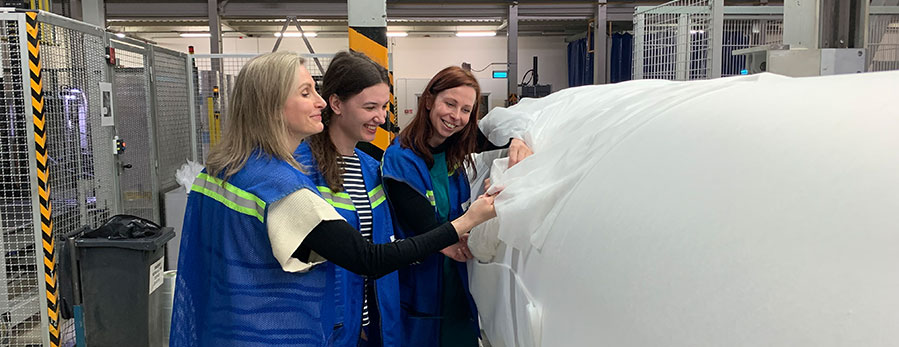
PFNonwovens production facilities © PFNonwovens
The nonwovens industry is moving towards a circular business model. As the growing world population is increasingly depending on soft and lofty nonwoven materials for absorbent products in everyday personal hygiene, from baby diapers to feminine hygiene products and incontinence care, certified renewable ™ polymers from Borealis help manufacturers combine efficient processability with significant benefits for the climate.

• PFNonwovens Group (PFN) reduces eco-footprint of nonwovens and sets new industry standard with Bornewables™ polypropylene (PP) for absorbent hygiene products

• Bornewables PP from ISCC PLUS mass balanced certified second-generation renewable feedstock derived entirely from waste and residue vegetable oil streams

• Industrial partnership embodies the Borealis EverMinds™ spirit of accelerating circularity and minimising carbon dioxide (CO?) emission


Significantly better environmental profile

In order to achieve their mission and offer value-added as well as more sustainable solutions to their customers, PFNonwovens Group teamed up with Borealis to enhance their production of nonwoven materials for the personal hygiene market and set a new industry standard by using Bornewables PP resins for spunbond and meltblown solutions.

“Anticipating the growing demand for more sustainable nonwoven solutions, we have focused our development resources over the past several years on the circular sphere to accelerate our journey towards climate neutrality,” explains Tonny De Beer, Chief Product, Technology & Sustainability Officer at PFNonwovens Group. ““For PFN’s nonwoven products, fossil-based resins are today the main contributor to the carbon footprint. Therefore, using the Borealis Bornewables instead of standard fossil-based resins will significantly reduce the carbon footprint, even enabling products with a carbon footprint under zero.”

Bornewables can be used as direct drop-in replacements for comparable fossil-based polyolefins. In PFN’s nonwoven production, they required no changes to the existing manufacturing process while delivering the same high quality and performance as previous non-renewable virgin materials.

Re-inventing essentials for sustainable living

In line with Borealis’s EverMinds™ ambitions to accelerate action on circularity, the Bornewables PP used by PFN is made with second-generation raw material feedstock derived entirely from waste and residue vegetable oil streams. The renewable content in all Bornewables products is mass balance accredited under the ISCC (International Sustainability and Carbon Certification) PLUS certification standard, confirming their authenticity and fully transparent traceability from the raw materials to the finished products.

“The combination of our expertise in polymer science and development with PFN’s processing know-how has resulted in nonwovens that make full use of the Bornewables advantages to minimise CO? emissions. Together we are reducing both waste and fossil depletion, while delivering cost-efficient products for the hygiene market with a premium look and feel,” adds Peter Voortmans, Global Commercial Director Consumer Product at Borealis. “At the same time, it serves as a role model of Borealis’ commitment to re-invent essentials for sustainable living in collaboration with value chain partners who share common goals.”


Taking a stand against climate change

Borealis adopted the mass balance approach for its renewable and chemically recycled polymers to provide products addressing climate change and circularity. The mass balance approach allows manufacturers to trace the exact share of sustainable feedstock allocated to their products, and Borealis’ ISCC PLUS certificates are audited annually to ensure that all requirements are met. Mass balancing makes it possible for customers to meet ambitious sustainability targets and stay on top of changing legislation. For PFN this means that for every tonne of certified Bornewables PP used in production, a maximum equivalent amount of nonwoven material can be claimed as certified renewable.

PFNonwovens Group’s new Bornewables based products for the personal hygiene market will be on display at INDEX™ 23, the world's leading nonwovens exhibition, from April 18 to 21 at the Palexpo Convention Centre in Geneva at Booth 1540.
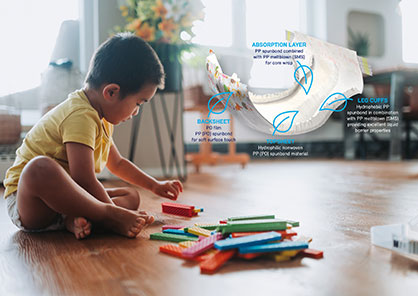

Nonwoven material for diapers produced by PFNonwovens contains renewably-sourced and ISCC PLUS mass balance certified polypropylene from the Borealis’ Bornewables™ portfolio of circular polyolefins. © Borealis


More News from TEXDATA International

#ITM 2026

ITM 2026: The new geography of textile production

New production hubs are emerging across North Africa and Central Asia, while Türkiye is accelerating its transformation toward higher-value, technology-driven and more sustainable textile manufacturing.

#Research & Development

“Production is a product”

From technical textiles and AI-driven robotics to the limitations of textile circularity: Professor Dr Thomas Gries looks back on more than two decades of development at ITA Aachen. In the interview, he explains why production technology remains a decisive success factor, discusses international collaborations and innovation ecosystems, and shares his views on the transformation of production landscapes and the challenges facing an increasingly regulated industry.

#Knitting & Hosiery

“We need to move away from the price trap and return to a value-driven mindset.”

With its new Textile Innovation Center, KARL MAYER is sending a strong signal for innovation, collaboration, and the future of textile applications. In this interview, Karl Josef Mayer discusses new opportunities in warp knitting, the processing of staple fibres, recycling, the changing role of machinery manufacturers, and why the textile industry must once again focus more strongly on the value of textiles. by Oliver Schmidt

#Associations

“Innovation, resilience and international experience remain the great strengths of the Swiss textile machinery industry”

Geopolitical uncertainty, growing competitive pressure from China, new free trade agreements and the shift towards a circular economy are currently reshaping the global textile industry. In this interview, Cornelia Buchwalder discusses the current mood within the Swiss textile machinery sector, the industry’s distinctive innovative strength, new market opportunities in India and Asia, and the technological trends that could shape the upcoming trade fair cycle leading up to ITMA 2027.

More News on Nonwovens / Technical Textiles

#ITMA Asia + CITME Singapore 2025

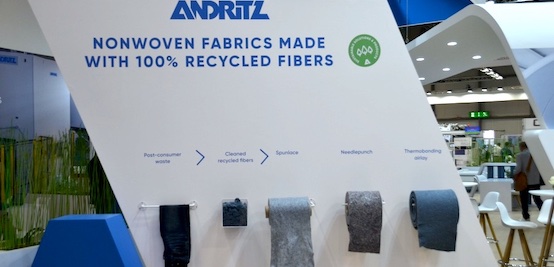
ANDRITZ sets focus on textile recycling and durable nonwoven production technologies at ITMA Asia 2025

International technology Group ANDRITZ will be presenting its innovative nonwovens production and textile solutions at ITMA ASIA + CITME 2025 in Singapore, from October 28 to 31, 2025 (Hall 2, D106). ANDRITZ will showcase its MMCF production plants, textile sorting and recycling, bast fiber processing, needlepunch, airlay, and life-cycle service technologies, with a focus on sustainable solutions. Discover how these innovations can grow your business opportunities and support a greener future.

#ITMA Asia + CITME Singapore 2025

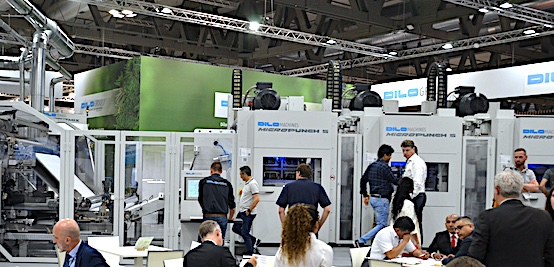
Dilo Group at ITMA ASIA Singapore 2025

At ITMA ASIA Singapore, the Dilo Group will exhibit at Booth No. H2 – D202. Together with Kansan Materials, Izmir, the company will present its latest developments and looks forward to welcoming visitors to exchange ideas and explore innovations in needling technology.

#Nonwovens

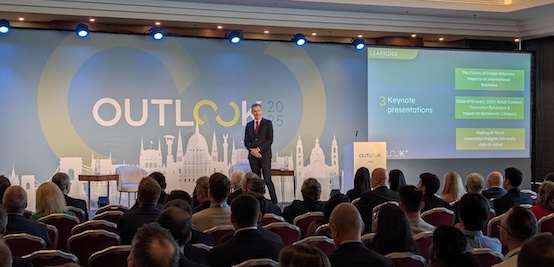
OUTLOOK™ 2025: Charting a sustainable and innovative future for the Nonwovens Industry

EDANA concluded its flagship event, OUTLOOK™ 2025, last week, marking it as a major success and addressing the biggest questions facing the industry. The three-day conference highlighted the urgent need for a unified approach to sustainability, regulation, and innovation in the absorbent hygiene and wipes sectors.

#Nonwovens

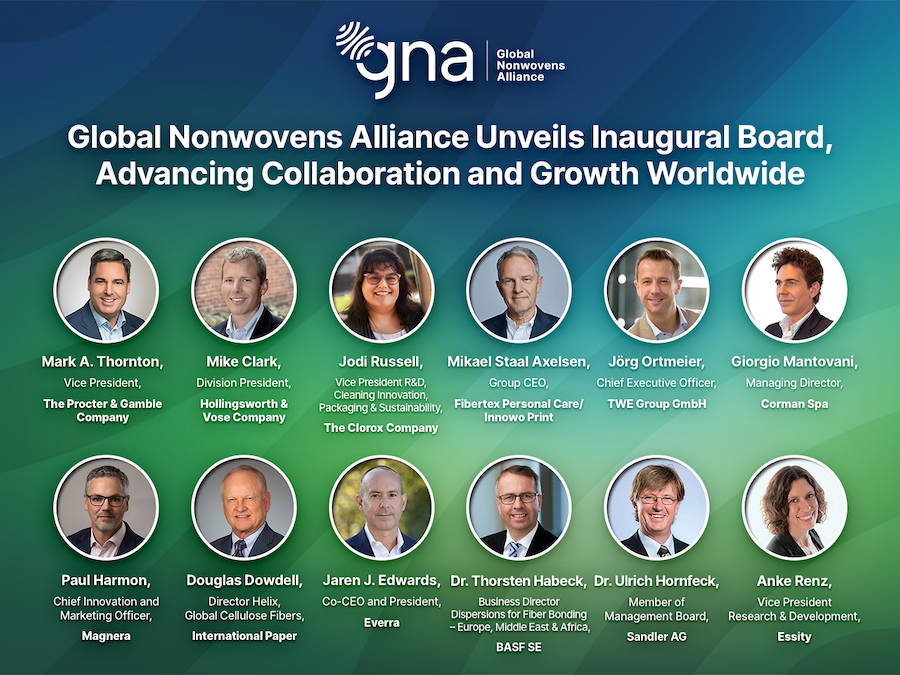
Global Nonwovens Alliance unveils Inaugural Board, advancing collaboration and growth worldwide

The Global Nonwovens Alliance (GNA), a tax-exempt federation jointly founded by INDA, the Association of the Nonwoven Fabrics Industry, and EDANA, the Voice of Nonwovens, announces the appointment of its founding Board of Directors. This group of leaders represents some of the most influential executives across the nonwovens value chain and reflects GNA’s mission to foster global collaboration, innovation, and growth in the industry.

Latest News

#ITM 2026

The future of textiles, the power of trade, and the summit of technology come together at ITM 2026

ITM 2026 International Textile Machinery Exhibition, one of the most prestigious organizations in the textile technologies sector, opens its doors to visitors between June 9-13. Expected to break records in terms of both exhibitor and visitor numbers, as well as the technological vision it presents, ITM 2026 will transform into a global trade hub with machine sales, and new business collaborations.

#Nonwoven machines

ATCO Hygienics, Uzbekistan, orders baby diaper production line from ANDRITZ

International technology group ANDRITZ has received an order from ATCO Hygienics to supply a new baby diaper production line for its plant in Tashkent, Uzbekistan. The order is included in ANDRITZ’s order intake for the first quarter of 2026. Commissioning of the production line is scheduled for the end of 2026.

#Weaving

Itema manufactures the first Projectile Weaving Machines “Made in Italy” at its Colzate Headquarters.

Itema proudly announces an important industrial milestone: in early May, the first Itema projectile weaving machines manufactured in Italy were successfully produced at the Group’s headquarters in Colzate.

#Spinning

Nico Pedretti appointed as Managing Director Graf Group

As of June 1, 2026, Nico Pedretti has assumed the role of Managing Director Graf Group. With more than 20 years of international industrial experience and extensive expertise in Operations, Supply Chain Management, Finance and Controlling, he brings a broad range of leadership and business experience to support Graf’s continued success.

TOP