[pageLogInLogOut]

#Nonwovens / Technical Textiles

First Swiss “Community Mask” with TESTEX label on the market

In recent weeks, mandatory use of face masks has become part of everyday Swiss life, at least on public transport. With immediate effect, the first fabric mask with the official “TESTEX Community Mask” test label is available from the two Swiss textile firms, Schoeller Textil AG and Forster Rohner AG. Since May, the companies have been able to offer their masks with official EMPA recommendation. The sustainable and economical quality products consist primarily of recycled performance fabric which can be recycled once again at the end of its service life.

Since 6 July, 2020, the wearing of face masks has been mandatory throughout the entire public transport network in Switzerland. In fact, the Federal Office of Public Health recommends wearing masks wherever social distancing is not practicable. Increasingly, voices calling for a sustainable and officially-recommended alternative to the previously widely-used FFP masks and medical masks are becoming louder. For this reason, the Swiss National Covid-19 Task Force has worked out the details of a recommendation, and defined the standards to be met. An expedient textile solution for Switzerland which meets these standards comes from within Switzerland. With no long transport routes or reliance on international supply chains.

Swiss cooperation

With the product from the two companies based in the east of Switzerland, Schoeller Textil AG and Forster Rohner AG, the Swiss market now boasts the first textile mask featuring the label “TESTEX Community Mask”. Together with the EMPA, TESTEX has developed a testing procedure which analyses textile masks with regard to their filter function, spray resistance, comfort of wear, reusability and additionally skin-friendliness of the textiles. By now, numerous Swiss and international consumers, as well as the employees of major companies (e.g. transport companies) have satisfied themselves of the suitability of the Swiss Community Masks for everyday use.

Recyclable fabric made with 60 % recycled fibres

The high-quality fabric components in the mask were developed by the innovative Rheintal-based company Schoeller Textil AG. The two-layer polyester fabric is hydrophilic (having an affinity to water) on the inside and hydrophobic (water-repelling) on the outside and furthermore features an antibacterial finish. Thanks to the cotton-like feel, the fabric offers pleasant wearing comfort. The sustainable fabric consists of 60 % recycled fibres. Within the framework of the wear2wear recycling cooperation (www.wear2wear.org), the masks can be recycled once again when they reach the end of their life cycle.

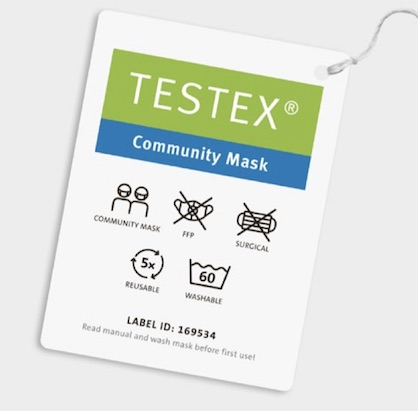
(c) 2020 «Testex.ch», «Forster Rohner AG / Schoeller Textil AG»


Innovative Swiss Companies, Schoeller Textil AG and Forster Rohner AG, present: the first Swiss “Community Mask” with TESTEX label on the market (c) 2020 «Testex.ch», «Forster Rohner AG / Schoeller Textil AG»


The reusable mask is made up by Forster Rohner AG in St. Gallen and in its European subsidiaries. It impresses with optimum fit and tested skin tolerance. All components of the mask comply with the OEKO-TEX® Standard 100. The testing process screens for numerous controlled and non-controlled substances. Masks with the OEKO-TEX® Standard 100 label are safe to wear. Forster Rohner also added a fashion component to the technically-innovative mask. The subsidiary, Jakob Schlaepfer AG, created a special print for the mask of the kind otherwise only developed for famous couture and prêt-à-porter fashion labels around the world. In addition to white and plain-coloured masks, a limited edition of available print designs emerges, or specific colours or even individual print designs are created for major customers.

The Community Masks are available online under:

www.cloth-shop.com

www.jakobschlaepfer.ch

www.forsterrohner.com


More News from Schoeller GmbH & CoKG

More News on Nonwovens / Technical Textiles

#ITMA Asia + CITME Singapore 2025

ANDRITZ sets focus on textile recycling and durable nonwoven production technologies at ITMA Asia 2025

International technology Group ANDRITZ will be presenting its innovative nonwovens production and textile solutions at ITMA ASIA + CITME 2025 in Singapore, from October 28 to 31, 2025 (Hall 2, D106). ANDRITZ will showcase its MMCF production plants, textile sorting and recycling, bast fiber processing, needlepunch, airlay, and life-cycle service technologies, with a focus on sustainable solutions. Discover how these innovations can grow your business opportunities and support a greener future.

#ITMA Asia + CITME Singapore 2025

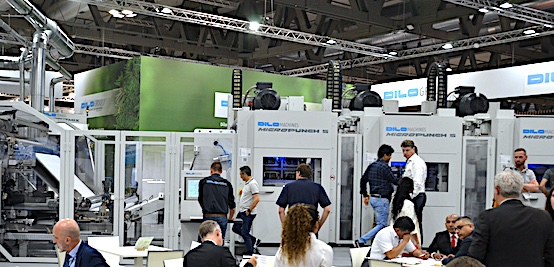
Dilo Group at ITMA ASIA Singapore 2025

At ITMA ASIA Singapore, the Dilo Group will exhibit at Booth No. H2 – D202. Together with Kansan Materials, Izmir, the company will present its latest developments and looks forward to welcoming visitors to exchange ideas and explore innovations in needling technology.

#Nonwovens

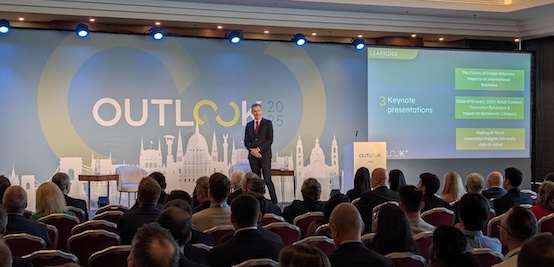
OUTLOOK™ 2025: Charting a sustainable and innovative future for the Nonwovens Industry

EDANA concluded its flagship event, OUTLOOK™ 2025, last week, marking it as a major success and addressing the biggest questions facing the industry. The three-day conference highlighted the urgent need for a unified approach to sustainability, regulation, and innovation in the absorbent hygiene and wipes sectors.

#Nonwovens

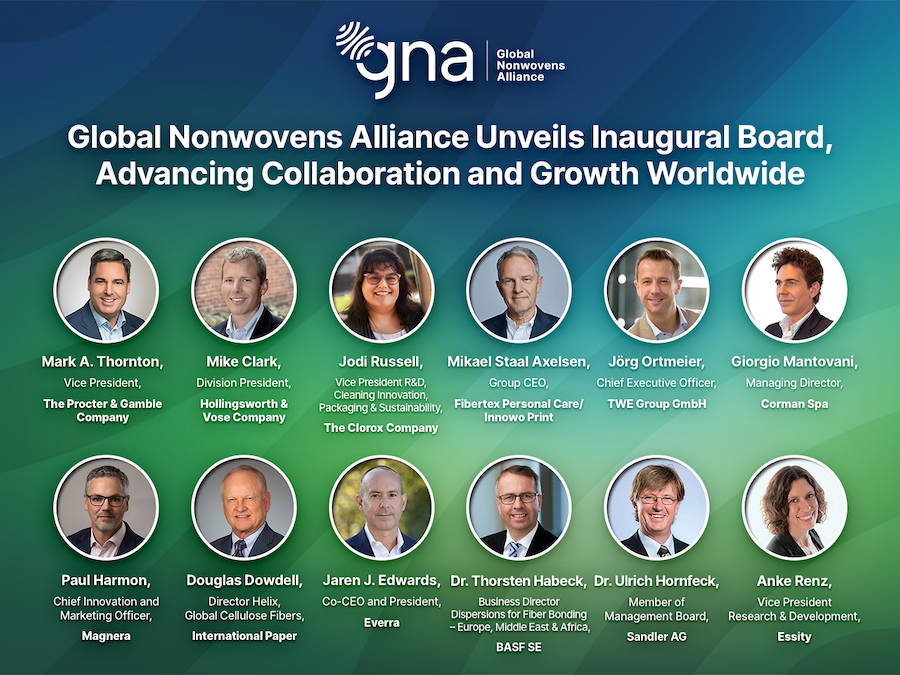
Global Nonwovens Alliance unveils Inaugural Board, advancing collaboration and growth worldwide

The Global Nonwovens Alliance (GNA), a tax-exempt federation jointly founded by INDA, the Association of the Nonwoven Fabrics Industry, and EDANA, the Voice of Nonwovens, announces the appointment of its founding Board of Directors. This group of leaders represents some of the most influential executives across the nonwovens value chain and reflects GNA’s mission to foster global collaboration, innovation, and growth in the industry.

Latest News

#Techtextil 2026

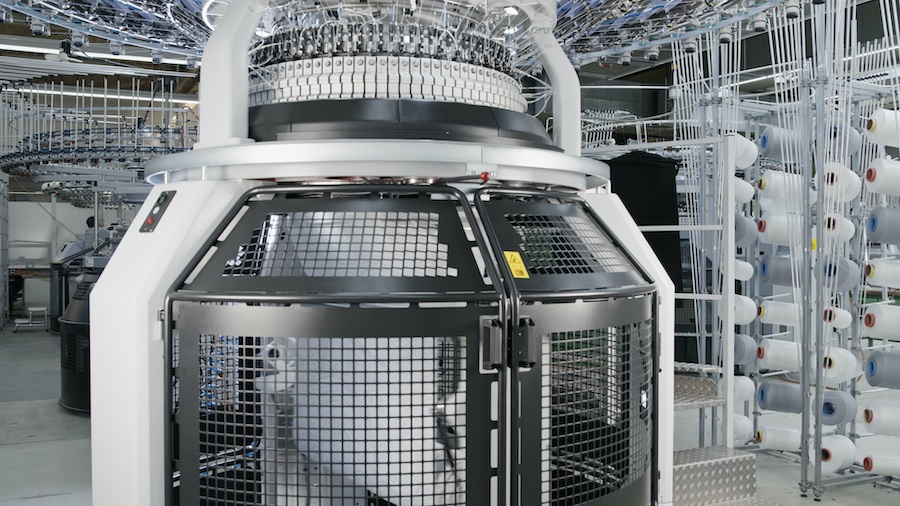
AI, Start-ups, Research: Techtextil and Texprocess bring together players in the textile industry

From start-ups to universities and research institutes: at Techtextil and Texprocess, the world’s leading innovation trade fairs in Frankfurt am Main, exhibitors present future-oriented concepts for the global textile industry. With the international Campus & Research area, a strong participation from start-ups and the latest AI applications for textile processing, both trade fairs showcase current developments in the textile industry. By bringing together innovation, research and application, they enable new partnerships across the textile value chain.

#Techtextil 2026

IVGT joint stand brings innovation and networking to Techtextil 2026

At Techtextil 2026 and the parallel Texprocess 2026, key transformation topics such as artificial intelligence, digitalisation, sustainability, recycling and the circular economy will be reflected across the show. Against this backdrop, the IVGT, together with 16 member companies, will present its joint stand in Hall 12.1 (Stand D62) as a platform for exchange and networking.

#Man-Made Fibers

Indorama Ventures supports Southeast Asia’s textile customers with reliable regional supply and global innovative portfolio

Indorama Ventures, one of the leading global polyester fiber and filament yarn suppliers globally, will participate in Indo Intertex 2026 in Jakarta this April, making its diverse global portfolio available to apparel, home textile, and hygiene customers across Southeast Asia.

#Raw Materials

New study shows low environmental impact by Cotton made in Africa Organic Cotton from Tanzania

Today, the Aid by Trade Foundation (AbTF) is announcing the results of a comprehensive life-cycle analysis (LCA) for cotton produced in Tanzania under the Cotton made in Africa Organic (CmiA Organic) standard. The study emphasises the small ecological footprint of CmiA Organic verified cotton. This can largely be traced back to the absence of synthetic pesticides, artificial fertilisers, and artificial irrigation. Consequently, CmiA Organic cotton can help the textile industry meet regulatory requirements as well as science-based targets. The results also show that the consequences of climate change threaten the livelihoods of these cotton farmers, even though the type of agriculture they practise barely contributes to climate change.

TOP