[pageLogInLogOut]

#Nonwovens / Technical Textiles

New investment in vertical lapping at NIRI
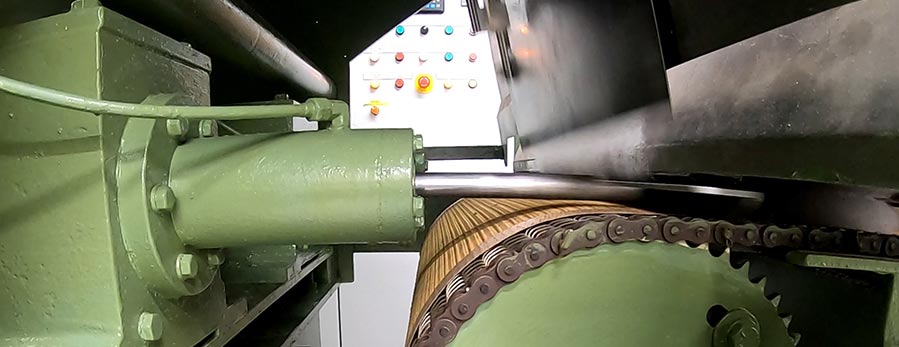
V-Lap installed at NIRI (c) 2019 NIRI
Nonwovens Innovation & Research Institute (NIRI) have added a new V-Lap machine to their extensive research and commercial facilities. This latest investment extends NIRI’s offering to clients in a wide range of sectors, including: automotive, filtration, medical, aviation, construction and renewables.

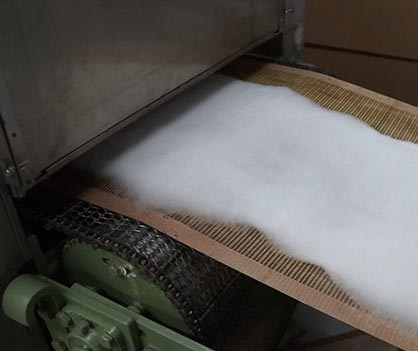
Vertical lapped materials have long been recognised for their thermal and acoustic properties and the weight reduction possibilities they offer.  However, the high initial investment required for production may have hampered experimentation.  NIRI have made significant investment, with a new V-Lap machine installed at their Leeds-based facilities, to help grow potential markets and applications.

The acoustic characteristics of vertical lapped materials - due to the unique vertical arrangement of the fibres within the fabric structure - lead to a high directional surface area, making them ideal for acoustical insulation.  A low weight-to-bulk ratio means that vertically-lapped products are foam-like, giving a reduced weight / cost balance at comparable thickness, increased breathability, and greater resilience and compression recovery. Further, vertical lapped materials have high thermal performance (? ? 0,04 W/mK) and are recyclable and non-toxic.

These properties make vertical lapped materials ideal for a range of sectors.  In the automotive industry, they are already used by some of the world’s biggest names, including BMW, Ford, General Motors, Honda, Mitsubishi and Toyota.  The combination of acoustic insulation, weight reduction and component uniformity has been successfully exploited for production of a range of automotive parts, including door insulators, headliner pads, under-carpet insulators, parcel shelves, bonnet protectors, dashboards, wheel arch liners and door components, where weight reduction can help with fuel efficiency.  

V-Lap, the company behind NIRI’s new equipment, advise that in filtration, the unique structure of vertically orientated webs improves coarse particle holding on the surface, as well as depth filtration of finer particles, resulting in a filter with very low pressure drop and high dust holding capacity. Applications include industrial processes such as abrasive blasting and metalworking, as well as water purification, waste water polishing and biochemical manufacturing.
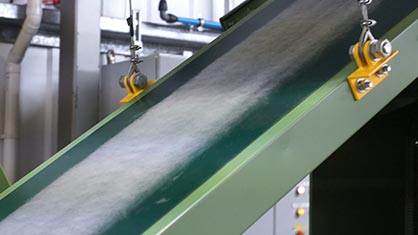
(c) 2019 NIRI
(c) 2019 NIRI


(c) 2019 NIRI
(c) 2019 NIRI


Within the medical and hygiene sectors, tests from 2017  evaluated the properties and efficacy of vertically lapped nonwoven fabric for hip protection pads.  With a similar force attenuation capacity to closed-cell foam, the inter-fibre and voids in the nonwoven structures enabled moisture to escape into the environment, with a significantly higher ability to transfer moisture than closed-cell foam pads.  As sectors where NIRI have extensive expertise, this is, clearly, an area where NIRI can help clients develop new and valuable applications.
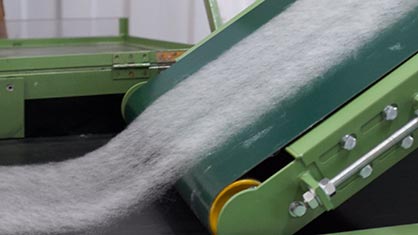
(c) 2019 NIRI
(c) 2019 NIRI


NIRI’s new V-Lap machine will also benefit clients interested in utilising waste fabrics from clothing and carpet waste, such as PET/PP, as the technology enables products to be recycled after their functional lifespan, then made into further materials, thus reducing the need for landfill.

The VLS500 Sample Line Model now installed at NIRI is designed to patented VLAP specifications and allows for quick and easy changeover between products.  At 400mm wide, it makes a trimmed product up to 300mm in width, between 20 and 42mm thick, and can accommodate virtually any manmade or natural fibre. 

Dr Matthew Tipper, Business Director at NIRI, comments, “This new equipment, building on significant investment over the last couple of years, further extends the opportunities for our clients to experiment with product development and new processes. We are keen to explore potential new applications for vertical lapped materials, building on NIRI’s research excellence and extensive and varied project portfolio.”
More News from TEXDATA International

#Texprocess 2026

Texprocess 2026: Automation, digitalisation and AI reshape textile processing

Investment decisions in textile processing have become increasingly complex. Rising energy prices, labour shortages and geopolitical uncertainties are forcing companies to prioritise technologies that deliver measurable improvements in efficiency and process stability. This applies not only to apparel production, but also to the processing of technical textiles and high-performance materials. Modernisation projects are therefore being evaluated more selectively – but the pressure to upgrade production systems continues to grow. Texprocess 2026 reflects this tension between cautious investment behaviour and increasing technological demand.

#Techtextil 2026

Textile Chemicals & Dyes: Innovation in Textile Chemistry moves into focus at Techtextil 2026

From PFAS-free finishes and water-saving dyeing technologies to advanced coatings and recycling-compatible formulations, innovation in textile chemistry is accelerating across the industry. Reflecting this development, Techtextil 2026 introduces Textile Chemicals & Dyes as a dedicated product segment, highlighting the growing role of chemical solutions in shaping the next generation of technical textiles.

#Recycling / Circular Economy

textile.4U publishes special edition “Top 100 Textile Recycling Companies 2025”

With a comprehensive 176-page special edition, textile.4U is dedicating its latest issue entirely to one of the most dynamic and influential topics in today’s textile industry: textile recycling. The new issue, published exclusively in high-quality print, presents the Top 100 textile recycling companies researched and selected by TexData – organizations that already play a key role in the transition to circular textiles or are expected to have a significant impact in the near future.

#Recycling / Circular Economy

Responsible Textile Recovery Act of 2024 signed by Governor

Senator Josh Newman (D-Fullerton) is proud to announce that Senate Bill 707 (SB 707), the Responsible Textile Recovery Act of 2024, has been signed into law by the Governor of California, Gavin Newsom. This groundbreaking legislation establishes the country’s first Extended Producer Responsibility (EPR) textile recycling program, marking a significant step forward in the state’s efforts to combat waste and promote sustainability.

More News on Nonwovens / Technical Textiles

#ITMA Asia + CITME Singapore 2025

ANDRITZ sets focus on textile recycling and durable nonwoven production technologies at ITMA Asia 2025

International technology Group ANDRITZ will be presenting its innovative nonwovens production and textile solutions at ITMA ASIA + CITME 2025 in Singapore, from October 28 to 31, 2025 (Hall 2, D106). ANDRITZ will showcase its MMCF production plants, textile sorting and recycling, bast fiber processing, needlepunch, airlay, and life-cycle service technologies, with a focus on sustainable solutions. Discover how these innovations can grow your business opportunities and support a greener future.

#ITMA Asia + CITME Singapore 2025

Dilo Group at ITMA ASIA Singapore 2025

At ITMA ASIA Singapore, the Dilo Group will exhibit at Booth No. H2 – D202. Together with Kansan Materials, Izmir, the company will present its latest developments and looks forward to welcoming visitors to exchange ideas and explore innovations in needling technology.

#Nonwovens

OUTLOOK™ 2025: Charting a sustainable and innovative future for the Nonwovens Industry

EDANA concluded its flagship event, OUTLOOK™ 2025, last week, marking it as a major success and addressing the biggest questions facing the industry. The three-day conference highlighted the urgent need for a unified approach to sustainability, regulation, and innovation in the absorbent hygiene and wipes sectors.

#Nonwovens

Global Nonwovens Alliance unveils Inaugural Board, advancing collaboration and growth worldwide

The Global Nonwovens Alliance (GNA), a tax-exempt federation jointly founded by INDA, the Association of the Nonwoven Fabrics Industry, and EDANA, the Voice of Nonwovens, announces the appointment of its founding Board of Directors. This group of leaders represents some of the most influential executives across the nonwovens value chain and reflects GNA’s mission to foster global collaboration, innovation, and growth in the industry.

Latest News

#Sustainability

Experts publish APAC policy priorities

Cascale today announced the publication of its APAC Policy Priorities Paper, developed by the Asia-Pacific (APAC) Policy Member Expert Team (MET) to identify key regional sustainability challenges and provide practical, aligned recommendations for policymakers and industry stakeholders across Asia-Pacific.

#Spinning

Temco launches a new DTY all-in-one solution

Temco introduces the DTY All-in-One Solution – a fully harmonized set of components engineered to give customers a highly stable, low maintenance and reproducible process environment. The solution reduces interruptions, extends component lifetimes and supports consistent yarn quality across all machine positions. All-in-One Solution – a fully harmonized set of components engineered to provide maintenance and reproducible process environment.

#Knitting & Hosiery

SHIMA SEIKI announces partnership with CLO Virtual Fashion

Leading computerized flat knitting innovator SHIMA SEIKI MFG., LTD. of Wakayama, Japan is partnering with digital garment solutions provider CLO Virtual Fashion of Seoul, South Korea for the integration of technology in garment design and simulation.

#Man-Made Fibers

Lenzing advances its transformation: Higher EBITDA, stronger free cash flow and more than EUR 200 million in cost savings

The business performance of the Lenzing Group in 2025 was affected particularly in the second half of the year by external factors such as international tariff measures, subdued demand and declining market prices. As a result, revenue decreased slightly by 2.3 percent to EUR 2.6 billion, primarily due to lower fiber sales volumes and lower prices for fibers and pulp, which were further negatively impacted by currency developments. Nevertheless, thanks to the comprehensive Performance Program, Lenzing was able to improve its operating performance and key financial indicators compared with the previous year.

TOP