[pageLogInLogOut]

#Making-Up

Prime Minister Mrs Malu Dreyer visits PFAFF
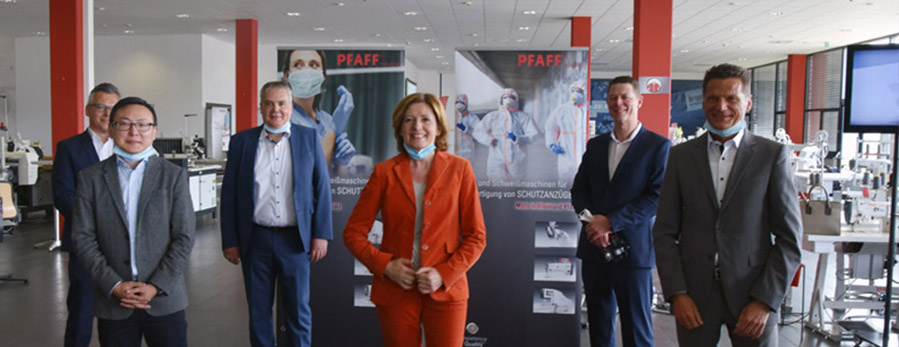
(c) 2020 Pfaff
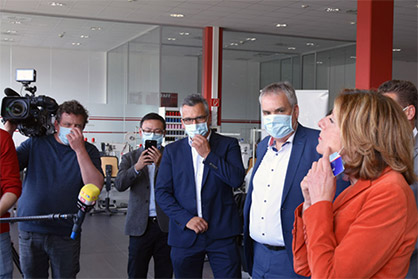
On 16 April, Prime Minister (State of Rhineland-Palatinate) Mrs Malu Dreyer visited PFAFF Industriesysteme und Maschinen GmbH in Kaiserslautern. Welcomed by the three PFAFF managing directors Michael Kilian, Guido Jaeger and Yongwu Chen, Malu Dreyer was there to find out about PFAFF's activities regarding the provision of production solutions for the manufacture of face masks.

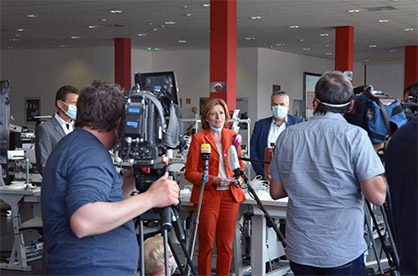
In the PFAFF showroom, the PFAFF management showed some solutions to the Prime Minister and explained which measures and adjustments have been implemented at PFAFF to meet the worldwide demand for sewing and welding solutions for the production of masks and protective clothing. Michael Kilian (PFAFF management spokesman) provided the information that, for example, in order to meet the high demand for welding machines, a second welding machine production line has been installed. 

Michael Kilian also said that PFAFF will install two fully automatic production lines for mask manufacturing at its locations in Kaiserslautern and Bensheim in the next few weeks and bring them into production. At full capacity, up to 3 million masks can be produced per month on the two production units (of a sister company within the group). Malu Dreyer was very impressed with this; further activities and procedures were discussed in intensive talks with PFAFF management. The basic tenor of the head of the federal state, “In the future, we cannot allow a situation where we are completely dependent on mask supplies from abroad. Regional manufacturing must be developed to ensure the necessary independence and flexibility". 
(c) 2020 Pfaff
(c) 2020 Pfaff


(c) 2020 Pfaff
(c) 2020 Pfaff


 A project of ITSMgroup GmbH (Mainz) and PFAFF, with the aim of establishing production of washable and reusable face masks in Germany within a few weeks, also follows the same line. This approach of "sustainable production and use" is fully supported by the Prime Minister. The state government is proud that the skills for the establishment of such sustainable mask production are available in the federal state and are being implemented concretely and at short notice in this difficult time.
More News from TEXDATA International

#ITM 2026

ITM 2026: The new geography of textile production

New production hubs are emerging across North Africa and Central Asia, while Türkiye is accelerating its transformation toward higher-value, technology-driven and more sustainable textile manufacturing.

#Research & Development

“Production is a product”

From technical textiles and AI-driven robotics to the limitations of textile circularity: Professor Dr Thomas Gries looks back on more than two decades of development at ITA Aachen. In the interview, he explains why production technology remains a decisive success factor, discusses international collaborations and innovation ecosystems, and shares his views on the transformation of production landscapes and the challenges facing an increasingly regulated industry.

#Knitting & Hosiery

“We need to move away from the price trap and return to a value-driven mindset.”

With its new Textile Innovation Center, KARL MAYER is sending a strong signal for innovation, collaboration, and the future of textile applications. In this interview, Karl Josef Mayer discusses new opportunities in warp knitting, the processing of staple fibres, recycling, the changing role of machinery manufacturers, and why the textile industry must once again focus more strongly on the value of textiles. by Oliver Schmidt

#Associations

“Innovation, resilience and international experience remain the great strengths of the Swiss textile machinery industry”

Geopolitical uncertainty, growing competitive pressure from China, new free trade agreements and the shift towards a circular economy are currently reshaping the global textile industry. In this interview, Cornelia Buchwalder discusses the current mood within the Swiss textile machinery sector, the industry’s distinctive innovative strength, new market opportunities in India and Asia, and the technological trends that could shape the upcoming trade fair cycle leading up to ITMA 2027.

More News on Making-Up

Latest News

#Man-Made Fibers

DYNEEMA® and NP Aerospace advance personal protection for military servicewomen

Dyneema®, owned by Avient Corporation, an innovator of materials solutions, is supplying its high-performance unidirectional (UD) materials to world-leading armor manufacturer NP Aerospace, enabling the production of armor systems designed specifically to fit the female body. With 2,000 new armor systems, including 4,000 plates, made in the United Kingdom (UK) and delivered in June 2026, this collaboration addresses a long-standing lack of high-quality personal protection specially built for female defense and security personnel.

#Man-Made Fibers

Textile Exchange publishes comprehensive polyester LCA study

Textile Exchange has released a new Life Cycle Assessment (LCA) study on polyester, providing detailed data on the environmental impacts of both virgin and recycled polyester production. The study aims to strengthen understanding across the fashion, textile and apparel industries and support more informed decision-making regarding polyester sourcing and production.

#Textiles & Apparel / Garment

Autopsy, the new trend book by Texworld Apparel Sourcing Paris, deciphers the fractures of our time through 12 creative signals

Presented during Texworld Apparel Sourcing Paris, from August 31 to September 2, 2026, at the Paris-Le Bourget Exhibition Center, Autopsy offers a reinterpretation of the contours of fashion in a world undergoing profound transformation, balancing radical introspection and sensitive renewal.

#Associations

Keeping products moving with Swedish automation at FILTECH 2026

At FILTECH 2026, taking place in Cologne from June 30th to July 2nd, members of TMAS – the Swedish textile machinery association – will highlight how the country’s engineering expertise is enabling filtration manufacturers to increase productivity, improve traceability and reduce dependence on labour-intensive manual processes.

TOP