[pageLogInLogOut]

#ITMA 2019

Mayer & Cie. at ITMA - Focus on sport and new customer experiences

Sportswear, as worn here by the Mayer & Cie. team that took to their bikes for the 2017 Albstadt Bike Marathon, is an important growth market for circular knitted fabrics. (c) 2019 Mayer & Cie
Albstadt-based circular knitting machine manufacturer Mayer & Cie. (MCT) is exhibiting at this year’s leading textile and garment technology trade fair ITMA with the slogan “Stay a winner. With Mayer & Cie.” The focus of the company’s presentation will be on sport. Sportswear, active leisurewear and sports shoes are increasingly made of circular knitted fabrics and the long-established German firm has the right machines to cater for this trend. Mayer & Cie. is also going for the improved customer experiences that consistent digitization makes possible.

The sportswear market is a growth market

“Circular knitting is one of the most efficient ways to manufacture textile surfaces,” says managing partner Marcus Mayer, in charge of technical development at Mayer & Cie. “A Mayer machine manufactures up to 40 kg of fabric per hour, enough for around 380 t-shirts. Jersey fabric is elastic too, which is good for wearing comfort, especially in the sport and leisure sectors.”

For years global demand for circular knitted goods has increased continuously. An important growth driver is the sportswear and sports fashion sector, including sports shoes. According to Euromonitor the market segment grew by about seven per cent per year between 2013 and 2017. By 2017 Euromonitor estimated its total market value to be around USD 78 billion. Lightweight synthetic fibres, new patterns and attractive functionalities are the key requirements in this area.

Mayer & Cie. can already fulfil many requirements with a portfolio of machines considered to be the largest in the industry. Lightweight mesh structures, often requested for running shirts, are a speciality of the IG 3.2 QCe interlock machine, for example. Jacquard machines from the OVJA family, in contrast, are suitable for the manufacture of shoe uppers. Hardy Bu?hler, trend scout and regional sales manager at Mayer & Cie., says that “for a sports shoe to be made of knitted fabric has only really been an option since the 2012 Olympics”. Compared with the conventional methods flat knitting and warp knitting, circular knitting scores points for productivity and significantly shorter set- up times.

“Because we think there continues to be a great deal of potential in sports- and leisurewear, our new machine developments are mainly located in that area,” says Marcus Mayer, summarising his company’s ITMA presentation.

Spinning and knitting on the way to new applications

Series production of the Spinit 3.0 E spinning and knitting machine has been under way since the end of 2018. It combines two previously separate processes – spinning and knitting – in one machine. That saves time, space and energy compared with conventional manufacturing processes. Mayer & Cie. has already won several awards for this approach, the latest being the Innovation Prize for the Climate and the Environment (IKU) that the Federal Environment Ministry and the Confederation of German Industry (BDI) award every other year.
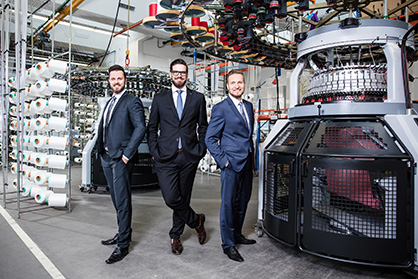

The Mayer & Cie. management trio: Benjamin Mayer, Sebastian Mayer and Marcus Mayer (from l. to r.) (c) 2019 Mayer & Cie


Circular-knitted shoe uppers score points against alternative manufacturing methods for productivity and significantly shorter set-up times. Photo: Adobe Stock, ChiccoDodiFC


 The company is presenting at ITMA its further developments of this machine. “We aren’t of course revealing yet exactly what they are,” says Marcus Mayer. “All I will say is that with this machine we aim to increasingly target sports- and leisurewear.”

Regeneration as part of sporting performance

Many top-flight athletes have long realised that a good night’s sleep is part of successful preparation for competitive events. Mattress covers and sportswear are a good match for Mayer & Cie. too. One ITMA exhibit is aimed specifically at this market segment. “The fully electronic circular knitting machines that are in demand can confidently be described as the premium class,” Marcus Mayer says. “Even though probably no-one remembers the pattern on their mattress, it is one of the most elaborate patterns that are made.” That is why a wide range of patterns, ease of use and, of course, the productivity of its circular knitting machines are key considerations for a mattress cover manufacturer.

Make collaboration easier, improve service

Along with machine development Mayer & Cie. has set itself another target for ITMA and thereafter: to improve the customer experience, a task of which Sebastian Mayer is in charge. His responsibilities at Mayer & Cie. are for corporate development and digitization. Digitization of the company’s extensive customer and machinery know-how is currently under way. Customers will be able to see and test the initial results at ITMA. Available for testing will be the new Web shop, linked with an analogue model of the high-bay warehouse in Albstadt-Tailfingen, and machine maintenance by means of HoloLens.

“And that is just a foretaste of what is to come,” says Sebastian Mayer. “We want to offer our know- how to our customers on a customer portal. That will make efficiency optimisation and predictive maintenance possible, delivering genuine customer benefits.”
More News from Mayer & Cie. Global GmbH

#ITM 2026

ITM 2026: Mayer & Cie. Global presents itself successfully at international industry trade fair

Mayer & Cie. Global has used ITM 2026 in Istanbul for its first major international appearance since the restart. Together with the Turkish representative Mayer Mümessillik, the company presented its premium circular knitting machines "Made in Germany", explained its future positioning within the group of companies and held talks with customers and representatives from numerous markets. The response to the restart was positive. The clear orientation of the company, the reliable worldwide network of representatives and the resumption of service and spare parts supply were welcomed by customers.

#ITM 2026

Mayer & Cie. Global is getting ready for ITM 2026

ITM 2026 marks the beginning of a new chapter for Mayer & Cie. Global. For the first time, the company will present itself to the international textile machinery industry in its new setup: combining proven circular knitting technology engineered in Germany with a clear commitment to its Albstadt headquarters and an internationally shaped, agile management approach.

#Knitting & Hosiery

Closing completed – Mayer & Cie. Global starts business operations

The future of the Mayer & Cie. brand has been secured: Following the successful completion of the purchase agreement for assets in the circular knitting machinery segment of the German traditional company Mayer & Cie., which was signed in February this year, the brand will continue to exist. The transfer of these assets to the new owner, Xu Hongjie, was formally completed yesterday afternoon. This clears the way for the resumption of business operations at the Albstadt site.

#Knitting & Hosiery

Huixing acquires insolvent Mayer & Cie.

Insolvency proceedings for the circular knitting and braiding machine manufacturer Mayer & Cie. were opened on December 1, 2025. Immediately following the opening of proceedings, the complete cessation of business operations was initiated. Most employees were subsequently given notice effective the end of February 2026. The production of the remaining orders in the circular knitting segment is expected to be completed by the end of the month. As early as December 2025, Mayer & Cie.’s braiding machine division was sold to an Italian investor.

More News on ITMA 2019

Latest News

#Recycled Fibers

Naia™ from Eastman strengthens western hemisphere textile connections at Apparel Sourcing Show Guatemala

As brands and retailers explore more diversified and responsive sourcing networks, the Naia™ brand from Eastman is strengthening its engagement with the textile and apparel value chain across the western hemisphere. From August 18–20, the company will participate for the first time in Apparel Sourcing Show Guatemala, a regional meeting point for apparel sourcing, manufacturing and nearshoring.

#Man-Made Fibers

Dornbirn GFC 2026 expands conference program with new thematic sessions

For 65 years, Dornbirn GFC has stood for innovation and is one of the world’s leading conferences in the fiber industry. From September 16 to 18, 2026, the international fiber community will meet in Dornbirn, Austria, to discuss current trends, technological developments, and forward-looking solutions. More than 600 experts from industry and academia from over 30 countries are expected to attend. With around 100 presentations by renowned speakers, a 2,5-day conference program, and three parallel presentation rooms with moderated sessions, Dornbirn GFC provides a first-class platform for knowledge exchange, networking, and international collaboration. Together, participants will generate ideas and impulses that will sustainably shape the future of the global fiber industry.

#Research & Development

Europe is committed to recycling end-of-life wind turbine blades

Starting in 2026, Europe’s wind energy industry has committed itself to ensuring that wind turbine blades do not end up in landfills once they reach the end of their service life. The EU-funded research project REWIND is exploring ways to reuse this composite waste. The German Institutes of Textile and Fiber Research Denkendorf (DITF) are one of 13 project partners from seven countries.

#Functional Fabrics

PERFORMANCE DAYS announces new focus topic & forums for October 2026

With its upcoming October 13–14, 2026 edition, PERFORMANCE DAYS is placing the spotlight on one of the textile industry’s most important transformations: “Bio-Based Materials – From Fiber to Fabric”, a two-part Focus Topic exploring the future of bio-based innovation across the textile value chain. Part 1, presented in October 2026, will focus on fibers and next-generation material developments, while Part 2 at the March 2027 edition will shift the perspective toward dyeing, finishing, additives, and processing technologies.

TOP