[pageLogInLogOut]
TRÜTZSCHLER SPINNING - THE NEW CARD

#Industry 4.0 / Digitalization

Circularise and Porsche collaborate with Borealis, Covestro and Domo Chemicals to enable the traceability of plastics in the automotive sector

Circularise and Porsche together with the pioneering material suppliers Borealis, Covestro and Domo Chemicals launched a blockchain traceability project as part of the Startup Autobahn program. By digitizing materials Circularise was able to create a digital thread through the whole supply chain leading to tracing materials and CO? footprints.

Circularise, the blockchain supply chain transparency provider, as part of the Startup Autobahn innovation program, recently launched a project with Porsche and its pioneering material suppliers – Borealis, Covestro and Domo Chemicals – to enable the traceability of plastics on blockchain and to ensure that the use of sustainable materials in Porsche cars can be proven. By digitizing materials Circularise was able to create a digital thread through the whole supply chain, enabling material traceability, tracking the CO? footprint and other sustainability metrics like water savings.

Getting information from supply chains has always been a challenge. Not only because of the inherent complexity of the supply chains and the multitude of suppliers, but also due to concerns around trust, privacy and confidentiality. That is why blockchain is offering such a fitting solution to transparency challenges in supply chains. “We believe transparency should not come at the cost of reduced privacy and confidentiality. That is why we developed our patent pending technology for creating verified statements on public blockchains without revealing any underlying sensitive data. While this raw data is very valuable in a B2B setting, consumers demand a more distilled and interactive version. We are proud to present exactly that in collaboration with Porsche and some of their pioneering suppliers,” says Mesbah Sabur.

Porsche has a large number of suppliers providing parts to its cars but it doesn’t stop the company looking for more information about the materials that go into its cars. According to Antoon Versteeg, Project Lead Innovation Research at Porsche, “We need to know more details on the parts and materials being used in our products, that means information on production processes deep down the supply chain, statements of recycled content and more. With the help of Circularise, as well as with the help of their partners we were able to trace for a number of specific cases plastics from raw material production to the final car.”

A number of suppliers who can deliver sustainably produced materials for the automotive industry were involved in this project to realise the final outcome. Each batch of material was digitized on the blockchain receiving a digital copy called digital twin. The digital twin carries all relevant information regarding the batch, such as its environmental footprint and origin. This digital thread created transparency between project partners leading to an improved supply chain collaboration.

This also offers great advantages to the material manufacturers. According to Thomas Nuyts, Director of Global Product Management at Domo Chemicals, “as leader in the production of sustainable polyamides, we at Domo can only gain by making the supply chain more transparent. By tracking our materials, we will make a huge step ahead in supporting the automotive industry in its sustainability challenges. Besides providing recycled solutions from current sources we also aim to enlarge this loop and find new raw materials for our products to meet the mobility needs of today and tomorrow.”


Porsche and Circularise launch blockchain traceability project in cooperation with Borealis, Covestro and Domo Chemicals | Photo Courtesy: (c) 2020 Circularise

However, the companies cannot simply create a digital twin. First, the batch of materials needs to be audited by an independent third party to verify that the material and related claims are true. “Verification is essential. Even with a supply chain involving blockchains we want independent auditors for our system. And this is how we gain the trust and confidence of all our value chain members. Several years from now, after these systems are in place on a wider scale, things will have been standardized. For now, it’s still early days. Auditors and certifications are essential to ensure that no one can engage in greenwashing. But we really need to pick up the pace as we keep moving towards more circularity,” says Christopher McArdle, Borealis Vice President Polyolefin Strategy and New Business Development.

Once the materials are digitized, the parties along the supply chain can now update the digital twin mimicking the physical supply chain and reflecting the manufacturing processes along the lifecycle of the product. Due to Circularise’s “Smart Questioning” technology this process can happen while preserving everyone’s privacy regarding their identity and business relations and protecting confidential information.

Burkhard Zimmermann, Head of Resin, Digital Transformation & Sustainability at Covestro’s Polycarbonates segment: “For us, it is really important to share information and be more transparent while maintaining confidentiality. For instance, the material composition is of competitive advantage so we would never share that openly. Here, Circularise helps us to maintain this confidentiality and only disclose the information needed from raw material producer to recycler. And with that, we can close the loop.”

Not only this approach helps car manufacturers to make better decisions for the next generations of vehicles and support end-of-life recycling approaches, it also helps final consumers to learn more about their vehicle and its origins, enabling them to make more sustainable choices. Ultimately reducing the environmental impact across the whole value chain.


More News from Covestro AG

#Technical Textiles

Covestro showcases monomaterial concept in autonomous SUE People Mover

UE | STUDIOS has unveiled the fully autonomous electric minibus “Self-driving Urban E-Shuttle” (SUE), placing strong emphasis on sustainable material design. Developed within a project funded by the Federal Ministry for Economic Affairs and Energy (BMWE) and the European Union, the vehicle will begin public road testing this year. At the core of the concept is the consistent use of recyclable monomaterials to improve circularity at end of life.

#Textile chemistry

Covestro and Heraeus Precious Metals collaborate to enable safer, more sustainable antimicrobial textile coatings

Laboratory tests reveal that AGXX antimicrobial surface technology from Heraeus Precious Metals is fully compatible with Impranil® PU dispersions which are part of the waterborne INSQIN® textile coating technology from Covestro, paving the way for more sustainable antimicrobial textile coatings. This discovery comes at a key moment for the textile coatings industry. As the sharing economy continues to grow, more people are coming into regular contact with high-use surfaces, creating ideal conditions for bacteria, viruses, and other microorganisms to thrive.

#Textile chemistry

Covestro celebrates decade of innovation and sustainable growth

Covestro celebrates its 10-year anniversary today. Since its carve-out from Bayer in 2015, the company has developed into a global leader in high-performance polymer materials and a pioneer in circular economy solutions. With a strong focus on innovation and sustainability, Covestro’s materials are now embedded in countless applications worldwide – from mobility and construction to electronics, healthcare, and consumer goods.

#Textile chemistry

Covestro extends contract with CTO Dr. Thorsten Dreier ahead of schedule until 2031

Dr. Thorsten Dreier will remain Chief Technology Officer of Covestro for a further five years. The Supervisory Board has extended his contract, which runs until June 2026, ahead of schedule from July 1, 2026 to June 30, 2031.

More News on Industry 4.0 / Digitalization

#Man-Made Fibers

OnceMore® from Södra brings end-to-end traceability for circular Man-made Cellulosic Fibers (MMCF) using TextileGenesis

OnceMore® from Södra, the world’s first large-scale process for recycling blended fabrics into high‐quality dissolving pulp, will begin using TextileGenesis, a Lectra company, to strengthen traceability from raw material to retail across the value chain. OnceMore® produces dissolving pulp made from blended textile waste and wood sourced from responsibly managed Swedish forests. By integrating TextileGenesis, OnceMore® supports the growing need for verified data and secure, transparent tracking throughout increasingly complex supply chain.

#Denim

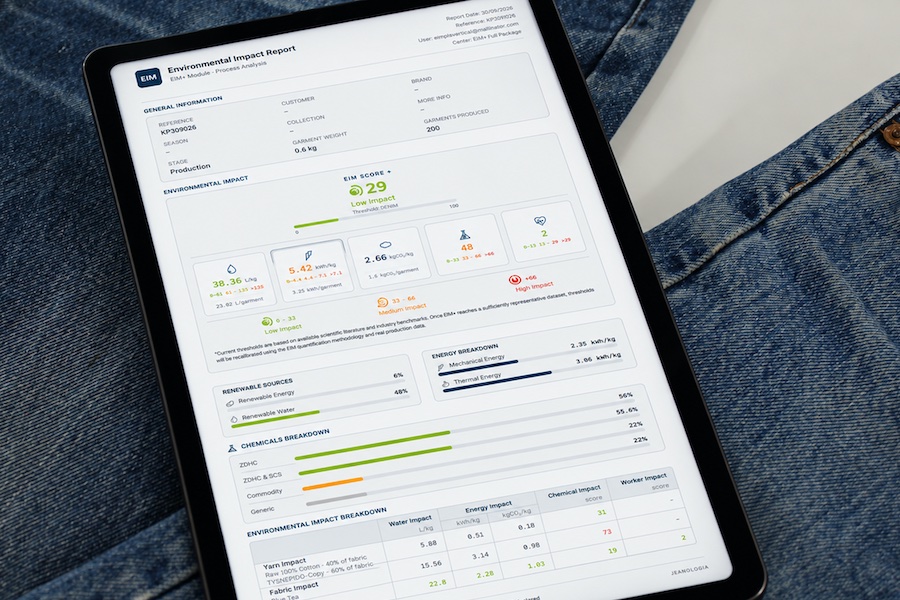
Jeanologia launches Billy

The new AI extracts precise laser designs from a garment image in minutes, transforming how vintage denim is recreated for production. If Jeanologia’s laser changed the way jeans were made at the end of the last century, its AI now takes the next step: moving from reproducing wear to designing it. / archive photo © 2026 Jeanologia

#Dyeing, Drying, Finishing

Monforts unveils interactive digital platform for textile finishers

Monforts has launched a new digital platform designed to give textile manufacturers faster, more intuitive access to the company’s finishing technologies, technical expertise and aftersales support worldwide.

#Spinning

Barmag presents the next generation of POY production – energy-efficient and partial-automated

With POY 2.0, Barmag is introducing a completely redesigned spinning concept that takes the production of partially oriented yarn (POY) to a new level in terms of technology and economy. The solution, which was presented to a selected audience of experts for the first time at ITMA Asia + CITME 2025, was met with great enthusiasm: several yarn producers worldwide immediately expressed their interest in a pilot plant.

Latest News

#Techtextil 2026

Gebr. Otto highlights versatility at Techtextil with regional supply chains, yarn innovations and new hygiene segment

At this year’s Techtextil, Gebr. Otto places its versatility at the center of its presentation. In addition to spinning, twisting and dyeing – traditionally focused on fine cotton – textile processors will also find a competent development partner for technical specialty solutions. The Dietenheim-based spinning mill has now built up a decade of experience in the production of technical yarns, particularly from aramids. A new hygiene segment has also been established, where yarns for medical and hygiene products are currently being produced. In the future, this department could also develop textile products for the food sector. Gebr. Otto will once again be present at the BW-i joint stand, booth D81, hall 12.1. What is wound onto the spool is determined by the customer: Gebr. Otto develops according to specific customer requirements and transforms its own ideas into yarn innovations.

#Europe

Commission presents proposal for EU Inc. - unlocking the full potential of the Single Market for Europe's entrepreneurs

Today, the European Commission presented its proposal for EU Inc., a new single set of corporate rules, building the cornerstone and starting point for the EU's 28th regime. EU Inc. is an optional, digital-by-default European corporate framework. It will make it easier for businesses to start, operate and grow across the EU – incentivising them to stay in Europe, and encourage those who once looked elsewhere to return.

#Sustainability

Experts publish APAC policy priorities

Cascale today announced the publication of its APAC Policy Priorities Paper, developed by the Asia-Pacific (APAC) Policy Member Expert Team (MET) to identify key regional sustainability challenges and provide practical, aligned recommendations for policymakers and industry stakeholders across Asia-Pacific.

#Spinning

Temco launches a new DTY all-in-one solution

Temco introduces the DTY All-in-One Solution – a fully harmonized set of components engineered to give customers a highly stable, low maintenance and reproducible process environment. The solution reduces interruptions, extends component lifetimes and supports consistent yarn quality across all machine positions. All-in-One Solution – a fully harmonized set of components engineered to provide maintenance and reproducible process environment.

TOP