[pageLogInLogOut]

#ITMA 2019

New 3D braiding machine and mixed reality learning environment for the weaving process

At the ITMA in Under Linkway booth D221 (UL D221), the Institut für Textiltechnik of RWTH Aachen University (ITA), will demonstrate the digital retrofitting of a 3D braiding machine for the production of three-dimensionally reinforced ceramic turbine components and a mixed reality learning environment for a weaving process to qualify new and also experienced employees.

Digital retrofitting of a 3D braiding machine for the production of three-dimensionally reinforced ceramic turbine components

Developed from an existing conventional mechanics, a 3D braiding machine was digitized and rebuilt according to industry 4.0 standard. This enables, for example, the prototyping and production of three-dimensionally reinforced ceramic components. As a virtual micro factory, the processing of very sensitive or brittle fibre materials can be simulated in an appropriate software environment. Subsequently, the process data is generated and the production is mapped in the real machine. The process stability is thus almost doubled, the machine speed could be increased by 150 percent. The location-independent simulation and control software (open source) allows extremely flexible process planning and control of the process chain with a mobile terminal - in our application for the production of a textile preform for a ceramic component in turbine construction.

The exhibit demonstrates on the one hand the successful digital retro-fitting of analogous machines and on the other hand the holistic (virtual and real) process design for the processing of sensitive fibre materials, which are used in highly efficient energy conversion as lightweight construction materials.

For further information please contact martin.kolloch@ita.rwth-aachen.de.

Mixed-reality learning environment for weaving process

Training and qualification of new and existing employees are important prerequisites for a company's success, especially for machine and textile manufacturers. The ITA has developed a learning environment based on a 3D model of a tape loom using mixed-reality technology. Mixed reality is the combination of data from reality with artificial 2D or 3D objects (virtual reality).
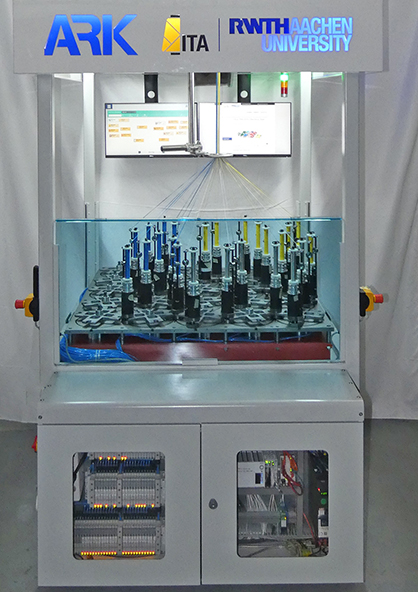
3D braiding machine (c) 2019 ITA


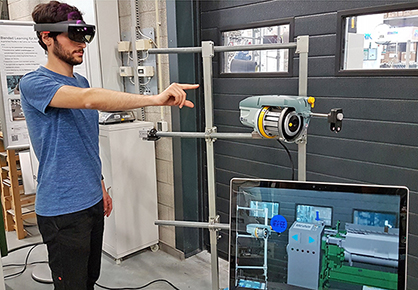
Mixed reality learning environment for weaving process (c) 2019 ITA

The 3D model of a wide loom is presented to the employee in the room for illustration using mixed-reality technology. Mixed reality glasses transfer step-by-step work instructions for setting up the machine to real machine components. Now, for example, the employee can interactively correct a process error that led to a machine standstill on the 3D model without any further assistance being required. In this example, it is the breakage of a weft thread.

A new feature of this model is the interaction of real and virtual machine parts within an application using mixed-reality technology.

The target groups for this learning environment are in particular textile and textile machine manufacturers as well as textile training institutions.

The learning environment described above can be viewed in the shop window of the Mittelstand 4.0-Kompetenzzentrum Textil vernetzt in the Digital Capability Center in Vaalser Straße 460 in Aachen, Germany. An individual application can be developed within one to six months, depending on the level of detail and the scope of the mixed-reality applications. For further information please contact arash.rezaey@ita.rwth-aachen.de.

ITA looks forward to seeing you at ITMA in the Under Linkway booth D221 (UL D221)!


More News from Institut für Textiltechnik of RWTH Aachen University (ITA)

#Research & Development

Solid Air Dynamics wins second place at RWTH Innovation Award

On 30 January, RWTH spin-off Solid Air Dynamics was awarded second place in the RWTH Innovation Awards for its research in the field of aerogel fibres. Manufactured from renewable raw materials, aerogel fibres offer outstanding thermal insulation, are extremely lightweight and completely biodegradable, and can consist of over 90 per cent air.

#Research & Development

Award-winning research for sustainable carbon fibre cycles

Sustainable recycling of carbon fibres is possible through targeted electrochemical surface modification, which makes the sizing of carbon fibres resistant to solvolysis. ITA PhD student Sabina Dann was awarded the MSW Award from RWTH Aachen University for her master's thesis on this development. The award ceremony took place on 12 November 2025 in Aachen.

#Research & Development

Kick-off for the Textile Production of the Future: Establishment of a Textile Technology and Development Centre in Mönchengladbach, Germany

The Institut für Textiltechnik (ITA) of RWTH Aachen University, together with its partners, is pleased to announce that it has received approval for its joint initiative, ‘Textile Factory 7.0’. The goal of the project is the establishment of a technology and development centre for the textile industry in Mönchengladbach.

#Research & Development

Exchange data between textile companies openly, securely and cost-effectively without a central platform – ITA makes it possible

The Institut für Textiltechnik (ITA) of RWTH Aachen University has launched a new demonstrator for an open and secure data space in the textile industry at the Digital Innovation Centre Europe (DICE). For the first time, the demonstrator shows directly and clearly how companies can share their data securely with each other without the need for a central platform. Data exchange is based on shared, freely usable technical foundations.

More News on ITMA 2019

Latest News

#Recycling / Circular Economy

Circulose restarts commercial-scale production at Ortviken plant in Sundsvall

Circulose today announced the restart of its commercial-scale production plant at Ortviken in Sundsvall, Sweden, marking a significant step in scaling next-generation materials for the global fashion industry. The company plans to resume production of CIRCULOSE®, a recycled pulp made entirely from discarded cotton textiles, in the fourth quarter of 2026.

#Textiles & Apparel / Garment

VIATT 2026 to debut German Pavilion, strengthening European participation alongside key Asian textile hubs

Vietnam’s textile and garment sector continues to be a major contributor to the country’s economic growth, with export revenues expected to reach USD 46 billion in 2025, a 5.6% increase from 2024 . From 26 – 28 February, the Vietnam International Trade Fair for Apparel, Textiles and Textile Technologies (VIATT) is set to contribute to economic growth opportunities by accelerating digital transformation and green transition across the entire textile value chain. The upcoming edition will respond to the rising demand for advanced technologies and sustainable materials with the introduction of the German Pavilion, alongside strong exhibitor participation from key Asian sectors, as well as several high-profile fringe events.

#Sustainability

Ying McGuire becomes new CEO of Cascale

Cascale today announced the appointment of Ying McGuire as Chief Executive Officer, effective June 1, 2026.

#Technical Textiles

Sustainable, lightweight, and sound absorbing: Polyester-based front trunk solution for BEVs

As car manufacturers look to further reduce their carbon footprint, Autoneum has developed an innovative front trunk solution for battery electric vehicles (BEVs), made entirely from polyester-based textile. The Ultra-Silent Frunk offers significant weight reduction, improved acoustic and thermal insulation, and uses up to 70 percent recycled material, supporting sustainable and efficient vehicle design. Autoneum, global technology leader in acoustic and thermal management for vehicles, has already received orders for the new frunk from three major OEMs in Asia and Europe to be built in three BEV models. Series production for two BEVs has been underway in China and Germany since last year.

TOP