[pageLogInLogOut]

#Europe

Textile ETP presented EU funding opportunites at EURATEX Convention

On 8 and 9 Novem­ber 2021, Euro­pean tex­tiles and cloth­ing com­pa­nies met in Antwerp to dis­cuss the future of the tex­tile industry.

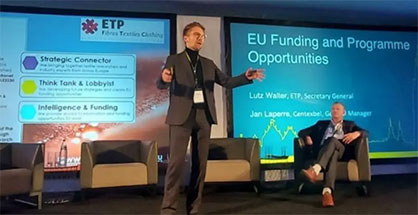
At the EURATEX Convention on 9th November 2021 in Antwerp, Lutz Walter presented an overview of EU funding opportunities for textile research and innovation. 

He highlighted the challenges and opportunities of such public funding for textile innovators and discussed with participants the best practices to access and exploit them in the most fruitful way.

Presentation:

https://cdn2.assets-servd.host/deranged-cormorant/production/Lutz-Walter_EU-funding-opportunities-for-Textile-Innovation_EURATEX-convention_09-11-2021-1.pdf

© 2021 Textile-platform


More News from TEXDATA International

#ITM 2026

ITM 2026: The new geography of textile production

New production hubs are emerging across North Africa and Central Asia, while Türkiye is accelerating its transformation toward higher-value, technology-driven and more sustainable textile manufacturing.

#Research & Development

“Production is a product”

From technical textiles and AI-driven robotics to the limitations of textile circularity: Professor Dr Thomas Gries looks back on more than two decades of development at ITA Aachen. In the interview, he explains why production technology remains a decisive success factor, discusses international collaborations and innovation ecosystems, and shares his views on the transformation of production landscapes and the challenges facing an increasingly regulated industry.

#Knitting & Hosiery

“We need to move away from the price trap and return to a value-driven mindset.”

With its new Textile Innovation Center, KARL MAYER is sending a strong signal for innovation, collaboration, and the future of textile applications. In this interview, Karl Josef Mayer discusses new opportunities in warp knitting, the processing of staple fibres, recycling, the changing role of machinery manufacturers, and why the textile industry must once again focus more strongly on the value of textiles. by Oliver Schmidt

#Associations

“Innovation, resilience and international experience remain the great strengths of the Swiss textile machinery industry”

Geopolitical uncertainty, growing competitive pressure from China, new free trade agreements and the shift towards a circular economy are currently reshaping the global textile industry. In this interview, Cornelia Buchwalder discusses the current mood within the Swiss textile machinery sector, the industry’s distinctive innovative strength, new market opportunities in India and Asia, and the technological trends that could shape the upcoming trade fair cycle leading up to ITMA 2027.

More News on Europe

#Europe

The Digital Product Passport registry is now live

On 20 July, the European Commission launched the Digital Product Passport Registry together with a testing environment, marking an important milestone in making the Digital Product Passport (DPP) a practical reality for businesses placing products on the EU market.

#Europe

EU ban on destroying unsold clothing and footwear now in force

The European Union's ban on the destruction of unsold clothing, clothing accessories and footwear has entered into force. Since July 19, 2026, large companies across the EU have been prohibited from destroying unsold textile products, while medium-sized companies will be required to comply with the same rules from 2030.

#Recycling / Circular Economy

Commission clarifies rules on plastic bottles recycling

The European Commission today adopted new rules on recycling of single-use plastic beverage bottles made primarily of polyethylene terephthalate (PET bottles). These rules establish, for the first time, a methodology to calculate, verify and report chemically recycled content. This is part of the Commission’s December 2025 plastics package.

#Europe

Circular economy offers the EU win-win on environment and economy

Stepping up a circular economy offers the European Union the potential for significant positive impacts on Europe’s environment and poses an untapped and strategic economic opportunity in terms of better access to materials and the creation of new businesses. Three new assessments on circularity, published today by the European Environment Agency (EEA), also stress the need to accelerate investment in circularity efforts to meet EU climate and environment policy targets.

Latest News

#Functional Fabrics

PERFORMANCE DAYS announces new focus topic & forums for October 2026

With its upcoming October 13–14, 2026 edition, PERFORMANCE DAYS is placing the spotlight on one of the textile industry’s most important transformations: “Bio-Based Materials – From Fiber to Fabric”, a two-part Focus Topic exploring the future of bio-based innovation across the textile value chain. Part 1, presented in October 2026, will focus on fibers and next-generation material developments, while Part 2 at the March 2027 edition will shift the perspective toward dyeing, finishing, additives, and processing technologies.

#Nonwoven machines

MENANG rapidly resumes production with new ANDRITZ airlay line after major fire

MENANG, a Malaysian manufacturer of nonwoven automotive components, has resumed production after a major fire severely damaged its airlay line in mid-March 2026. A new airlay line supplied by ANDRITZ enabled production to restart within only four months.

#Exhibitions & Events

Febratex 2026 to be the largest edition of the leading textile trade fair in the Americas with 10 exhibition halls

Febratex 2026 will be the largest edition in the history of the leading textile trade fair in the Americas. Dedicated to the textile and apparel manufacturing industries, the event will take place from August 18–21, 2026, in Blumenau, Santa Catarina, Brazil, with a strong focus on technology, sustainability, and business generation.

#Raw Materials

Cotton Brazil Dialogues field trip brings international stakeholders closer to Brazil’s cotton production chain

How do you build trust across the global textile value chain? By opening the farm gates. This is the principle behind the Cotton Brazil Dialogues. At the end of July, the programme welcomed its first group of international participants for a five-day immersion into Brazilian cotton production, combining field visits with technical workshops to showcase the quality, sustainability, innovation and traceability behind one of the world’s leading cotton origins.

TOP