[pageLogInLogOut]

#Dyeing, Drying, Finishing

The sustainable way of discontinuous dyeing

The Swiss company Benninger, renowned for its innovative textile machinery, has introduced its latest marvel, the FabricMaster, to the Indian market. This soft flow machine is already making waves globally, with installations in Europe, the USA, Peru, Central America and Bangladesh. Now, it is set to transform the Indian textile industry, with production taking place at Benninger’s High Tech Fabrication facility in Pune.
FabricMaster – fast, versatile, and economic jet dyeing machine © 2024 Benninger


Benninger’s FabricMaster revolutionizes textile dyeing in India

The first FabricMaster in India has been operational for a year at Amarnath Dyeing And Bleaching Works Private Limited. The machine’s outstanding performance has led Amarnath to order a second unit, underscoring their complete satisfaction with its capabilities. This second machine is now ready to leave the Benninger Works in Pune, marking another milestone in the FabricMaster’s journey.

“This innovative technology transforms our production capabilities, setting new benchmarks in the industry. Our new machines will help us reach our goal of becoming the leader in quality fabric processing while caring about ecology. The machines will help us do so by enhancing our efficiency, reducing waste, and minimizing our environmental impact. This investment not only underscores our commitment to excellence but also to sustainable practices that benefit both our customers and the planet”, says Sudarshan Chandak, Director at Amarnath Dyeing And Bleaching Works Private Limited.

Excellent dyeing performance

The FabricMaster is designed to handle the most challenging dyeing tasks with ease. It excels in dyeing difficult Lycra blends of Cotton, Rayon, Nylon, and Modal fabrics in open width form, without any rope marks or edge curling. 

The FabricMaster ensures optimal dye penetration and color consistency achieving uniform fabric handling during the dyeing process. This is ensured thanks to the FabricMaster’s nozzle which can be precisely adjusted based on the weight of the fabric being dyed. Lightweight fabrics benefit from low liquor volume, while heavier fabrics are treated with increased flow. Furthermore, the internal fabric plaiter operates at varying speeds, accommodating different fabric types. Moreover, its automated add tank ensures accurate chemical addition simplifying chemical dosing and mixing. 

Key factors are minimal consumption of water, steam, chemicals and dyestuff, to ensure right-first-time results with lowest waste. The FabricMaster boasts an optimized chamber design, resulting in the lowest liquor ratio among water-driven piece dyeing machines. The carbon footprint of the FabricMaster is designed to be the future industry benchmark for sustainability.

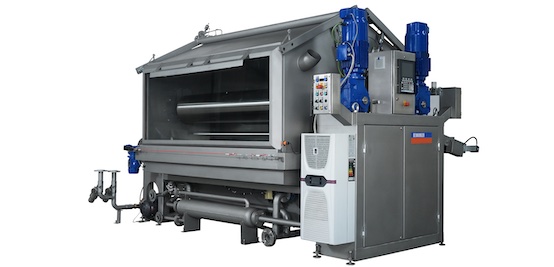
Benninger FabricMaster – ready to be delivered to Amarnath Dyeing And Bleaching Works © 2024 Benninger


Why FabricMaster also stands out

The FabricMaster’s self-cleaning lint filter keeps the system running smoothly to enhance productivity. It monitors lint accumulation and automatically cleans itself, minimizing downtime and maintenance hassles. Furthermore, the FabricMaster’s high-capacity heat exchanger accelerates heating gradients, reducing cycle times.

After dyeing, unloading the fabric swiftly is crucial. The FabricMaster features a frequency-controlled unloading winch, ensuring efficient fabric removal without compromising quality. The fabric lift from the chamber to the reel is less than half that of competitors’ machines, improving fabric transport. 

The FabricMaster is a testament to Benninger’s commitment to innovation and quality. As it continues to gain traction in the Indian market, it promises to revolutionize fabric dyeing processes, setting new standards for efficiency, quality and precision to textile dyeing processes.
More News from Benninger AG

#Dyeing, Drying, Finishing

Dyeing, finishing and singeing expertise now closer than ever to Brazilian customers

Benninger AG from Switzerland and Grupo NS from Brazil announce joined forces to support textile customers across Brazil with a strong portfolio of textile wet processing technologies, practical application know-how, and reliable local service. The cooperation combines Benninger's long-standing engineering expertise in textile finishing and dyeing with Grupo NS's deep understanding of the Brazilian textile market, customer needs, and service requirements.

#ITMA Asia + CITME Singapore 2025

Benninger’s must-see dyeing and finishing solutions at ITMA Asia + CITME 2025

Benninger, a complete system supplier with leading technologies for continuous wet processing and discontinuous dyeing, as well as technical textiles, reinforces its commitment to sustainable textile production with resource-efficient machinery that increases both top and bottom line performance. At ITMA Asia + CITME 2025, Benninger will showcase a brand-new singeing machine for knitwear alongside proven solutions from its extensive portfolio.

#Dyeing, Drying, Finishing

Revolutionizing textile finishing with advanced mercerizing solutions

In the competitive world of textile manufacturing, precision, sustainability, and efficiency are essential for success. The BEN-DIMENSA Mercerizing Systems by Benninger redefine these standards with cutting-edge technology and exceptional results. By combining a patented, globally unique system of chain-based and chainless fabric guidance, BEN-DIMENSA ensures unmatched precision, adaptability, and efficiency.

#Dyeing, Drying, Finishing

JigMaster – most gentle and versatile

Benninger, a global leader in the development and production of textile finishing systems, designed a jigger for exceptional performance in the field of discontinuous fabric dyeing, ideal for delicate and intricate fabrics. Benninger JigMaster integrates innovative features that allow dyers to improve their processes while reducing the environmental impact. Customers are excited; the case of Swisstulle is exemplary.

More News on Dyeing, Drying, Finishing

Latest News

#India ITME 2026

India’s textile industry: Current position, growth targets and industrial development

With ambitious export targets, major investments in manufacturing infrastructure and new international trade agreements, India is pursuing a comprehensive development strategy for its textile and apparel industry. An overview of the industry’s current position, government initiatives, progress achieved and challenges ahead.

#Weaving

“A complex design is only useful if the machine can reproduce it consistently”

Andreas Schnabel, Head of R&D for Technical Weaving Systems at Stäubli, discusses how 3D weaving can create textile reinforcements tailored to the loads within a composite component, where near-net-shape weaving can reduce processing steps and material waste, and what it takes to produce complex structures reliably and economically. He also explains how manufacturers can adapt Stäubli’s modular TF weaving platforms to new applications and how the company’s centre of excellence in Bayreuth supports the transition from research to industrial production.

#India ITME 2026

India ITME 2026: Textile technology meets India's investment ambitions

With ambitious growth targets, government incentive programmes and industrial development initiatives already underway, India is preparing for the next stage of its textile transformation. Against this backdrop, the 12th India ITME, taking place in Greater Noida from 4 to 9 December 2026, arrives at a particularly important moment for machinery manufacturers and textile producers alike.

#ITMA Asia + CITME 2026

ITMA ASIA + CITME 2026: Shanghai prepares for a record edition

With record demand for exhibition space, a strong presence of international technology suppliers and growing interest in automation and intelligent manufacturing, ITMA ASIA + CITME 2026 will provide an important overview of technological developments in the world’s largest textile producing region.

TOP