[pageLogInLogOut]

#Shanghaitex 2019

BENNINGER shows innovations at Shanghaitex

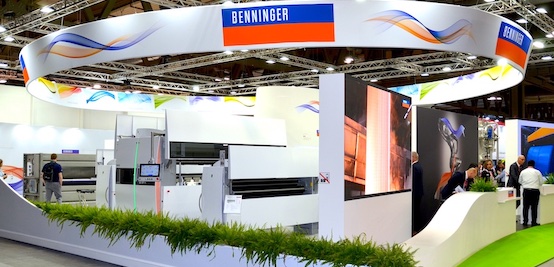
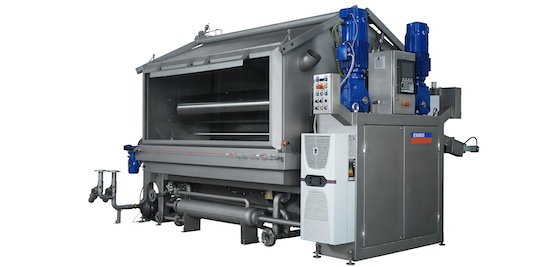
At Shanghaitex Benninger shows a Benninger-Küsters DyePad Basic which is manufactured in Suzhou Benninger Küsters Machinery Co., Ltd. This padder has been specially designed for the needs of the Asian markets, and focuses on easy handling.

Benninger-Küsters DyePad

Two swimming  rollers  ensure  a  maximum  deflection  potential  and  allow  dyeing  of  knit  and woven  fabrics  without  limitations.

BENNINGER  is  the  only  textile  machine  manufacturer with  the  know-how  of  the  original  S-roller  technology,  which  is  synonymous  with  an  even dyeing resultacross the entire fabric width.In addition the Benninger-Küsters DyePad allows salt-free dyeing without the use of energy by using the cold pad batch (CPB) dyeing process. All  these  advantagesand  facts  make the Benninger-Küsters DyePad to  the  leading  CPB dyeing station with more than 80% market share in CPB dyeing.

Contamination Sensor

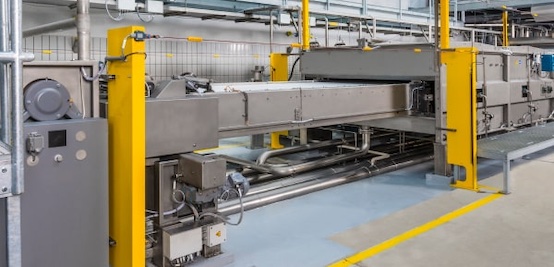
Benninger has developed a contamination sensor for the washing compartments where the degree of contamination regulates the necessary amount of fresh water in order to a.) guarantee the lowest possible water and energy consumption and b.) ensure a high reproducibility of the washing result.


Benninger –160 years of commitment to textiles, 160 years of responsibility towards sustainable production

The main driver for Benninger for the past 160 years was always to come up with consistent innovation and the continuous improvement of our products, processes and services in order to save limited resources such as water and energy. Sustainability is becoming a more and more important factor for the textile industry but for Benninger sustainability not only means saving limited resources but also long lasting quality production ranges and therefore long lasting end products of our customers.
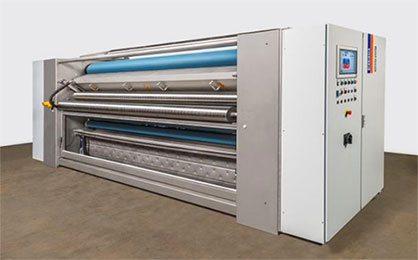
 

Benninger Küsters DyePad (c) 2019 Benninger

Visit Benninger at Shanghaitex, join them in celebrating 160 years of textile competence and connect with them.

Benninger looks forward to welcoming you at stand D10in hall W2.
More News from Benninger AG

#ITMA Asia + CITME Singapore 2025

Benninger’s must-see dyeing and finishing solutions at ITMA Asia + CITME 2025

Benninger, a complete system supplier with leading technologies for continuous wet processing and discontinuous dyeing, as well as technical textiles, reinforces its commitment to sustainable textile production with resource-efficient machinery that increases both top and bottom line performance. At ITMA Asia + CITME 2025, Benninger will showcase a brand-new singeing machine for knitwear alongside proven solutions from its extensive portfolio.

#Dyeing, Drying, Finishing

Revolutionizing textile finishing with advanced mercerizing solutions

In the competitive world of textile manufacturing, precision, sustainability, and efficiency are essential for success. The BEN-DIMENSA Mercerizing Systems by Benninger redefine these standards with cutting-edge technology and exceptional results. By combining a patented, globally unique system of chain-based and chainless fabric guidance, BEN-DIMENSA ensures unmatched precision, adaptability, and efficiency.

#Dyeing, Drying, Finishing

JigMaster – most gentle and versatile

Benninger, a global leader in the development and production of textile finishing systems, designed a jigger for exceptional performance in the field of discontinuous fabric dyeing, ideal for delicate and intricate fabrics. Benninger JigMaster integrates innovative features that allow dyers to improve their processes while reducing the environmental impact. Customers are excited; the case of Swisstulle is exemplary.

#Dyeing, Drying, Finishing

The sustainable way of discontinuous dyeing

The Swiss company Benninger, renowned for its innovative textile machinery, has introduced its latest marvel, the FabricMaster, to the Indian market. This soft flow machine is already making waves globally, with installations in Europe, the USA, Peru, Central America and Bangladesh. Now, it is set to transform the Indian textile industry, with production taking place at Benninger’s High Tech Fabrication facility in Pune.

More News on Shanghaitex 2019

Latest News

#Techtextil 2026

AI, Start-ups, Research: Techtextil and Texprocess bring together players in the textile industry

From start-ups to universities and research institutes: at Techtextil and Texprocess, the world’s leading innovation trade fairs in Frankfurt am Main, exhibitors present future-oriented concepts for the global textile industry. With the international Campus & Research area, a strong participation from start-ups and the latest AI applications for textile processing, both trade fairs showcase current developments in the textile industry. By bringing together innovation, research and application, they enable new partnerships across the textile value chain.

#Techtextil 2026

IVGT joint stand brings innovation and networking to Techtextil 2026

At Techtextil 2026 and the parallel Texprocess 2026, key transformation topics such as artificial intelligence, digitalisation, sustainability, recycling and the circular economy will be reflected across the show. Against this backdrop, the IVGT, together with 16 member companies, will present its joint stand in Hall 12.1 (Stand D62) as a platform for exchange and networking.

#Man-Made Fibers

Indorama Ventures supports Southeast Asia’s textile customers with reliable regional supply and global innovative portfolio

Indorama Ventures, one of the leading global polyester fiber and filament yarn suppliers globally, will participate in Indo Intertex 2026 in Jakarta this April, making its diverse global portfolio available to apparel, home textile, and hygiene customers across Southeast Asia.

#Raw Materials

New study shows low environmental impact by Cotton made in Africa Organic Cotton from Tanzania

Today, the Aid by Trade Foundation (AbTF) is announcing the results of a comprehensive life-cycle analysis (LCA) for cotton produced in Tanzania under the Cotton made in Africa Organic (CmiA Organic) standard. The study emphasises the small ecological footprint of CmiA Organic verified cotton. This can largely be traced back to the absence of synthetic pesticides, artificial fertilisers, and artificial irrigation. Consequently, CmiA Organic cotton can help the textile industry meet regulatory requirements as well as science-based targets. The results also show that the consequences of climate change threaten the livelihoods of these cotton farmers, even though the type of agriculture they practise barely contributes to climate change.

TOP