[pageLogInLogOut]

#Domotex

Oerlikon Neumag presents itself as sustainable
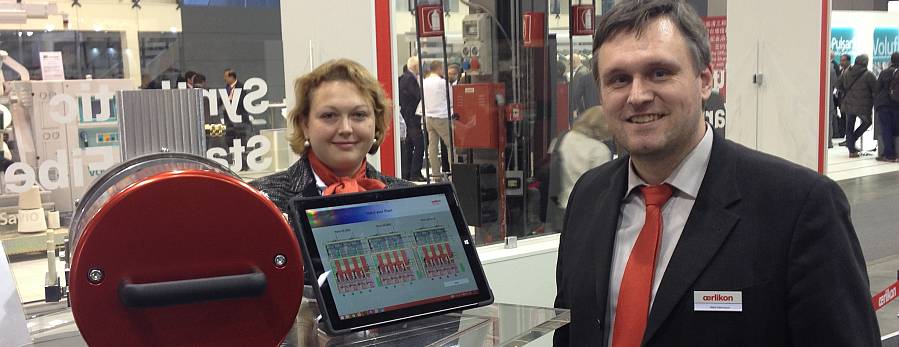
Presentation of the Rotac 3 at ITMA 2015 in Milan (c) 2016 TexData
At this year’s Domotex trade show in Hanover, Germany, Oerlikon Neumag presents itself with its diverse range of products and services in Hall 5, Stand A31. The world’s leading trade fair for carpets and flooring will be taking place between January 16 and 19.
The focus of the Oerlikon Neumag booth will be on solutions for the sustainable manufacture of carpet yarns. The fact that this is also a major trend in BCF yarn production is shown by the exemplary success of the RoTac tangling unit. 

RoTac³ convincing yarn manufacturers

Since the market launch of the RoTac3 as the new tangling unit for the BCF S+ system a year ago, almost 90 percent of all new sales have been equipped with the rotating tangling unit. The retrofitting business with the component is also operating well, comments Martin Rademacher, Oerlikon Neumag Sales Director: “For us, this is a signal that energy costs are playing an increasingly important role in BCF production.”

The RoTac has been deployed as the tangling unit in the single-end Sytec One system since 2012. Meanwhile, virtually all Sytec One systems are sold with the RoTac tangling unit. To this end, the further development of the unit to create a three-end system was a logical consequence.

Well-equipped for all requirements

With its range of systems, the market leader from Neumünster covers almost all requirements of carpet yarn manufacturers, something that is demonstrated by the high demand for the BCF S+ and Sytec One systems. While the S+ is a convincing solution for commercial applications, the Sytec One is particularly good for demanding production processes due to its monofilament character. “With the S+ and Sytec One, were are extremely well positioned within the BCF market worldwide. We can cover practically all customer requirements with these two systems”, summarizes Martin Rademacher.


More News from Oerlikon Neumag, Zweigniederlassung der Oerlikon Textile GmbH & Co. KG

More News on Domotex

Latest News

#Techtextil 2026

AI, Start-ups, Research: Techtextil and Texprocess bring together players in the textile industry

From start-ups to universities and research institutes: at Techtextil and Texprocess, the world’s leading innovation trade fairs in Frankfurt am Main, exhibitors present future-oriented concepts for the global textile industry. With the international Campus & Research area, a strong participation from start-ups and the latest AI applications for textile processing, both trade fairs showcase current developments in the textile industry. By bringing together innovation, research and application, they enable new partnerships across the textile value chain.

#Techtextil 2026

IVGT joint stand brings innovation and networking to Techtextil 2026

At Techtextil 2026 and the parallel Texprocess 2026, key transformation topics such as artificial intelligence, digitalisation, sustainability, recycling and the circular economy will be reflected across the show. Against this backdrop, the IVGT, together with 16 member companies, will present its joint stand in Hall 12.1 (Stand D62) as a platform for exchange and networking.

#Man-Made Fibers

Indorama Ventures supports Southeast Asia’s textile customers with reliable regional supply and global innovative portfolio

Indorama Ventures, one of the leading global polyester fiber and filament yarn suppliers globally, will participate in Indo Intertex 2026 in Jakarta this April, making its diverse global portfolio available to apparel, home textile, and hygiene customers across Southeast Asia.

#Raw Materials

New study shows low environmental impact by Cotton made in Africa Organic Cotton from Tanzania

Today, the Aid by Trade Foundation (AbTF) is announcing the results of a comprehensive life-cycle analysis (LCA) for cotton produced in Tanzania under the Cotton made in Africa Organic (CmiA Organic) standard. The study emphasises the small ecological footprint of CmiA Organic verified cotton. This can largely be traced back to the absence of synthetic pesticides, artificial fertilisers, and artificial irrigation. Consequently, CmiA Organic cotton can help the textile industry meet regulatory requirements as well as science-based targets. The results also show that the consequences of climate change threaten the livelihoods of these cotton farmers, even though the type of agriculture they practise barely contributes to climate change.

TOP

