[pageLogInLogOut]

#Digital Printing

Mimaki launches most productive Tiger600-1800TS dye sublimation printer to boost adoption of digital textile printing
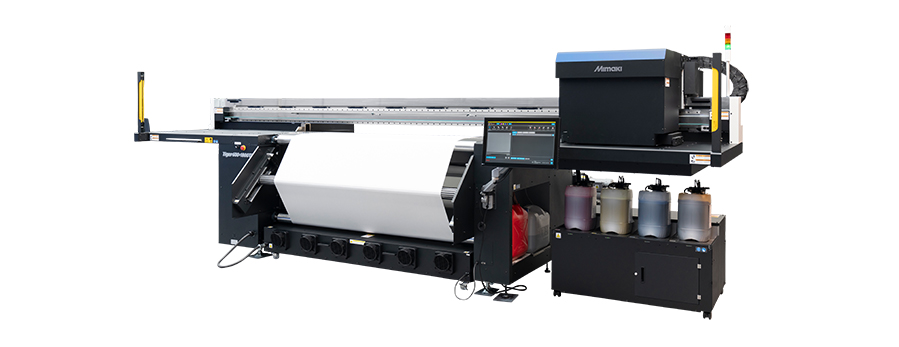
Mimaki’s latest dye sublimation printer, the Tiger600-1800TS © 2023 Mimaki
Mimaki Europe, a leading provider of industrial inkjet printers, cutting plotters, and 3D printers, is debuting the new Tiger600-1800TS, Mimaki’s most productive sublimation transfer printer, on its stand (H7-C304) at ITMA 2023. This latest high-speed, compact and robust roll-to-roll inkjet printer has been designed to accelerate the analogue to digital transformation within the textile printing industry.

The Tiger600-1800TS boasts a maximum printing speed of 550 m2/h (43% faster than the previous model) owing to the renovated high-speed printhead and Mimaki’s proprietary image quality enhancement technologies. The printer’s size has also been halved compared to the previous system, with the paper mounting and winding system both located at the back of the machine. This smaller footprint enables customers to easily install multiple units to meet fluctuating demand, whilst also increasing overall production capacity.

“All of these latest and innovative developments ideally position the Tiger600-1800TS to compete with analogue textile operations and support the move to digital print production,” explained Arjen Evertse, General Manager Sales, Mimaki Europe. “The benefits of digital printing are wide-ranging compared to lengthy, complicated and unsustainable analogue production methods. Digital printing offers a seamless, cost-effective solution for producing smaller quantities that can be adjusted to fit varying demand. It also enables greater design flexibility and reduces environmental impact by enabling local production, minimal inventories and therefore, wasted products, as well as completely cutting out the wastewater that results from the analogue process.”

A further environmental benefit of the Tiger600-1800TS will be the imminent bluesign® (1) certification of its MLSb510 series sublimation transfer inks. This certificate, expected to be awarded in June 2023, will provide assurance that these inks are of highest quality combined with due consideration for the safety of consumers and print operators, and environmental conservation, and therefore, contributing to the sustainability of the textile industry.


Mimaki’s renowned expertise in developing reliable, easy-to-use and efficient solutions has also not faltered in the development of the Tiger600-1800TS. The printer’s ink tanks can be replaced without interrupting the printing process, minimising down time. Maintenance of the printer is also reduced with its roller paper feeding method eliminating the need for the application of adhesives onto a belt.

“The Tiger600-1800TS captures the needs of our customers and prospects perfectly with all of its advanced engineering and practical, user-friendly features. We’re confident this new addition to the Mimaki portfolio will further promote the shift to digital textile printing, thereby supporting this inspiring industry to be quicker to adapt to changing production requirements, whilst also being more environmentally conscious,” Arjen concludes.

(1) bluesign: A certification for products from sustainable supply chains within the textile and apparel industry. The certification programme is administered by bluesign technologies ag, situated in Switzerland.


More News from Mimaki Europe B.V.

#Digital Printing

Keeping print inclusive: Empowering women in the print industry

Across all industries, cultivating a diverse and inclusive workplace is increasingly recognised as valuable and essential to long-term success. However, despite the print industry’s significant advancements in technology and innovation, visible representation of women remains limited. As the sector grapples with low recruitment, it’s important to challenge outdated perceptions. Creating real change, however, requires collective effort - no single company can do it alone.

#Digital Printing

Express Print boosts production using an expanded fleet of Mimaki technologies

Express Print, a fast-growing Bulgarian provider of visual communication and soft signage solutions, has significantly enhanced its production workflow with a comprehensive portfolio of Mimaki digital printing systems. Based in Varna and active for more than 10 years, the company maintains a strong focus on the advertising sector. Over the years, it has steadily expanded its operations, driven by a clear vision to bring the full spectrum of large-format printing services in-house, avoiding outsourcing and ensuring complete control over production quality.

#Digital Printing

Erreà upgrades sportswear printing operations with seven high-performance Mimaki digital textile printers

Mimaki Europe, a leading manufacturer of industrial inkjet printers and cutting systems, has supported renowned Italian sportswear brand, Erreà in upgrading its digital textile printing operations with the installation of seven high-performance Mimaki systems. The new installation includes three Tiger600-1800TS industrial dye-sublimation printers and four TS330-1600 solutions, replacing a previous fleet of 28 digital printers. This major upgrade marks a significant step forward in Erreà’s production strategy, enabling the company to streamline its printing infrastructure while improving efficiency, colour consistency and overall production control.

#Digital Printing

Maximising print efficiency exploring ink saving features for modern print production

In today’s print industry, balancing quality, efficiency, and environmental responsibility is a growing priority. With increasing pressure on margins and sustainability, solutions that streamline production without sacrificing results are more relevant than ever.

More News on Digital Printing

#Digital Printing

Former ASOS CEO Nick Beighton joins Kornit Digital to help shape the future of on-demand fashion

Kornit Digital LTD. (NASDAQ: KRNT) ("Kornit" or the "Company"), a global leader in sustainable, on-demand digital fashion and textile production technologies, today announced it has appointed Nick Beighton, former Chief Executive Officer of ASOS, as a strategic advisor to the Company and its Board of Directors. His appointment reflects Kornit’s continued focus on strengthening its connection to global brands, retailers, and digital commerce platforms as the industry transitions toward on-demand production. The Company plans to nominate Mr. Beighton for election to the Board at Kornit’s 2026 Annual Shareholder Meeting.

#Digital Printing

FESPA confirms participation from leading exhibiting suppliers and brands for inaugural textile event

FESPA has confirmed a strong exhibitor line-up for its inaugural Textile show, a dedicated new event that will run as part of FESPA 2026, alongside co-located events: Global Print Expo, Personalisation Experience, European Sign Expo, WrapFest and the brand-new Corrugated.

#Digital Printing

UK Manufacturer Basic Prints commits to digital-first production model with dual investment in Kornit Digital’s Apollo

Kornit Digital, a global leader in sustainable, on-demand digital fashion and textile production technologies, today announced that UK clothing manufacturer Basic Prints has expanded its digital production capacity with a second Kornit Apollo Direct-to-Garment (DTG) system. This marks a strategic shift supporting Basic Prints’ digital-first manufacturing model.

#Digital Printing

Hybris Productions scales licensed apparel production moving from screen to digital with Kornit Digital

Kornit Digital, a global pioneer in sustainable, on-demand digital fashion and textile production technologies, today announced that Hybris Productions has adopted Kornit’s direct-to-garment (DTG) digital production technology to scale licensed apparel manufacturing with greater speed, design flexibility, and on-demand production capabilities supporting retail and e-commerce growth.

Latest News

#Techtextil 2026

Performance Apparels: Functional textiles drive innovation at Techtextil 2026

From high-performance fibres and advanced membranes to smart textiles and sustainable material concepts – functional apparel is becoming one of the most dynamic innovation fields in technical textiles. At Techtextil 2026, exhibitors demonstrate how new materials, finishing technologies and digital functions are shaping the next generation of protective, workwear and outdoor systems.

#Textile chemistry

A flagship for chemical production: BASF inaugurates world-scale Verbund site in China

BASF today (March 26, 2026) celebrated the official inauguration of its newly built, world-scale Verbund site in Zhanjiang, Guangdong Province in southern China. Covering an area of around four square kilometers, it is more than a major BASF project in the chemical growth market of China. “Zhanjiang shows what the future of chemistry looks like: efficient, digital and sustainable by design. The site showcases a smart integrated Verbund structure on an industrial scale,” said Dr. Markus Kamieth, CEO of BASF, at the ceremony attended by representatives from government, customers, business partners and employees.

#Nonwovens

VEOCEL™ Lyocell production expands to Asia – Launching a new chapter for nonwovens in the region

VEOCEL™, Lenzing's flagship specialty nonwovens brand, expands production at its Thai plant in Prachinburi. This is the first-ever production of its nonwoven-grade lyocell fibers in Asia. Built in 2022 with a 100,000-ton annual production capacity, the facility - previously focused on fibers for textile applications - now can directly meet the demand for VEOCEL™’s biodegradable¹, wood-based lyocell fibers for nonwovens products. These fibers are an essential ingredient for high-quality nonwovens products, ranging from baby wipes to facial sheet masks and everyday personal hygiene items.

#Research & Development

Hof University develops sustainable textile coating for the fashion of tomorrow from mushrooms

Clothing is often treated as disposable: T-shirts for events, general merchandise, or short-term campaigns frequently end up in the trash after only a few uses. This is particularly problematic given that their production still largely relies on fossil-based materials. This is precisely where a new research project at Hof University of Applied Sciences comes in.

TOP