[pageLogInLogOut]

#Digital Printing

EFI Reggiani launches the fastest high-quality scanning digital textile printer in the market
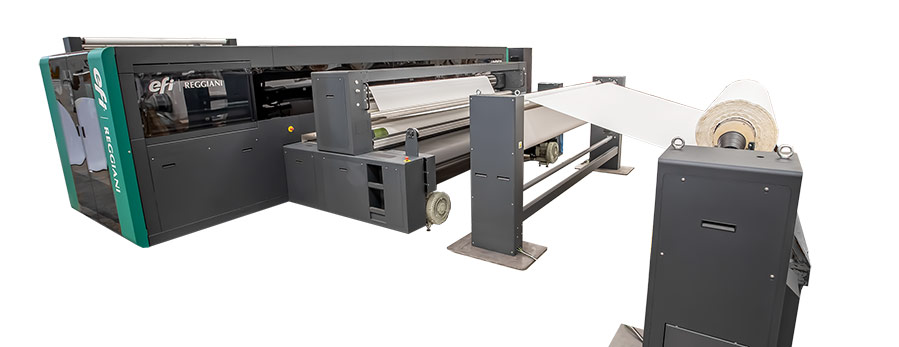
EFI Reggiani HYPER © 2021 EFI Reggiani
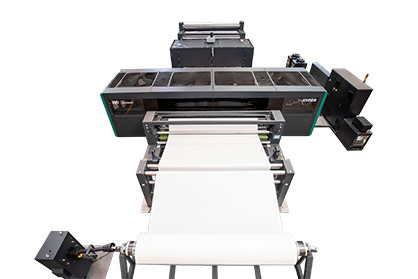
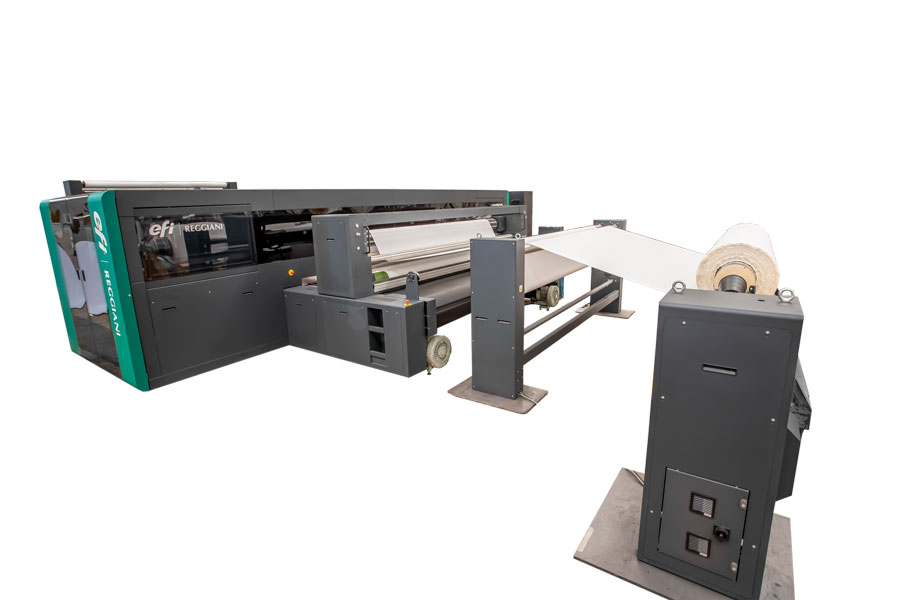
Today, Electronics For Imaging, Inc. is launching its third new digital textile printer of 2021, delivering the world’s highest real production throughput for a scanning digital textile printer. The EFITM Reggiani HYPER is a scanning printer available in 1.8-metre, 2.4-metre or 3.4- metre widths.

With an up to eight-colour configuration, the EFI Reggiani HYPER prints at up to 13 linear metres per minute in two-pass production mode, making it the fastest textile scanning printer on the market. The new printer is suitable for high-quality production on knitted or woven fabrics and is designed with smart technology that enables it to be integrated into Industry 4.0 projects. 
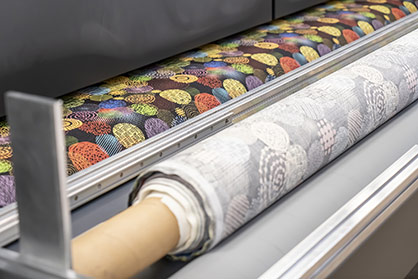
© 2021 EFI Reggiani
© 2021 EFI Reggiani


EFI is promoting the new EFI Reggiani HYPER printer in an exhibit at the 8-11 September TME Exhibition Textile Machinery Fair, at the Istanbul Expo Center, in hall 1, stand D7.

“Our track record of accelerated innovation continues, as we make good on our promises to deliver a third new textile printer this year,” said EFI Reggiani Senior Vice President and General Manager Adele Genoni. “And, with the new HYPER model, our R&D team has outdone itself, bringing even more innovation to digital textile printing despite the constraints of the pandemic. We have learned from our customers how productivity and sustainability are key drivers to support their business through the digital transformation.”

The new EFI Reggiani HYPER targets the industrial high-speed segment of the multi-pass textile printing sector. Not only is it the fastest multi-pass printer that EFI Reggiani has ever developed, but the fastest of its kind in the market, offering extraordinary printing quality with unmatched productivity. 
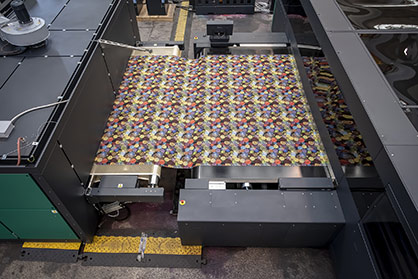
© 2021 EFI Reggiani
© 2021 EFI Reggiani


The HYPER’s superfast carriage with 72 printheads can print two passes with production quality at speeds up to 13 metres per minute for a 1.5-metre-wide roll, or up to 10 metres per minute for a 3-metre-wide roll. On a 3.4-metre Reggiani HYPER printer, users can print a pair of 1.5-metre-wide rolls in parallel, delivering a total throughput of up to 20 metres per minute, which is comparable to some single-pass printers currently in the market.

The printer is powered by EFI Reggiani genuine inks, with high-quality formulas developed to ensure the best performance in terms of runnability and longer printhead life while producing astonishing colour depth and brightness, as well as excellent fastness properties.
© 2021 EFI Reggiani
© 2021 EFI Reggiani


Unique printhead design for advanced productivity

“We are especially excited about filling out our portfolio with a very dependable, very fast printer that delivers greater throughput than other scanning printers,” said Genoni. “Thanks to a unique design for its 72 printheads – which recirculates ink up to the heads’ nozzle plate – and the legacy EFI Reggiani continuous ink recirculation system, HYPER is also a champion for uptime and reliability, maximising printer availability for production with excellent printing results. 

“With HYPER, textile producers will benefit from a truly remarkable production solution that builds on EFI Reggiani’s many years of experience and innovation in textile printing.”

The EFI Reggiani HYPER printer features:

  • 72 recirculating print heads with 600-dots per inch (dpi) native resolution and full variable drop size.
  • Recirculation up to the nozzle plate and an innovative printhead maintenance system featuring contactless wiping to help ensure that printheads are ready to print.
  • Enhanced, proprietary auto-calibrating continuous ink recirculation system to reduce maintenance at start up and during production.
  • A double bridge that provides maximum stability and accuracy, while ensuring easy carriage access for smooth maintenance on all the printheads.
  • A wide range of printing modes, including EFI Reggiani’s legacy high uniformity printing modes, to ensure outstanding quality and extreme design versatility. Users gain much more capability and versatility, eliminating the limits faced with printing solid colours, geometric patterns, fine lines, deep blacks, smooth gradients and more, while satisfying their need for speed.
  • EFI Reggiani proprietary electronics and software with real-time image processing and no image pre-calculation time prior to printing. This enables production of design changes on the fly with a complete WYSIWYG (what you see is what you get) experience to maximise throughput and productivity.
  • A precision Kevlar® conveyor belt with an embedded magnetic device for adhesive application, along with EFI Reggiani’s original longitudinal belt movement control to ensure optimal and accurate belt movement, even when running at high speed.
  • Longitudinal belt movement control for extreme belt precision during high-speed printing.
  • Several fabric feed and take-up options, including an oscillating brace for folding, a small roll winder up to 400 mm, or a big roll winder up to 1,600 mm.
  • An industrial dryer with symmetrical ventilation and high-efficiency exhaust capacity powered by gas, electricity, oil or steam.

The new printer is commercially available worldwide as of this month. For more information about EFI Reggiani and other products and solutions from EFI, visit http://www.efi.com.

More News from Reggiani Macchine S.p.A.

More News on Digital Printing

#Digital Printing

Scaling print-on-demand: Imperial Custom Apparel connects industrial printing with e-commerce automation

Combining industrial direct-to-garment printing with integrated production software, Miami-based Imperial Custom Apparel has expanded its production capacity, improved print quality and streamlined its operations. The installation of three Kornit Atlas MAX PLUS systems alongside GelatoConnect software has enabled the company to serve more sales channels with fewer employees and significantly simplified workflows.

#Digital Printing

From a bedroom startup to 3,000 designs: How Lonely Kids Club built its business with DTG printing

Founded in Sydney in 2011, independent clothing label Lonely Kids Club has grown from a bedroom startup into a business offering around 3,000 graphic T-shirt designs. With its own production studio, direct-to-garment printing and a demand-driven manufacturing model, the company demonstrates how smaller apparel brands can combine creative independence with flexible production – while navigating the everyday challenges of quality control, workflow efficiency and sustainability.

#Digital Printing

Mimaki highlights growing demand for hybrid UV printing across European markets

Insights from Mimaki's European partner network reveal how hybrid UV printing is responding to different regional market needs, driven by growing demand for flexible, application-oriented printing technologies.

#Digital Printing

VistaPrint increases apparel production capacity with Kornit Apollo

Kornit Digital (NASDAQ: KRNT), a provider of on-demand digital textile production technologies, reports that VistaPrint has significantly increased its apparel production capacity through the implementation of the Kornit Apollo system. The installation has enabled the international print and design company to add approximately 25,000 units of weekly production capacity while improving production speed, operational efficiency and order turnaround times.

Latest News

#India ITME 2026

Groz-Beckert targets energy efficiency, productivity and process reliability across six textile technology sectors at India ITME 2026

At India ITME 2026 in Greater Noida from 4 to 9 December, Groz-Beckert will present its latest innovations across all six product areas – Knitting, Weaving, Nonwovens, Sewing, Tufting and Spinning. At Hall 14, Booth B6, the German textile technology specialist will showcase advanced components, systems, services and digital solutions designed to improve energy efficiency, productivity, process reliability and textile quality while addressing the increasingly diverse requirements of modern textile manufacturing.

#Knitting & Hosiery

Monarch extends its Woven Look knitting technology from mattress ticking to apparel and performance textiles

A fabric technology originally developed to reproduce the appearance of woven mattress ticking by Monarch Knitting Machinery, a member of the British Textile Machinery Association (BTMA), is finding new applications in apparel. With the introduction of its 36-gauge OD5B-M-7ED44 double-knit machine, Monarch is expanding the possibilities for producing fine knitted structures that closely resemble woven textiles while retaining the stretch and comfort associated with knitting.

#Textiles & Apparel / Garment

VIATT 2027 names Thailand as its inaugural Partner Country

Thailand will take centre stage as the inaugural Partner Country at the Vietnam International Trade Fair for Apparel, Textiles and Textile Technologies (VIATT), returning to Ho Chi Minh City from 24 to 26 February 2027. Featuring a pavilion, dedicated product displays and various fringe events, the Partner Country programme will showcase Thailand’s textile and fashion capabilities, complementing an exhibitor line-up spanning VIATT’s three sectors. Alongside this new cooperation, eight additionally confirmed country and region pavilions and zones are set to strengthen the fair’s international offering.

#Recycling / Circular Economy

IVGT presents initial findings from the Erasmus+ project Skills4Circularity

At Albstadt ID 2026, hosted by Albstadt-Sigmaringen University of Applied Sciences, IVGT project manager Iris Schlomski presented initial findings from Skills4Circularity on 12 November 2026. She opened her presentation with an estimate from the European Environment Agency: the EU generated around seven million tonnes of textile waste in 2022. The Erasmus+ project brings together 21 partners from twelve countries to identify the skills textile and clothing professionals need to design more durable products, use fewer resources in production and recover fibres after use.

TOP