[pageLogInLogOut]

#Composites

Spinnova enters composite markets with premium alpine skis

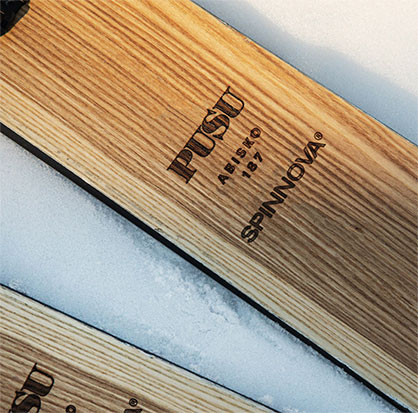
Sustainable material company Spinnova makes its debut in composites in partnership with ski manufacturer Pusu. In Pusu X Spinnova® alpine skis, carbon and glass fibres are replaced with Spinnova®.

Composites is a new application area for Spinnova, as the SPINNOVA® fibre has until now been demonstrated in apparel and interior design applications. Spinnova and Finnish ski maker PUSU today announce their partnership and pre-sales of skis strengthened with SPINNOVA® materials. Consumers can sign up for pre-sales at PUSU’s webshop, and deliveries of the first skis are expected to take place in early 2022.?

The products’ key features are high performance, sustainability and functional design. The sustainable SPINNOVA® material is laminated to the PUSU ski woodcore to replace carbon and glass fibres. Based on vigorous testing, initial results show that SPINNOVA® reinforced skis improves skiing experience and provides long-lasting performance and durability. Moreover, SPINNOVA® materials are safer to process than conventional composite materials.


"It’s been clear to us since the beginning that our fibre can be used in multiple ways. This is a great example of how SPINNOVA® fibres can be used in composites, and there are plenty of other exciting opportunities in the composites area in the future."

Spinnova’s CTO and co-founder Juha Salmela 


– It’s been clear to us since the beginning that our fibre can be used in multiple ways. This is a great example of how SPINNOVA® fibres can be used in composites, and there are plenty of other exciting opportunities in the composites area in the future. We’re happy that PUSU saw the potential in SPINNOVA® fibre as well. We expect to create sustainable skis without compromising excellent performance, says Spinnova’s CTO and co-founder Juha Salmela. ?

PUSU has been making skis and snowboards from sustainably sourced wood since 2016, and their philosophy is to maximize the use of natural materials. Ski manufacturing has traditionally relied on non-renewable materials like plastic, glass fibre, carbon fibre and costly metal blends. Winter-loving alpine skiers are now, however, more and more keen on alternatives that contribute to climate change as little as possible.

– We strongly believe that focusing on quality and natural materials creates the best and the most sustainable products for the environment and the user. Working with the SPINNOVA® fibre seems to prove we’re right – we have received outstanding feedback from professional test skiers using PUSU x SPINNOVA® skis, says PUSU founder and CEO Jani Ahvenainen.

There are some 135 million alpine skiers in the world, served by a 1.3 billion USD equipment market that has not seen much in the way of sustainable innovation yet.


Spinnova’s breakthrough technology makes textile fibre out of wood pulp or waste mechanically, with no harmful chemicals, minimal water usage and CO2 emissions. The 100% circular SPINNOVA® fibre does not shed any microplastics to the environment. The first commercial factory producing SPINNOVA® fibre is expected to begin production by the end of 2022. 
© 2021 SPINNOVA®
© 2021 SPINNOVA®


The ski collaboration is not expected to have a significant impact on Spinnova’s financial performance in 2021-2022.




More News from TEXDATA International

#ITM 2026

ITM 2026: The new geography of textile production

New production hubs are emerging across North Africa and Central Asia, while Türkiye is accelerating its transformation toward higher-value, technology-driven and more sustainable textile manufacturing.

#Research & Development

“Production is a product”

From technical textiles and AI-driven robotics to the limitations of textile circularity: Professor Dr Thomas Gries looks back on more than two decades of development at ITA Aachen. In the interview, he explains why production technology remains a decisive success factor, discusses international collaborations and innovation ecosystems, and shares his views on the transformation of production landscapes and the challenges facing an increasingly regulated industry.

#Knitting & Hosiery

“We need to move away from the price trap and return to a value-driven mindset.”

With its new Textile Innovation Center, KARL MAYER is sending a strong signal for innovation, collaboration, and the future of textile applications. In this interview, Karl Josef Mayer discusses new opportunities in warp knitting, the processing of staple fibres, recycling, the changing role of machinery manufacturers, and why the textile industry must once again focus more strongly on the value of textiles. by Oliver Schmidt

#Associations

“Innovation, resilience and international experience remain the great strengths of the Swiss textile machinery industry”

Geopolitical uncertainty, growing competitive pressure from China, new free trade agreements and the shift towards a circular economy are currently reshaping the global textile industry. In this interview, Cornelia Buchwalder discusses the current mood within the Swiss textile machinery sector, the industry’s distinctive innovative strength, new market opportunities in India and Asia, and the technological trends that could shape the upcoming trade fair cycle leading up to ITMA 2027.

More News on Composites

#Composites

JEC Forum Southeast Asia 2026 highlights Taiwan as a strategic hub for the global composites industry

The third edition of JEC Forum organized in Southeast Asia brought together 350+ participants from 22 countries for three active days of high-level Business Meetings, conferences, and networking, emphasizing Southeast Asia’s growing role in the global composites market. Held for the first time in Taipei from 23 to 24 June 2026, following the successful first editions in Bangkok, JEC Forum Southeast Asia 2026 confirmed its position as the region’s leading business platform dedicated to the composites industry.

#Composites

MEL Composites supports ELA Aviation with advanced composite materials

MEL Composites is supplying advanced composite materials and process consumables to ELA Aviation for the production of its next-generation gyroplanes. The collaboration underlines MEL Composites’ growing role in advanced aerospace mobility, providing lightweight materials designed to improve aircraft performance, manufacturing efficiency and structural reliability.

#Man-Made Fibers

DYNEEMA® and NP Aerospace advance personal protection for military servicewomen

Dyneema®, owned by Avient Corporation, an innovator of materials solutions, is supplying its high-performance unidirectional (UD) materials to world-leading armor manufacturer NP Aerospace, enabling the production of armor systems designed specifically to fit the female body. With 2,000 new armor systems, including 4,000 plates, made in the United Kingdom (UK) and delivered in June 2026, this collaboration addresses a long-standing lack of high-quality personal protection specially built for female defense and security personnel.

#Composites

JEC World 2026 confirms its standing as the unmissable event for composites and their applications

JEC World 2026 confirms its position as the leading global event for the composite materials industry and its applications across multiple sectors, bringing together the entire composites ecosystem in Paris for three days of business, innovation, and collaboration. True to its Pushing the Limits motto, the 2026 edition delivered outstanding results despite travel disruptions worldwide. The numbers speak for themselves: more than 1,400 exhibitors from over 50 countries, including over 150 first-timers, presented a global panorama of products, equipment, and services across the entire composites value chain.

Latest News

#Recycling / Circular Economy

Ence and ShareTex begin initial testing of the ATENEA innovation project to promote textile recycling in Spain

Ence and ShareTex are making progress on the Atenea R&D project, which aims to develop a complete value chain for textile recycling in Spain. Specifically, the goal of the ATENEA project—which is funded by the Center for Technological Development and Innovation (CDTI)—is to connect all the necessary stages for the recovery of textile waste, from collection and management, through recycling and transformation into new raw materials, to their incorporation into new textile products.

#Recycling / Circular Economy

DePoly Inaugurates its Showcase Plant in Monthey Switzerland

What if used plastic bottles, PET packaging material and polyester textiles could become raw materials just as high performing as virgin resources? That is the ambition of DePoly, a circular materials company based in Sion, Switzerland which inaugurated its Showcase Plant in Monthey on July 6th & 7th. The first depolymerization facility of its kind and scale in Switzerland, this industrial Showcase Plant represents a major milestone in the company's growth and its journey toward commercialization.

#Recycling / Circular Economy

Commission clarifies rules on plastic bottles recycling

The European Commission today adopted new rules on recycling of single-use plastic beverage bottles made primarily of polyethylene terephthalate (PET bottles). These rules establish, for the first time, a methodology to calculate, verify and report chemically recycled content. This is part of the Commission’s December 2025 plastics package.

#Sustainability

Global Standards establishes new non-profit foundation to strengthen governance

Global Standards gGmbH, the nonprofit organisation behind the globally recognised Global Organic Textile Standard (GOTS), announced a new governance structure designed to support its long-term mission and reinforce organisational autonomy of its Voluntary Sustainability Standards and programmes.

TOP