[pageLogInLogOut]

#Composites

Hexcel launches new HexPEKK® EM electromagnetic shielding and radar absorptive technology

Hexcel is pleased to announce the launch of its latest HexAM® materials technology, HexPEKK® EM – an electrically conductive, high-­performance, PEKK-­based thermoplastic carbon fiber composite additive manufacturing material offering industry-­leading performance.

HexPEKK® EM integrates advanced electromagnetic (EM) performance within complex 3D-­printed components for the Commercial Aerospace, Defense, and Military sectors. HexPEKK® EM composite components are flight-­ready after printing.

Formulated specifically to meet the static electricity management, electromagnetic shielding, and radiation absorption requirements of advanced aircraft applications, the new PEKK carbon-­fiber-­blended material

delivers unique electrical performance that complements Hexcel’s current portfolio of carbon fiber-­based and unfilled neat resin HexPEKK® 100 material offerings. Manufactured using the aerospace industry qualified HexAM® process, HexPEKK® EM components exhibit best-­in-­class environmental, operational temperature, and chemical resistant performance attainable in the aerospace industry.

By integrating this enhanced EM performance into additive manufactured components, HexPEKK® EM parts do not require costly and time-­consuming secondary processing steps, such as the application of conductive coating for the management of electromagnetic interference or radiation absorption.

Target applications for HexPEKK® EM cover a broad range of products such as exterior surfaces, leading edges, air inlets, electronic enclosures, and cockpit structures for commercial airplanes, military aircraft, helicopters, and UAV components.

HexPEKK® EM components will be produced at Hexcel’s Hartford (CT) plant, where the company continues to develop the HexAM® additive manufacturing process using powder bed fusion technology to fundamentally improve the way the world’s aircraft components are manufactured.
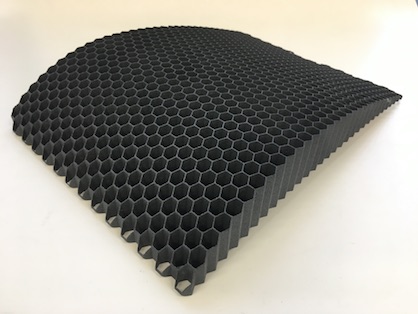
Hexcel HexPEKK® (c) 2020 Hexcel


Lawrence Varholak, Vice President of Additive Manufacturing at Hexcel, said, “The management of static electricity dissipation, electromagnetic interference, and radiation absorption is extremely important in the design of all air vehicles. The introduction of this advanced additive manufacturing material will enable the fabrication of extremely complex aerostructures with unparalleled structural and electrical functionality. It significantly reduces weight and cost while providing unlimited design flexibility.”
More News from Hexcel Corporation

More News on Composites

#Composites

Kordsa showcases its global expertise in material technologies at JEC World 2026

Kordsa, a subsidiary of Sabancı Holding, shared its global expertise in material technologies with participants at JEC World 2026, held in Paris. The company’s solutions developed for a wide range of industries—particularly aviation, energy, and automotive—stood out among its key innovations at the exhibition. Throughout the event, Kordsa also presented its vision for sustainable growth and its strategic transformation in composite technologies to international stakeholders.

#Composites

JEC Composites Startup Booster: 2026 winners announced

The leading global startup competition for composites and advanced materials has crowned its 2026 champions, ahead of a landmark 10th anniversary edition next year. The winners of the JEC Composites Startup Booster 2026 were announced on Wednesday, 11 March, at JEC World, recognizing the most promising emerging companies reshaping the future of composites and advanced materials.

#Yarn & Fiber

Teijin Carbon strengthens high‑end sports offering with advanced prepreg and resin technologies for next‑generation bicycle performance

High‑end bicycle manufacturers are entering a new era in which modern frames and components must be lighter, stiffer, tougher and more sustainable – all while enabling fast, repeatable and cost‑efficient production. To support this shift, Teijin Carbon is expanding its portfolio of advanced prepreg systems developed specifically for premium road, gravel and mountain bike applications.

#Composites

JEC WORLD 2026 opens: Paris becomes the World Capital of composites

JEC World 2026 opens tomorrow, March 10, at Paris Nord Villepinte, bringing together the entire composites ecosystem for three days of exhibitions, conferences, technical sessions, strategic industry gatherings, and business meetings. As the “festival of composites”, JEC World is also a destination for a broad spectrum of other professional visitors, eager to discover how these advanced materials can offer sustainable solutions to their industries.

Latest News

#Textile chemistry

A flagship for chemical production: BASF inaugurates world-scale Verbund site in China

BASF today (March 26, 2026) celebrated the official inauguration of its newly built, world-scale Verbund site in Zhanjiang, Guangdong Province in southern China. Covering an area of around four square kilometers, it is more than a major BASF project in the chemical growth market of China. “Zhanjiang shows what the future of chemistry looks like: efficient, digital and sustainable by design. The site showcases a smart integrated Verbund structure on an industrial scale,” said Dr. Markus Kamieth, CEO of BASF, at the ceremony attended by representatives from government, customers, business partners and employees.

#Nonwovens

VEOCEL™ Lyocell production expands to Asia – Launching a new chapter for nonwovens in the region

VEOCEL™, Lenzing's flagship specialty nonwovens brand, expands production at its Thai plant in Prachinburi. This is the first-ever production of its nonwoven-grade lyocell fibers in Asia. Built in 2022 with a 100,000-ton annual production capacity, the facility - previously focused on fibers for textile applications - now can directly meet the demand for VEOCEL™’s biodegradable¹, wood-based lyocell fibers for nonwovens products. These fibers are an essential ingredient for high-quality nonwovens products, ranging from baby wipes to facial sheet masks and everyday personal hygiene items.

#Research & Development

Hof University develops sustainable textile coating for the fashion of tomorrow from mushrooms

Clothing is often treated as disposable: T-shirts for events, general merchandise, or short-term campaigns frequently end up in the trash after only a few uses. This is particularly problematic given that their production still largely relies on fossil-based materials. This is precisely where a new research project at Hof University of Applied Sciences comes in.

#Raw Materials

Fashion for Good mobilises industry to adopt mass balance attribution and accelerate decarbonisation

Fashion for Good launches today the Mass Balance Demonstrator project, a collaborative industry initiative to implement and scale the mass balance attribution (MBA) chain-of-custody model for biomass-attributed PET in textile applications. The project represents a concrete step toward accelerating brand-driven decarbonisation across the apparel value chain.

TOP