[pageLogInLogOut]

#Associations

Slight capacity growth and lower fibre consumption in 2023

The International Textile Manufacturer Federation has published its International Textile Industry Statistics (ITIS) on productive capacity and raw materials consumption in the short-staple organized (spinning mill-) sector in virtually all textile-producing countries in the world. ITMF has used a new calculation method and reviewed past time series.

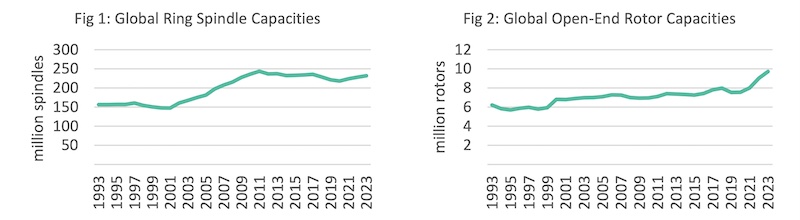
The estimated global number of installed short-staple spindles reached 232 Mio units in 2023 and the number of installed open-end rotors grew to 9.7 Mio (see Fig. 1 and 2). Capacity building is still disproportionally targeting Asia. The number of installed air-jet spindles soared to 637 thousand. Outside Asia, the main capacity increase was registered in Türkiye.
© 2025 ITMF
© 2025 ITMF
© 2025 ITMF
© 2025 ITMF


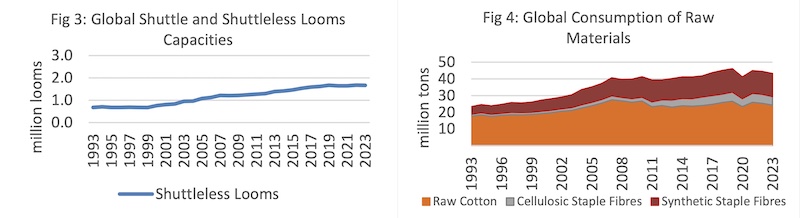
The number of installed shuttle-less looms increased to 1.7 Mio in 2023 (see Fig. 3). Total raw material consumption in the short-staple organized sector slightly decreased to 43 Mio tons (see Fig. 4). Global consumption of raw cotton and cellulosic short-staple fibers decreased by -4.4% and -2.9%, respectively. Consumption of synthetic short-staple fibers increased by 0.5%.

Find out more on itmf.org.



More News from

#Sustainability

Number of GOTS-certified facilities grow 15% globally as demand for credible sustainability standards continues to strengthen

Global Organic Textile Standard (GOTS) certification continued to grow in 2025, with nearly 18,000 certified facilities worldwide, despite ongoing geopolitical uncertainty and rapidly evolving regulatory requirements across global textile supply chains.

#Raw Materials

ECCO introduces first shoe featuring innovative protein-based fibre

ECCO, in partnership with Spinnova, announces the launch of the limited edition ECCO BIOM® 720, a first-of-its-kind shoe utilising an often overlooked leather by-product, transformed into a protein-based fibre. The fibres are produced using patented technology that advances material innovation while reducing waste and supporting full resource use across the leather and textile industry.

#Man-Made Fibers

The LYCRA Company strengthens sustainability leadership, appoints Alistair Williamson as VP of Product Sustainability

The LYCRA Company has appointed longtime executive Alistair Williamson as vice president of product sustainability, reaffirming its commitment to developing sustainable solutions for apparel and personal care products. In this role, he will guide the company’s next chapter of sustainability strategy and oversee all initiatives aimed at reducing environmental impact across products, operations, and innovation platforms.

#Raw Materials

Kraig Biocraft Laboratories reports major progress converting record-setting spider silk cocoon production into reeled silk

Kraig Biocraft Laboratories, Inc. (OTCQB: KBLB) (“the Company”, “Kraig Labs”, or “Kraig’s”), a world leader in spider silk technology*, today announced significant progress in the processing of its recently produced recombinant spider silk cocoons into reeled silk.

More News on Associations

#Techtextil 2026

VDMA members at Techtextil: Smart technologies for technical textiles

At Techtextil 2026 in Frankfurt, the members of VDMA Textile Machinery underline their key role as global technology leaders for technical textiles and textile processing. With a strong presence of more than 50 members they will highlight how engineering excellence, innovation strength and sustainability expertise from Germany and Europe are shaping the future of the textile industry. Seven companies will be present at the VDMA group stand in the centre of hall 12.0.

#Techtextil 2026

Between geopolitical pressure and industrial resilience

In this interview, Dr. Janpeter Horn (VDMA) discusses the current challenges facing textile machinery manufacturers, shaped by geopolitical tensions, regulatory developments and subdued investment. He also outlines why innovation strength, integrated solutions and strategic positioning remain key to global competitiveness.

#Texprocess 2026

Between investment restraint and modernization pressure

Texprocess 2026 takes place in a complex market environment shaped by uncertainty and innovation pressure. In this interview, Elgar Straub (VDMA) explains why the trade fair is particularly relevant this year and which technologies are driving efficiency and competitiveness.

#Associations

Europe is losing its textile industry

EURATEX has released its latest Economic Update on the performance of the European textile and apparel industry in 2025. For the third consecutive year, the sector recorded negative results across all key indicators — production, turnover and employment — confirming a continued erosion of competitiveness across Europe.

Latest News

#Textile processing

trinamiX mobile NIR spectroscopy: New applications for the footwear and textile industry

trinamiX GmbH expands its solution portfolio for the circular economy, now enabling the identification of materials used in the footwear and textile industries. With its mobile near-infrared (NIR) spectroscopy solutions, trinamiX supports manufacturers, sorters, recyclers, and brand owners in reliably identifying materials and improving transparency across increasingly complex value chains.

#Sustainability

bluesign technologies introduces bluepass

bluesign technologies ag (www.bluesign.com) today announces the launch of bluepass, a new certification mark and product labeling system created to deliver clear, substantiated, and verifiable sustainability claims at scale.

#Texprocess 2026

Texprocess 2026: Style3D | ASSYST showcases AI, 3D, 2D and automation and meets strong industry response

Four days, countless discussions and a clear signal from the industry: the future of fashion is digital and AI-driven. At Texprocess 2026, Style3D | ASSYST demonstrated how AI, 3D and automation are already fundamentally transforming processes from design to production.

#Dyeing, Drying, Finishing

Smart Quality Control for Technical Textiles

In the end, what matters is the result: a filter that performs reliably, a membrane that remains stable in storm conditions, a composite material with precisely defined properties. But the path to achieving this is demanding. In the production of technical textiles, numerous parameters interact – and even the smallest deviations can have major consequences.

TOP