[pageLogInLogOut]

#Associations

A unique product created with Swedish innovation
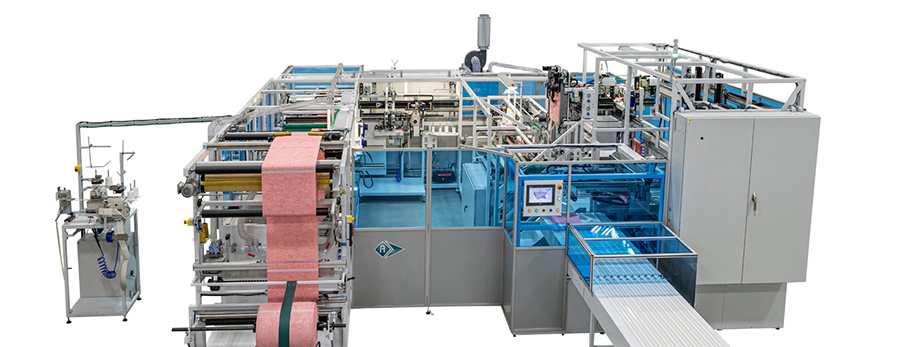
The Automatex automatic tote/consumer bag machine. © 2023 TMAS
Digitalisation and highly automated new technologies are enabling companies in high wage countries to competitively thrive in textile markets that for many years have been closed to them.

Just as significantly, these technologies are providing the tools to differentiate in highly competitive fields, as is demonstrated by a recent project initiated by TMAS – the Swedish Textile Machinery Association – for the highly automated production and decoration of a unique tote bag.
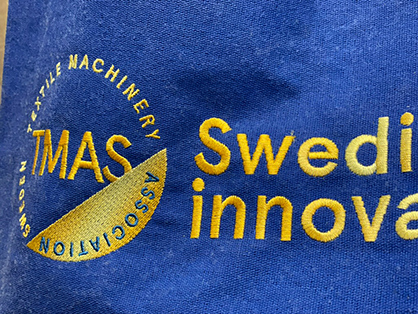
Coloreel technology makes it possible to produce gradients in embroidery designs. © 2023 TMAS


Plastic reduction

Back in 2015, the European Parliament reinforced legislation to encourage an 80% reduction in the use of conventional single-use plastic carrier bags by 2025.

The initiative immediately had broad public support, effectively encouraging a basic and widespread change in consumer behaviour. As a result, the consumption of disposable plastic bags has fallen significantly, along with a corresponding reduction in the waste they create.

There has also been a swing towards durable woven shopping bags which in the past have been labour-intensive to produce cheaply, as a result of the cutting and sewing involved.

Thanks to Swedish innovation, this is no longer the case.

Fully automatic

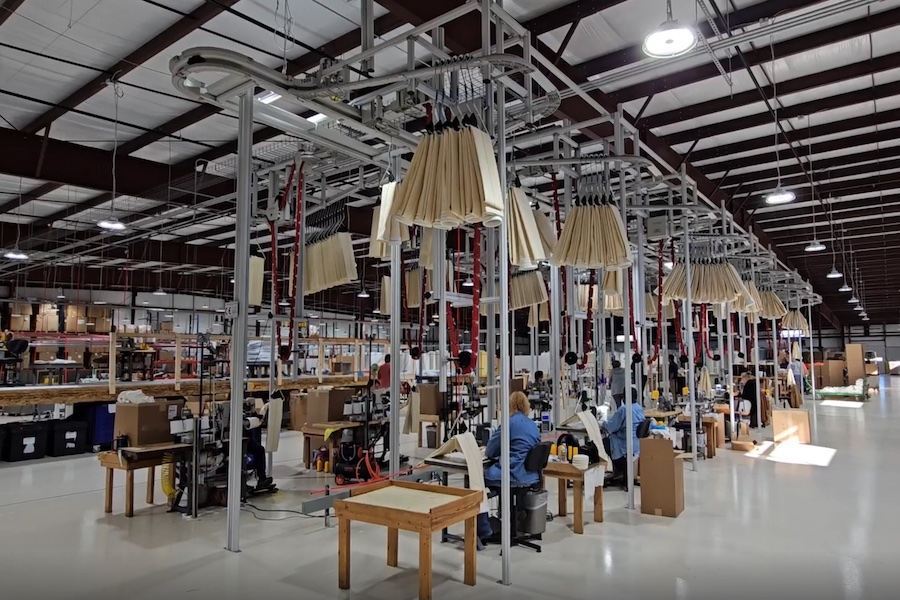
TMAS member Automatex has developed a fully automatic tote/consumer bag sewing unit which can produce fully finished bags in heights of between 35-80cm and widths of 30-80cm. The machine is configured to carry out all the necessary automated operations including hemming, handle insertion, cutting, labelling, bag forming and gusset forming, which previously had to be carried out manually. 
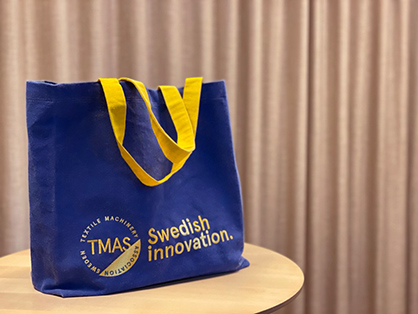
The Automatex unit carries out all operations including hemming, handle insertion, cutting, labelling, bag forming and gusset forming automatically. © 2023 TMAS


Its output is some 540 units an hour, introducing a completely new cost paradigm.

The resulting bags, however, are still plain and uniform at this point, and with products that are intended to be used for as long as possible, personalisation is the key. Unique designs work to ensure purchasers are likely to become more attached to their products – and are happy to pay a little more for them in the first place.

Instant colouration

In order to add decorative appeal, another TMAS member company, Coloreel, became involved in the project.

Coloreel continues to secure multiple orders for its instant thread dyeing technology for high-speed decoration and embroidery – notably with the fast-rising new generation of online merchandisers and brands for whom mass customisation and produce-on-demand sales are the key. The addition of a distinctive embroidered design to the tote bag using Coloreel’s technology took the product to a new level of attractiveness, as a further showcase for Swedish innovation.
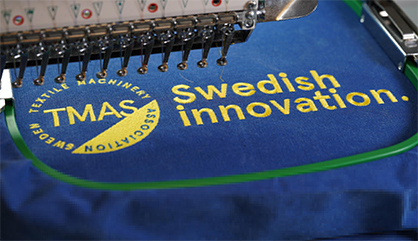
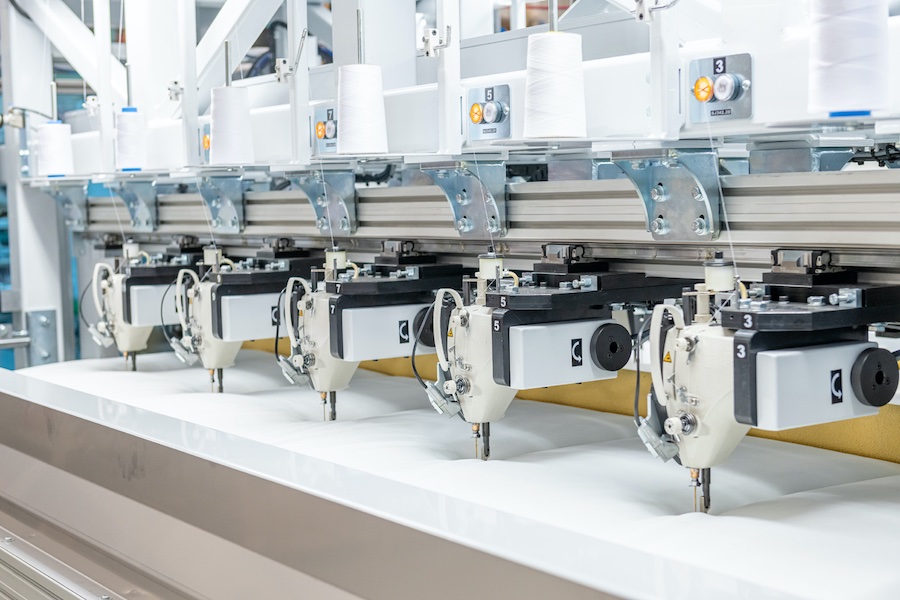
Coloreel’s rapid colour formulation software and high-speed drive technology allow a single needle to carry out what it previously required many multiples of them to do. © 2023 TMAS


The technology enables the high-quality and instant dyeing of a textile thread while it is actually being used in embroidery production. It can be used with any existing embroidery machine without modifications. Additionally, this technology makes it possible to produce gradients in an embroidery design, as demonstrated by the TMAS logo and the text in the image.

Advanced rapid colour formulation software and high-speed drive technology allow a single needle to carry out what it previously required many multiples of them to do – and with much more consistent stitch quality.

By instantly dyeing a recycled white thread during production, the system enables complete freedom to create unique decorations and embroideries without any limitations. Colour changes along the thread can either be made rapidly from one solid colour to another, or gradually, to make smooth transitions or any colouring effect desired.

This provides big benefits when it comes to both sustainability and design creativity.

Potential of Swedish innovation

“Coloreel’s designs on the batch of bags produced on the Automatex machine are truly outstanding and have been turning heads wherever they appear,” says TMAS secretary general Therese Premler-Andersson. “The collaboration really emphasizes the positive potential of the latest Swedish digital textile technologies which are enabling companies to generate new revenue streams wherever they happen to be located.”
More News from Textile Machinery Association of Sweden

More News on Associations

#Associations

IVGT membership: expertise that pays off

For energy-intensive textile companies, government compensation mechanisms are an important economic factor. The IVGT successfully supports its member companies in applying for state aid and thereby regularly contributes to significant financial relief.

#Associations

Italian textile machinery orders show quarterly recovery in Q2 2026

In the period between April and June 2026, order intake for Italian textile machinery manufacturers showed mixed but encouraging signals for the second half of the year. The order index at constant prices stood at 46.6 points (taking 2021=100 as the base year), showing a slight decrease of 3% compared to the same quarter of 2025. This trend was largely due to the contraction recorded in the domestic market, which fell by 25% compared to the corresponding period of the previous year.

#Associations

Consolidation amidst difficult market conditions

The International Textile Manufacturer Federation has published its International Textile Industry Statistics (ITIS) on productive capacity and raw materials consumption in the short-staple organized (spinning mill-) sector in virtually all textile-producing countries in the world.

#Recycling / Circular Economy

ReSpin joins TMAS to advance textile recycling technology

Swedish textile recycling company ReSpin has joined the Textile Machinery Association of Sweden (TMAS) as a new member. The company develops a patented mechanical recycling technology designed to transform textile waste into new fibres suitable for yarn production.

Latest News

#Man-Made Fibers

Ministry of Industry Delegation visits NatureWorks’ second global manufacturing site at Nakhon Sawan Biocomplex

NatureWorks Asia Pacific Limited welcomed a high-level delegation led by Mr. Varawut Silpa-archa, Minister of Industry, to its manufacturing site at the Nakhon Sawan Biocomplex (NBC). The visit follows the successful inauguration of the site on April 29, 2026, and highlights the role of public-private collaboration in advancing Thailand’s sustainable industrial development and bioeconomy ambitions.

#Recycling / Circular Economy

Indorama Ventures advances circularity tthrough PETValue Philippines' “Zero Waste to Landfill Partnership” with Republic Cement

Indorama Ventures Public Company Limited, a global sustainable chemical company, is advancing the circular economy through a new Zero Waste to Landfill initiative at its recycling site PETValue Philippines, further demonstrating how collaboration across industries can maximize resource efficiency and reduce waste.

#Research & Development

Networking Day 2026: Industry stakeholders unite around textile recycling

In 2026, the Industry Research Group (IRG) Polymer Recycling once again brought together some of the key stakeholders in textile recycling for its annual Networking Day. This year, the event took place at EREMA’s premises in Ansfelden, Austria. It brought together key players from across the textile recycling value chain for a day of structured exchange and in-depth discussions.

#Knitting & Hosiery

The new RDJ 7/3 defines the design footprint of modern athletic shoes

Stylish, functional, and efficient to produce – spacer fabrics are the all-arounders among textile materials. These versatile fabrics are particularly in demand in the sports and casual footwear sector, as they combine comfort, breathability, and design freedom. At the same time, this industry is trend-driven, dynamic, and price-sensitive like few others. Innovations are therefore a decisive factor for success. With the RDJ 7/3, KARL MAYER offers a solution specifically tailored to these requirements. The particular strength of the new double raschel machine: its exceptional flexibility, thanks to its three jacquard bars.

TOP