[pageLogInLogOut]

#Associations

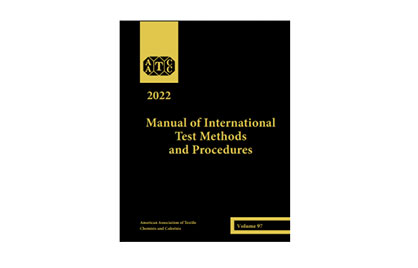
2022 International Manual of Test Methods and Procedures

AATCC standards are developed, specified, and performed around the world. Volume 97 of The AATCC International Manual of Test Methods and Procedures will be available beginning January 2022. USB editions and PDF versions of individual standards will be available on January 4, 2022.

The hardbound version will be available for purchase after January 15, 2022. To purchase a 2022 Technical Manual, click here: https://members.aatcc.org/store/2022b/3601/ for the USB version or here:https://members.aatcc.org/store/2022a/3600/ for the hardbound book. You can also email ordering@aatcc.org to purchase a Technical Manual.

The following AATCC standards have been developed, revised, or reaffirmed since the publication of the 2021 volume of the Manual of International Test Methods and Proce­dures. In accordance with AATCC M13, Rules of Procedure for AATCC Test Method and Technology Committees, all technical changes are unanimously approved by the responsible research committee and the Technical Committee on Research (TCR) before publication.

AATCC TM6-2021 Test Method for Colorfastness to Acids and Alkalis. Revised to clarify and align with pre­scribed AATCC style guidelines.

AATCC TM15-2021, Test Method for Colorfastness to Perspiration. Revised for clarity and to add a history section.

AATCC TM20-2021 Test Method for Fiber Analysis: Qualitative. Revised to update Table V.

AATCC TM20A-2021 Test Method for Fiber Analysis: Quantitative. Revised to correct Table I.

AATCC TM35-2018e2 Test Method for Water Resis­tance: Rain. Editorially revised to remove excess wording from Figure 2 and to add history.

AATCC TM 110-2021 Test Method for Whiteness of Tex­tiles. Revised for clarity and to add history section to align with AATCC Style Guide.

AATCC TM114-2021 Test Method for Retained Chlo­rine: Tensile Loss. Revised to clarify and align with pre­scribed AATCC style guidelines.

AATCC TM118-2020e Test Method for Oil Repellency: Hydrocarbon Resistance. Editorially revised to update from CAS# 8012-95-1 (which is paraffin oil) to CAS #8042-47-5 (which is white mineral oil) to correct the reference.

AATCC TM133-2020e Test Method for Colorfastness to Heat: Hot Pressing. Editorially revised to update test method reference to match current title.

AATCC TM148-2014e4(2021) Test Method for Light Blocking Effect of Textiles and Related Materials: Photo-detector. Reaffirmed and editorially revised to add history per AATCC Style Guide.

AATCC TM163-2013(2020)e2 Test Method for Color­fastness to Storage: Dye Transfer. Editorially revised to update history order.

AATCC TM165-1999e10(2021)e Test Method for Color­fastness to Crocking: Textile Floor Coverings—Crock-meter. Reaffirmed and editorially revised to include history section per the AATCC Style Guide.

AATCC TM173, Test Method for Calculation of Small Color Differences for Acceptability. Withdrawn and replaced with AATCC EP14, Evaluation Procedure for Small Color Differences.

AATCC TM182-2021 Test Method for Relative Color Strength of Dyes in Solution. Revised to clarify the wave­length requirements, update terms, and add history section to align with AATCC Style Guide.

AATCC TM185-2021 Test Method for Chelating Agent Content in Hydrogen Peroxide Bleach Baths: Copper PAN Indicator. Revised to clarify and align with prescribed AATCC style guidelines.

AATCC TM191-2021 Test Method for Acid Cellulase Enzyme Treatment of Cellulosic Fabrics. Revised to clar­ify and align with prescribed AATCC style guidelines.

AATCC TM196-2011e3(2021) Test Method for Colorfast­ness to Sodium Hypochlorite of a Textile Floor Covering. Reaffirmed in 2021.

AATCC TM203-2021 Test Method for Light Blocking Effect of Textiles: Spectrophotometric. Revised for clarity and to add history section per AATCC Style Guide.

AATCC TM211-2021 Test Method for the Reduction of Bacterial Odor on Antibacterial-Treated Textiles. NEW method used to supplement current industry test methods and directly address odor caused by bacteria not simply organism numbers. It allows for measurement of odor and the capacity for odor reduction by treated articles.

AATCC TM212-2021 Test Method for the Fiber Frag­ment Release During Home Laundering: Accelerated. NEW method used to measure the fiber fragment shedding from fabrics in an accelerated laundering setting.

AATCC EP6-2021 Evaluation Procedure for Instrumen­tal Color Measurement. Revised for clarity and to add history section to align with AATCC Style Guide.

AATCC EP7-2021 Evaluation Procedure for Instrumen­tal Assessment of the Change in Color of a Test Specimen. Revised to remove table option and restructure calculations for clarity.


AATCC EP9-2021 Evaluation Procedure for Visual Assessment of Color Difference of Textiles. Revised to update steps in Table III and to align with AATCC Style Guide.

AATCC EP11-2021e Evaluation Procedure for UV Energy of Optically Brightened Textiles: Spectrophotometer Cal­ibration. Revised to update reference to ASTM E308 table references and to add history section per the AATCC Style Guide. Editorially revised the AATCC ordering process and clarified stability and storage.

AATCC EP13-2021 Evaluation Procedure for Electrical Resistance of Electronically Integrated Textiles. Revised to update steps in Table III and to align with the AATCC Style Guide.

AATCC EP14-2021 Evaluation Procedure for Small Color Differences. NEW Evaluation Procedure to replace AATCC TM173, Test Method for Calculation of Small Color Differences for Acceptability.

AATCC LP1-2021 Laboratory Procedure for Home Laundering: Machine Washing. Revised to update the tables and add Type 4 ballast.

AATCC M3-2008(2021)e2 High Efficiency Washers in North America. Reaffirmed in 2021.

AATCC M11-2021 Glossary of AATCC Standard Termi­nology. Revised to add terminology.

© 2021 AATCC
© 2021 AATCC


More News from American Association of Textile Chemists and Colorists

#Research & Development

New funding available for textile research

The AATCC Foundation Student Research Support Grant Program provides financial assistance for undergraduate and graduate students pursuing textile-related projects. Students may submit proposals now for funding to be awarded January 2026. Applications must be submitted by October 1, 2025, to be considered.

#Recycling / Circular Economy

AATCC’s Circularity Conference approaches as organization continues 2025 Sustainable Textile Event series

The American Association of Textile Chemists and Colorists (AATCC) announces that registration is closing soon for its highly anticipated Circularity Conference, continuing this year’s sustainability event series that has delivered significant value to industry professionals.

#Associations

AATCC Textile Standards adopted by Colombian and Sri Lankan Governments

AATCC test methods and procedures are international standards, meeting the criteria set forth by the World Trade Organization and used around the globe. The standards gain additional recognition through Memoranda of Understanding with Colombia and Sri Lanka.

#Associations

Program announced for 2024 AATCC Textile Discovery Summit

AATCC is excited to announce the program for the 2024 Textile Discovery Summit, held October 6 to 8 in Savannah, Georgia, USA. With a focus on A Path Forward Through Innovation, this year’s conference will be a groundbreaking event for the textile industry.

More News on Associations

#Associations

Joint Statement: Urgent clarification needed on scope of Textiles EPR for PPE and Medical Devices

EDANA, the voice of nonwovens, alongside fellow industry associations CIRFS (European Man-Made Fibres Association), EURATEX (The European Apparel and Textile Confederation), ESF (European Safety Federation), and EuroCommerce (Retail & Wholesale), has issued a joint statement raising critical concerns regarding the transposition of Directive (EU) 2025/1892, the targeted revision of the Waste Framework Directive.

#Associations

Young researchers recognised for cutting-edge work in recycling, fibre technology and textile mechanics

At the Aachen-Dresden-Denkendorf International Textile Conference held in Aachen at the end of November, Peter D. Dornier, Chairman of the Walter Reiners Foundation of the VDMA, honoured five successful young engineers. Promotion and sustainability prizes were awarded in the categories bachelor/project theses and diploma/master theses. Academic theses that develop solutions for resource-saving products and technologies, for example, are eligible for the sustainability awards.

#Europe

Level playing field at stake: Europe’s textile industry demands decisive action

Yesterday, the European Parliament took a welcomed and necessary step by voting a resolution calling for stronger market surveillance, reinforced customs controls and faster enforcement of the Digital Services Act in case of infringements. For Europe’s textile and clothing manufacturers, this is the first political acknowledgement that the system is broken — and that enforcement must finally match the scale of the problem.

#Natural Fibers

Better Cotton Initiative partners with Uzbek government agency to offset certification costs

The Better Cotton Initiative (BCI) has today announced a strategic agreement with Uzbekistan’s Light Industry Agency to increase financial support for cotton farming clusters adopting sustainable agricultural practices.

Latest News

#Natural Fibers

38th International Cotton Conference Bremen: Let´s Talk about Cotton!

The 38th International Cotton Conference Bremen, to be held on 25-27 March 2026 in Bremen’s parliament building on market square, once again sends a powerful signal for professional excellence and international dialogue. The focus is on the latest market trends and technical innovations throughout the entire value chain – from agriculture and quality assurance to processing and the circular economy. With its high-calibre speakers, the conference remains an indispensable forum for anyone involved in shaping the cotton industry scientifically, technically, or economically.

#Recycled_Fibers

Leading fashion brands step up to unlock the next chapter of Circulose

Since 2024, under new ownership and leadership, Circulose has set a renewed strategic direction focused on securing long-term commitments with partner brands to bring CIRCULOSE® back to market at scale. This strategy has proven successful.

#Research & Development

More safety and comfort for protective clothing thanks to auxetic fabrics

When everyday materials are pulled, they stretch or elongate in the direction of the pull and become narrower in cross-section. We can also observe this property in two-dimensional textiles. Auxetic structures behave differently here. They have the striking property of not changing under tensile stress or even increasing their width or thickness. These properties are advantageous, for example, in protective textiles or textile filter media. The DITF are researching auxetic fabrics for various applications.

#Recycled_Fibers

Recycling mixed-fibre garments becomes a reality: RadiciGroup, The LYCRA Company and Triumph take circular fashion a step forward

The process, which is both economically and environmentally sustainable, has enabled the production of an underwear set made from 100% recycled nylon and LYCRA® fibre in a closed-loop system.

TOP