#Nonwovens / Technical Textiles
Top technology for the boom sector
Switzerland’s innovation DNA supports nonwovens producers
Originally conceived as a low-cost, high-volume alternative to knitting and weaving, nonwovens was already expanding its market boundaries by the 1970s with new applications in ‘disposables’ such as diapers, hygiene and teabags.
Industry update
In the past five decades, the nonwovens business has exploded in all directions, reaching a global market worth USD 40.5 billion in 2020, projected to grow to USD 53.5 billion by 2025. This annual growth rate of 5.7% (MarketsandMarkets, Nonwoven Fabric Market Report) is based on countless new applications and expansion into durable, as well as additional disposable, products.
Major growth drivers include the hygiene sector, and filtration media for power plants and air conditioning systems. Especially during the peak of the COVID pandemic in 2020 and 2021, demand in the hygiene sector multiplied. Worldwide capacities for both meltblown and spunlace production rocketed compared to a normal business year. Swiss Autefa Solutions, for example, significantly benefited from this trend, notably with the launch of a fully-automatic machine for producing face masks.
The automotive industry is the second big growth area, with many new applications being pioneered. The trend to electric and hybrid vehicles has helped this, as nonwovens reinforced with carbon fibres are widely used as battery housings.
Swiss nonwovens competence
Innovative applications across all sectors have driven the rapid evolution of sophisticated nonwovens machinery. Today’s trends demand higher productivity, sustainability and Industry 4.0 compatibility – demonstrated by the full equipment portfolio of Swiss Textile Machinery member Autefa Solutions, which is now recognized as a leading name in the nonwovens industry. With V-Jet Futura, the company recently sealed the link in its product range between web forming and drying technology. This latest Hydroentanglement Machine, together with the SQ-V Square Drum Dryer, embodies advanced technology combined with significant reductions in energy consumption compared to other process solutions.
A vital contribution to nonwovens production is offered by Rieter subsidiary Graf, a leading supplier of clothing and combs for carding and combing processes in spinning and nonwovens. Graf's Hipro card clothings – suitable for any man-made fibres in the nonwovens sector – are the answer to demands for higher productivity. Their superior performance delivers up to 10% higher throughput and greater carding efficiency compared to conventional clothings. These reliable card clothing elements also ensure a consistently reproducible high web quality, as well as 20% fewer failures in the web, thanks to the precise fibre transfer to and from the cylinder.
Another constant trend in nonwovens today is the drive for better quality. Manufacturers want to take charge of contamination levels in their processes, as well as eradicating defects which may arise during production. Uster Technologies, the leading provider of quality management solutions from fibre to fabric, offers a combined solution to achieve both these required quality standards. At the fibre preparation stage, Uster Jossi Vision Shield N ensures the best possible initial inspection and removal of contamination. Then, at the end of the production sequence, Uster EVS Fabriq Vision N handles automated detection and marking of all the main defects caused during production. This combined solution avoids material waste and takes full advantage of the potential for process optimization.
Virtually unlimited
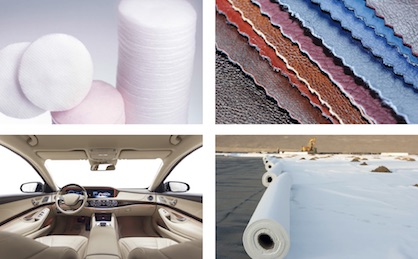
Nonwovens production lines can be complex and diverse, turning out an extraordinary variety of materials. The list takes in artificial leather, filter media, boot linings and headliners for cars, geotextiles, floorcoverings, insulation and sound-absorbing fabrics and, of course, even more hygiene products. Raw materials include man-made fibres such as PP, PES, PA, PAN, PTF and viscose, as well as glass and carbon fibres and natural fibres like flax, hemp, jute, wool and cotton. The range of product parameters is huge: from very lightweight cloths of only 10 g/m² to heavyweight fabrics up to 6000 g/m².
Innovative products and recycling present the industry with new challenges. “Sustainability and circular economy become key issues in today’s production of nonwovens. We observe an increase in projects with natural fibres such as flax, hemp or jute. In blends, hybrid products with special properties are created,” says André Imhof, CEO, Autefa Solutions Switzerland AG und Autefa Solutions Austria GmbH. “Therefore, successful machines manufacturers also need individual solutions, as well as turnkey lines, for nonwovens manufacturing.”
Key players must work with their customers on new concepts, while dedicated competence centres might also be regarded as a future option. Two more factors will be mandatory for nonwovens machine manufacturers: automation and energy saving. Innovative power is part of the DNA of Swiss Textile Machinery members, and that is certain to have a positive impact on the development and growth of the nonwovens industry.