[pageLogInLogOut]

#Associations

International Textile Industry Statistics n°62/2019

ITMF (International Textile Manufacturer Federation (www.itmf.org) has published its report on International Textile Industry Statistics (ITIS) on productive capacity and raw materials consumption in the short-staple organized (spinning mill-) sector in virtually all textile-producing countries in the world.

Decrease in global short-staple and rotor capacities

The 2019 data shows a decrease in short-staple spindles and open-end rotors capacities around the world (see Fig. 1). The number of installed short-staple spindles went down from 230 million. in 2018 to 223 million in 2019. The number of installed open-end rotors decreased from 8.2 million in 2018 to 7.4 million in 2019. These changes are mainly driven by scraping of outdated machinery in China. The trends observed in other regions are stable. The number of installed air-jet spindles is increasing worldwide, mainly in Asian countries and Turkey.
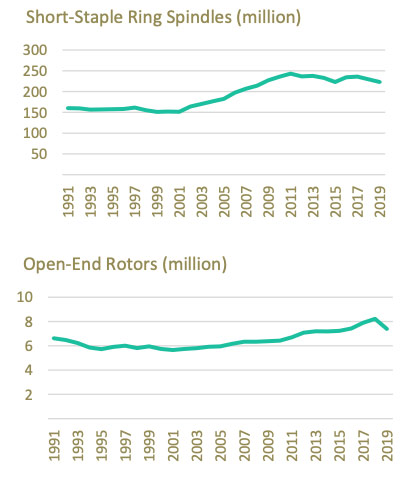
Global Installed Capacitiesin the Spinning Sector


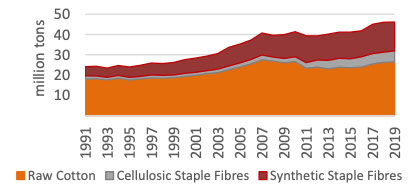
The substitution between shuttle and shuttle-less looms continues but the growth in shuttle-less looms capacities has slowed down (see Fig. 2). The number of installed shuttle-less looms increased by 1% in 2019 and reached 1.7 million units. Total raw material consumption in the short-staple organized sector has stagnated in 2019 (see Fig. 3). Consumption of cellulosic short-staple fiber increased by 9% to 5.4 million tons and consumption of synthetic short-staple fibers decreased by -4% to 14.2 million tons. The consumption of cotton has stabilized at 26 mill tones.
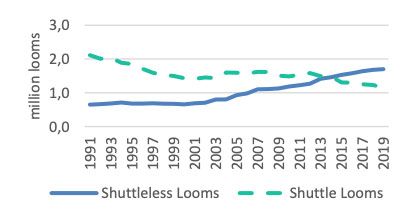
Global Shuttleless Looms Capacities


Global Consumption of Raw Materials


More News from International Textile Manufacturers Federation (ITMF)

More News on Associations

#Associations

Joint Statement: Urgent clarification needed on scope of Textiles EPR for PPE and Medical Devices

EDANA, the voice of nonwovens, alongside fellow industry associations CIRFS (European Man-Made Fibres Association), EURATEX (The European Apparel and Textile Confederation), ESF (European Safety Federation), and EuroCommerce (Retail & Wholesale), has issued a joint statement raising critical concerns regarding the transposition of Directive (EU) 2025/1892, the targeted revision of the Waste Framework Directive.

#Associations

Young researchers recognised for cutting-edge work in recycling, fibre technology and textile mechanics

At the Aachen-Dresden-Denkendorf International Textile Conference held in Aachen at the end of November, Peter D. Dornier, Chairman of the Walter Reiners Foundation of the VDMA, honoured five successful young engineers. Promotion and sustainability prizes were awarded in the categories bachelor/project theses and diploma/master theses. Academic theses that develop solutions for resource-saving products and technologies, for example, are eligible for the sustainability awards.

#Europe

Level playing field at stake: Europe’s textile industry demands decisive action

Yesterday, the European Parliament took a welcomed and necessary step by voting a resolution calling for stronger market surveillance, reinforced customs controls and faster enforcement of the Digital Services Act in case of infringements. For Europe’s textile and clothing manufacturers, this is the first political acknowledgement that the system is broken — and that enforcement must finally match the scale of the problem.

#Natural Fibers

Better Cotton Initiative partners with Uzbek government agency to offset certification costs

The Better Cotton Initiative (BCI) has today announced a strategic agreement with Uzbekistan’s Light Industry Agency to increase financial support for cotton farming clusters adopting sustainable agricultural practices.

Latest News

#Recycled_Fibers

Circulose and Birla Cellulose announce partnership agreement to advance circular textiles

Circulose, a leading producer of recycled textile pulp for the fashion and textile industry, and Birla Cellulose, a global leader in sustainable viscose fiber, have signed a strategic partnership agreement to jointly accelerate textile recycling.

#HIGHTEX 2024

Global vision in medical textiles meets at HIGHTEX 2026

Developments in the medical textile sector are already making HIGHTEX 2026 one of the most remarkable international meeting points in the region. A wide technological spectrum—from nonwoven technologies to meltblown lines, from spunbond production systems to advanced composite healthcare textiles—will come together at HIGHTEX 2026.

#Nonwovens

EDANA wraps up its Sustainability & Policy Forum 2025: Uniting the industry and EU policymakers to navigate the future of nonwovens

Against a backdrop of rapidly evolving environmental legislation, the EDANA Sustainability & Policy Forum 2025 concluded the past week in Brussels, marking a step forward in the dialogue between the nonwovens industry and European policymakers. Held from 9-10 December at the historic Residence Palace, the two-day event successfully brought together business leaders, sustainability experts, and EU officials to address the dual challenges of circularity and industrial competitiveness.

#Heimtextil 2026

Mimaki demonstrates versatile, simple TRAPIS textile printing at Heimtextil 2026

Mimaki’s textile pigment transfer printing system, TRAPIS, is able to print on a diverse range of fabrics - unlike traditional processes - including natural fibres and synthetic fabrics. The full solution will be shown on Mimaki’s booth (Hall 3.0 Stand A97), as the company returns to Heimtextil to showcase its advancements in sustainable, high quality and efficient textile printing.

TOP