[pageLogInLogOut]

#Associations

Italian textile machinery: ACIMIT general meeting confirms industry downturn
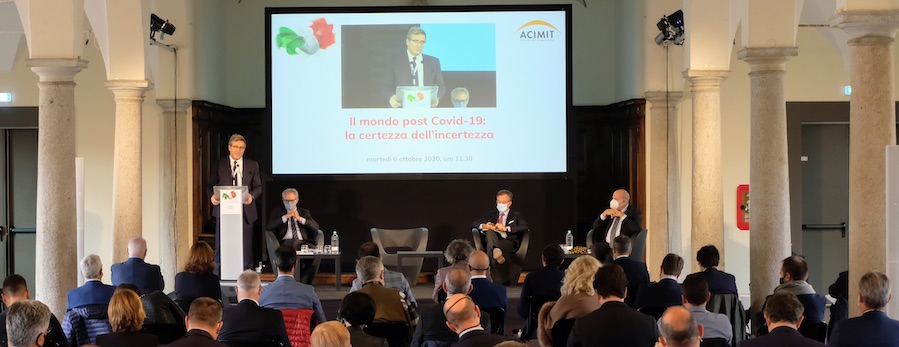
(c) 2020 ACIMIT
The world that awaits us in this post Covid-19 era was the dominant theme discussed at the annual general meeting of ACIMIT, held in Milan on October 6th. “In the coming years, the climate of uncertainty we are experiencing will worsen, and health emergencies will combine with further geopolitical tensions which are already heavily affecting business,” stated ACIMIT president Alessandro Zucchi, as he submitted 2019 figures for the Italian textile machines industry and 2020 forecasts.

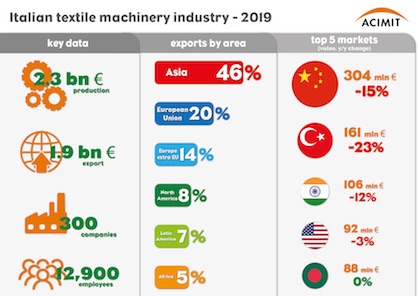
In 2019, Italy’s production output of textile machinery dropped by 11% compared to 2018, while exports fell 12%. The sharp decline in manufacturing activity in 2019 was common to both foreign and domestic markets in Italy. This widespread lessened demand in the main Asian and European markets has weighed heavily on machinery sales abroad, also affecting the United States and South America. A similar scenario was observed in Italy, where both imports of machinery of foreign origin and deliveries by Italian manufacturers decreased significantly.
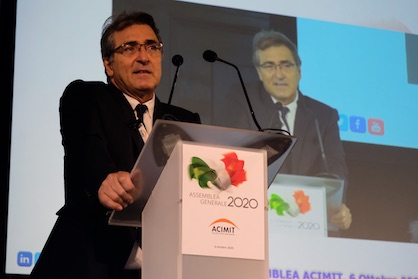
ACIMIT president Alessandro Zucchi (c) 2020 ACIMIT


This precarious economic situation, which in early 2020 hit Italy’s textile machinery industry - already affected by a weaker global demand - then suffered from the strong impact brought on by the pandemic. The repercussions are highlighted by a severe scaling back in orders for Italian producers, as monitored by our Association on a quarterly basis. The order index for the first six months of the year dropped 39% compared to the same period for January to June 2019; a recessionary picture that remains confirmed for the whole of 2020, despite some timid signs of recovery in the third quarter. A recovery towards export levels resembling those of the period prior to Covid-19 can only be expected in 2021.
(c) ACIMIT
(c) ACIMIT


More News from Associazione Costruttori Italiani di Macchinario per l Industria Tessile (ACIMIT)

#Associations

Italian textile machinery orders show quarterly recovery in Q2 2026

In the period between April and June 2026, order intake for Italian textile machinery manufacturers showed mixed but encouraging signals for the second half of the year. The order index at constant prices stood at 46.6 points (taking 2021=100 as the base year), showing a slight decrease of 3% compared to the same quarter of 2025. This trend was largely due to the contraction recorded in the domestic market, which fell by 25% compared to the corresponding period of the previous year.

#Associations

Textile machinery: Italian technology charts the course for revival

Operating in a scenario characterized by geopolitical instability, slowing industrial investments, and new protectionist pressures. This is the main challenge for the Italian textile machinery industry that emerged during the General Assembly of ACIMIT (Association of Italian Textile Machinery Manufacturers), held today in Milan at the Shareholders’ Hall of Palazzo Edison.

#Associations

Bangladesh: Italian textile machinery mission stops in Dhaka and Chittagong

Technological upgrading and the transition toward higher value-added production are driving the new Italian industrial mission to Bangladesh. This year, the mission will split between the country’s two main manufacturing hubs, where Italian manufacturers will meet the leaders of the local textile supply chain in two strategic stages: July 7th in Dhaka and July 9th in Chittagong.

#Associations

Mongolia: Workshop on Italian textile technologies kicks off in Ulaanbaatar

The workshop dedicated to Italian textile technologies will kick off in Ulaanbaatar from 21 to 23 June 2026. Focused on the most advanced innovative solutions for the textile industry, the initiative will bring together 13 Italian textile machinery manufacturers, confirming the growing interest in strengthening industrial cooperation between the two countries and highlighting Mongolia’s strategic importance for Italian textile machinery producers.

More News on Associations

#Associations

Automation, digitalization and new business models are shaping the future of footwear and leather technology

The European footwear and leather machinery industry is facing profound transformations. Global competitive dynamics, technological innovation, automation and digitalization are fundamentally reshaping markets, production processes and business models. This is one of the key findings of the new study “Threads of the Future – Footwear and Leather Technology Edition”, which was presented today by VDMA Textile Care, Fabric and Leather Technologies (VDMA TFL) during a press conference at SIMAC Tanning Tech in Milan.

#Associations

EURATEX calls for urgent action on industrial competitiveness

EURATEX, the European Apparel and Textile Confederation, welcomes today’s State of the Union Address by European Commission President, Ursula von der Leyen, and in particular her recognition of Europe’s need to rebalance unfair trade, cut red tape, and strengthen its industrial and strategic autonomy.

#Raw Materials

Cotton Brazil Dialogues 2026 concludes with 50 international participants immersed in Brazilian cotton production

The Cotton Brazil Dialogues concludes its 2026 edition after a series of technical visits to farms, cotton gins and reference centers, as well as workshops focused on Brazilian cotton production. A total of 50 participants from 14 countries took part in the field trips. The initiative is led by the Brazilian Association of Cotton Growers (Abrapa) and the National Association of Cotton Exporters (Anea), with support from the Brazilian Trade and Investment Promotion Agency (ApexBrasil).

#Europe

European textile industry calls for €10 handling fee on ultra-fast-fashion imports

The introduction of the €3 customs duty on low-value imports marks an important milestone in Europe’s efforts to address the challenges created by the rapid growth of ultra-fast-fashion imports. Together with the abolition of the €150 customs duty exemption, it demonstrates that policymakers are willing to act when market distortions become impossible to ignore. However, the European textile and clothing industry considers this a first step rather than the final destination.

Latest News

TOP