#Nonwovens / Technical Textiles
Processing technical yarns – the right configuration to suit every application
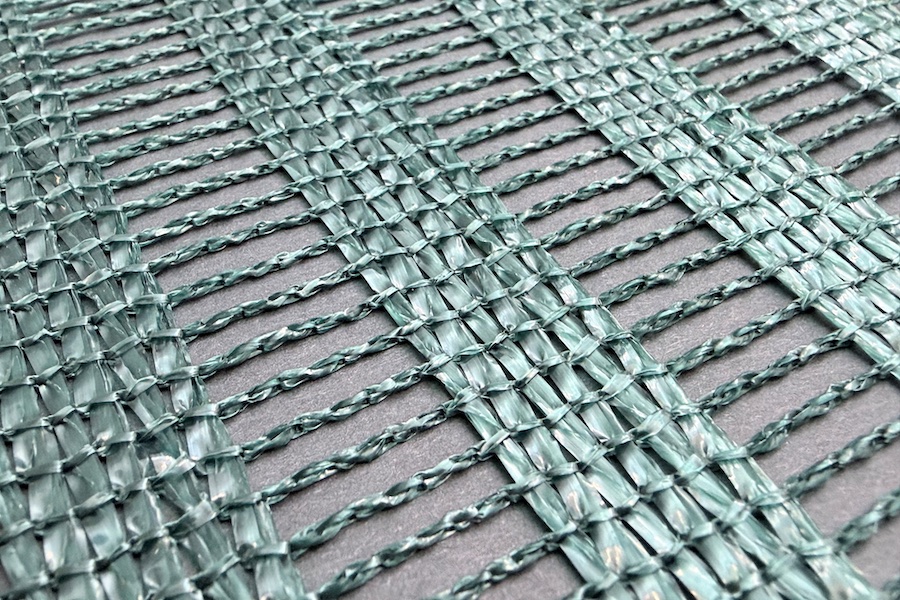
According to the Industrieverband Veredlung, Garne, Gewebe, Technische Textilien, IVGT (Industrial Association for Finishing, Yarns, Fabrics and Technical Textiles), their share of total sales in the textile industry currently amounts to more than 50%, which represents an increase of more than 25% over the last ten years.
The growth potential of these functional textile materials is due to their wide range of different end-uses. They are used in a wide variety of different industrial sectors and are benefiting from a relatively strong growth in demand. /1/ In order to take the best advantage of the opportunities on offer, the entire manufacturing process must be as efficient as possible. KARL MAYER’s warp preparation machines win maximum points in terms of productivity and versatility. This complete provider of preparatory machines for the weaving and warp knitting sectors can supply a wide range of machinery for producing technical textiles, and these can be combined to create customised solutions. The Opt-O-Matic sectional warping machine and the MULTITENS yarn tensioning system are both worth a special mention here. The count of technical yarns presents a particular challenge. Yarns having a count of above 1,100 dtex are usually heavy, require high processing forces, and tend to form large yarn balloons during take-off at high speeds. If the yarn ends fall down in an uncontrolled manner, this can also result in unwinding of the entire package. Stiff yarns run the risk of jumping out of the yarn guides and thick yarns do not adhere securely to the package because of their relatively small area in relation to their large circumference – and these are just some of the factors that have to be taken into account when processing technical yarns.
The Opt-O-Matic sectional warping machine
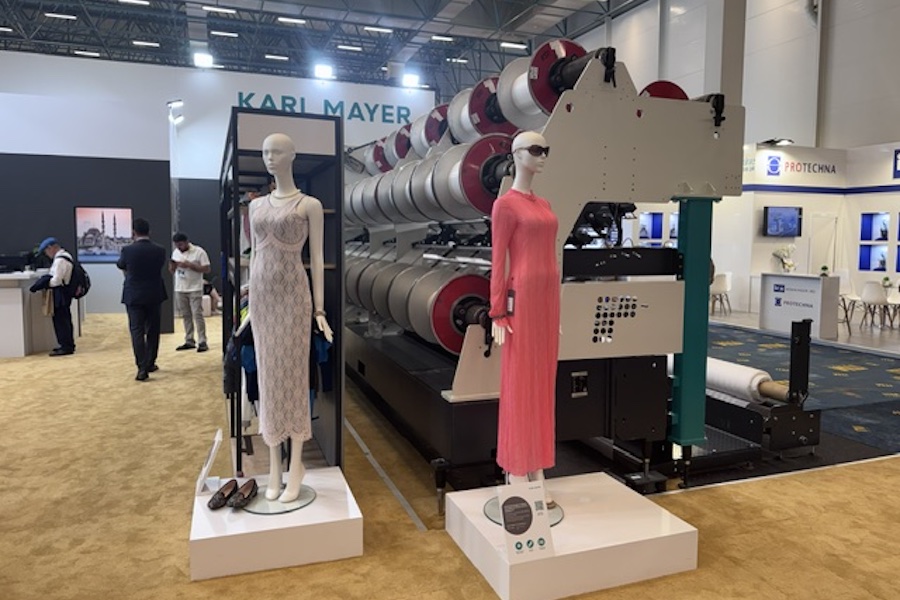
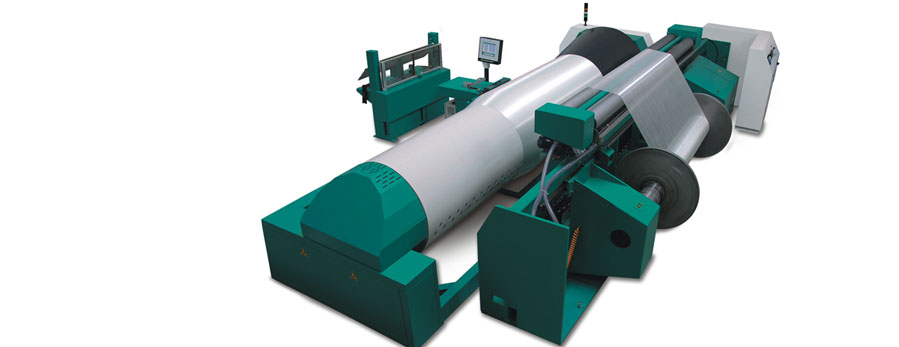
The Opt-O-Matic (Pic. 1) is the perfect machine for meeting the high demands of the specific processing conditions, efficiency and flexibility in the exacting field of technical textiles. This sectional warping machine for producing production warps operates at working widths of 2,000 mm to 5,400 mm, and band widths of 850 mm, 650 mm and 500 mm. A yarn tension in the wide range of 50 N to 40,000 N can be used for processing a wide range of functional yarns during beaming. The maximum speed is 300 m/min or 500 m/min, depending on the motor and drives. During warping, a maximum speed of 1,000 m/min can be achieved at a yarn tension of 800 N or 1,600 N. With its sophisticated technical features, the Opt-O-Matic offers excellent quality and ease of handling. The laser is at the heart of the machine. The laser-controlled band build-up measuring system guarantees uniform band circumferences and warping carriage movements, without the need for intermediate stops to make adjustments. The control system operates on the basis of the diameter as the control variable. It consists of an active press roller, a deflector and measuring roller, and a central creel adjustment facility with version 1, or a roller aggregate with version 2. The press roller system guarantees a uniform surface. A 100% reliable yarn breakage stop motion also increases the machine’s efficiency, while a user-friendly beam mounting and removal system facilitates handling. Other advantages of the machine include a semi-automatic leasing device and an efficient man/machine communication system with a clear operator console and numerous recording and documentation options. A direct beam system is available as a special feature for all those warping jobs that can be worked directly from the creel. A feed unit for processing coarse- and fine-count technical yarns is also available. When combined with a variety of yarn-specific creel systems, the Opt-O-Matic can be used for almost any application.
The types of creel available
The Opt-O-Matic can be supplied with yarns from a carriage, magazine, swivel-frame or standard creel when processing technical filament and spun yarns.
The standard creel has one or two rows, and operates without reserve loading (Pic. 2). It is therefore suitable for packages having long running lengths. In comparison, the swivel-frame creel includes a loading device for the reserve packages.
.jpg "Pic. 2: Diagram of the GN-1 standard creel // (c) 2012 Karl Mayer")
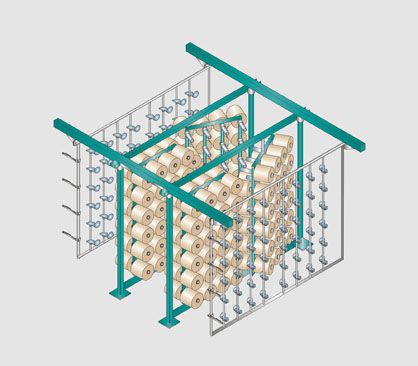
The frame-like structure can be moved in order to bring the new yarn into position (Pic. 3). The magazine creel has two bobbin positions for every take-off position. This arrangement, which is used in conjunction with knotting-on of the yarn reserve, allows the yarn to run continuously whilst the packages are being changed. The carriage creel uses a bobbin carriage for supplying the yarns efficiently, and these can be moved into or out of the swivel-frame creel one after the other. By selecting the most suitable accessories, the creels can be adapted to suit the specific conditions in which they are used.
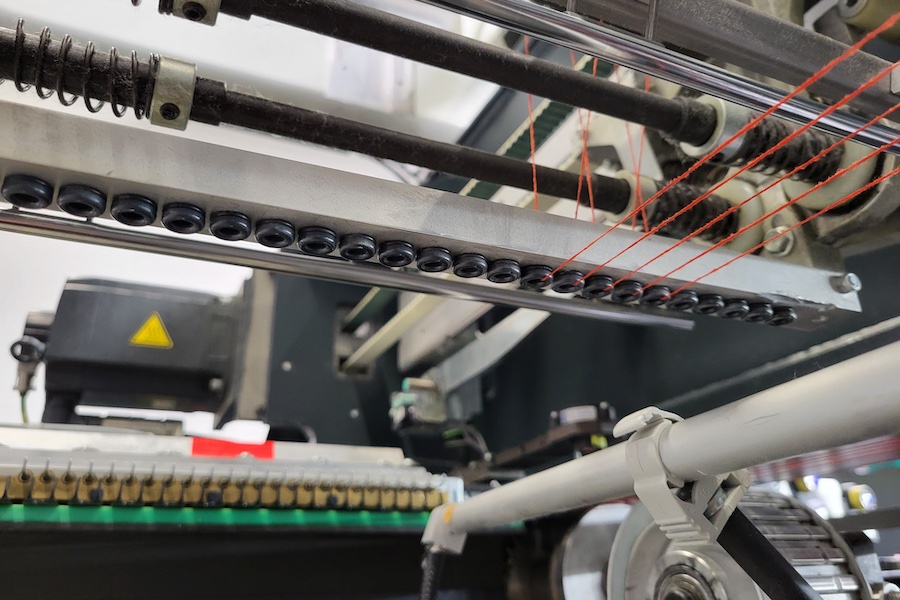
Examples of effective auxiliary components include vertical and horizontal balloon limiters, foam rubber covers on the bobbin plates, covers on the yarn tensioner or a special draw-off holder, which replaces the KFD yarn tension controller – if the yarn is too heavy for overhead take-off. If required, the swivel-frame creel can also have five or six levels for use in technical applications. Another modification relates to the use of a solid steel frame construction with extendable brake walls for holding the yarn guides and yarn tensioners when processing packages having a diameter of up to 320 mm. However, the most important step in customising the creels to suit the specific end-use is to use the most suitable yarn tensioning system in each case. The MULTITENS yarn tensionerThe KFD-AIR compensating yarn tensioner and the AccuTense computer-controlled induction yarn tensioner, which uses the principles of eddy-current braking, are generally used in technical applications. However, the MULTITENS is also recommended for this particular application. This flexible and efficient piece of creel equipment allows conventional as well as special technical yarns to be processed at take-off speeds of up to 1,200 m/min, so that a yarn tension range of 3 cN to 250 cN can be catered for. The MULTITENS system guarantees uniform yarn tension levels under every condition, regardless of the count, the characteristics of the yarn, the friction values, the package diameters, the warping speeds or the creel parameters, such as the length and draw-off angle. This is an important prerequisite for weaving textiles with uniform and consistent characteristics. When producing technical woven fabrics in particular, the system offers specific cost advantages, since different package diameters can be processed, without reducing the quality of the fabric because of yarn striping. The absolutely uniform yarn tension is the result of efficient control at every individual tensioner position. To do this, the yarn tension sensor determines the actual value, the computer compares it with the target value that has previously been input, and the yarn tensioner corrects any variations. Despite this individual position control facility, the entire system communicates via a bus system and can be set up simply by connecting up a few cables. MULTITENS is also extremely efficient as far as data management is concerned. An integrated database enables the article-specific parameters to be stored, and these can be called-up easily and securely if required. This enables the creel preparation times to be reduced considerably. The production data, such as the yarn tension for each position, can be configured across the entire warp. This targeted process recording technique is particularly important in technical applications for providing the required certification, such as when producing certified woven textiles for airbags and medical textiles. Another important advantage of MULTITENS is that it handles the yarns gently. To guarantee smooth yarn running, the tension control system operates with slip-free yarn feed and just a few deflection points.
/1/ Eric Heymann, Textil-/Bekleidungsindustrie: Innovationen und Internationalisierung als Erfolgsfaktoren (Textile/Clothing Industry: Innovation and Internationalisation as Success Factors), Deutsche Bank Research, 5.07.2011