Nonwovens / Technical Textiles
CFP taps into new opportunities
At the beginning of the nineties, the company began the in-house testing of the first warp knitting machines equipped with CFP profiled bars having lengths of up to 7 m, and the HKS 3-M was exhibited at ITMA 2007 as the first model in a new generation of machines equipped with CFP bars.
In 2008, KARL MAYER took another step towards consolidating its activities in the field of fibre-reinforced plastics when it set up its CFP Centre of Excellence, thus creating a department that was dedicated to the development of systems-integrated, easily adaptable composite solutions.
As well as developing structural components from CFP, this department also designed leaf springs made from glass-fibre-reinforced plastics (GFP) and made them suitable for mass production. The CFP Centre of Excellence is now extending its services to external companies.
The KARL MAYER CFP Centre of Excellence – tailor-made solutions for the company itself and external customers
KARL MAYER’s services in the field of fibre-reinforced plastics include developing components having integrated functional characteristics and complex structures, and with a high potential for replacing conventional products both technically and economically for maximum benefit. The components developed and produced by the CFP Centre of Excellence offer a whole package of decisive advantages. These include excellent fatigue strength and a low density, but especially a specific coefficient of thermal expansion, which can be set in the positive and negative value range, including zero.
This is an important factor, particularly when the machine components have to interact precisely with each other under varying climatic conditions. The CFP components developed by KARL MAYER are also designed as plug and play parts.
This design concept was developed by liaising closely with the users and with various departments within the textile machine company itself, such as Engineering, Prototype Production, Testing and Mass Production – a one-stop solution that has proved to be extremely effective.
With its know-how and technical equipment specialising in fibre-reinforced plastics, this manufacturer has equipped all its high-speed tricot machines with CFP components and, by doing this, has achieved a considerable increase in speed and performance. The raschel machines are currently being fitted with CFR components. The company’s clients are increasingly impressed with the success of this concept.
In order to take account of the growing interest of industries outside the textile machine building sector, KARL MAYER added a CFP Laboratory to its CFP Centre of Excellence in the spring of this year.
The new CFP Laboratory – a one-stop solution that offers even greater expertise
Until now the specialists in CFP technology have been using the measuring and testing facilities that KARL MAYER developed for building its textile machines, but they now have at their disposal equipment that is designed exclusively to suit their special requirements.
This includes a heated laboratory press for producing components in dimensions of 500 mm x 800 mm when developing prototypes. A special oven having dimensions of 1,000 mm x 1,500 mm is available for producing larger components.
Components can also be produced with several curves, 3D reinforcement and other complex geometrical shapes. The range of equipment used in KARL MAYER’s CFP Laboratory can be used for carrying out every type of processing stage efficiently, from textile preforming to impregnating with liquids. At the beginning of the production sequence, the dry blanks of textile reinforcement are given the shape of the final component, which is usually three-dimensional, by inserting a binder web and hot-pressing. The preform, which is already close to the final shape, is then placed into a tool and impregnated with resin. The tool used for doing this can also be supplied by the company’s own mould-making department.
The impregnation process complements KARL MAYER’s existing mass production facilities effectively: tube blowing and prepreg pressing.
Before the component that has been developed goes into mass production, it undergoes thorough testing. A tensile/compression tester developed by the Zwick Roell Group is used to study the rigidity and strength as well as the setting characteristics in creep tests.
The new KARL MAYER CFP Laboratory is also equipped with a climate chamber. This piece of testing equipment, which is used to vary the atmospheric humidity and temperature, provides important information regarding any changes that occur in the components caused by the effects of heat and moisture. A team of highly qualified staff is on hand to fully exploit all the technical facilities available in the CFP Laboratory.
The CFP team – the right know-how for every processing stage
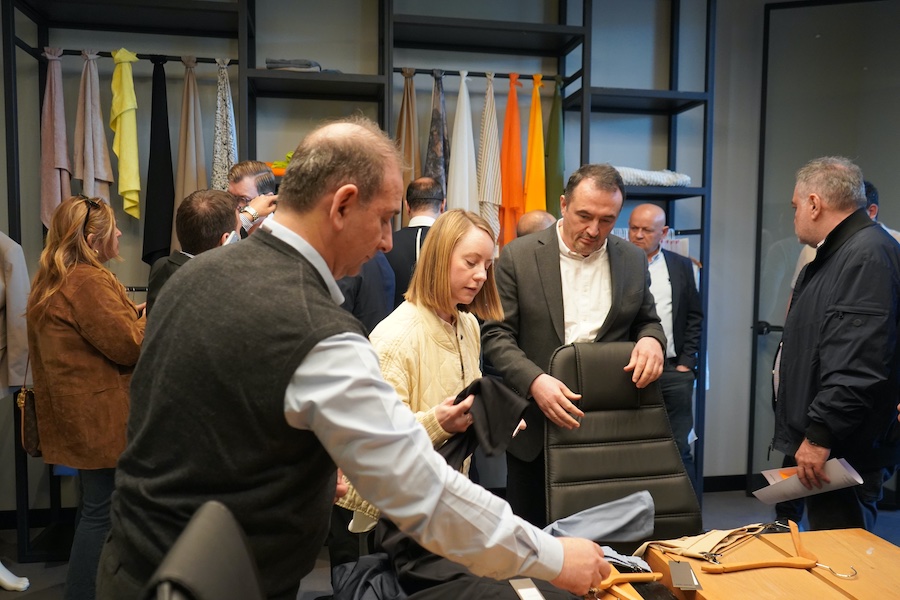
By targeting its expertise in CFP to providing external users with one-stop solutions as well, KARL MAYER has enhanced its technical capabilities and also expanded its team of interdisciplinary specialists. This interdisciplinary group (Fig.) now includes specialists in structural mechanics and component design, tool development and prototype construction, and testing and the mass production of fibre/plastic composites (FPC), and relies on a strategic, in-house organisational structure for doing this. The development team’s contact is Dr. Tim Grundmann, an experienced production technologist. The result is highly efficient, interdisciplinary cooperation for reinforcing and consolidating a key area of expertise, from which companies not involved in warp knitting machine building can also benefit.