[pageLogInLogOut]

#Textiles & Apparel / Garment

Reducing the carbon footprint of footwear production

Covestro, textile technology company Huafeng and green fiber technology company Cyclone from China have jointly developed a solution to produce high-quality running and sports shoes in a much more sustainable way than before: recycled fabric made from CYCLONE® recycled polyester (rPET) yarns is used as the shoe upper and selectively coated using Huafeng's HAPTIC® technology.

In the process, Huafeng uses a polyurethane (PU) dispersion from the INSQIN® portfolio of Covestro, half of whose carbon content comes from bio-based raw materials. The greenhouse gas emissions for each pair of shoes produced in this way are around 230 grams of CO? equivalent less than a pair using conventional fossil-based PU dispersions and virgin PET fabric.

3D HAPTIC® textile printing with partially bio-based INSQIN® system on recycled PET

Successful cooperation with textile and yarn technology companies in China
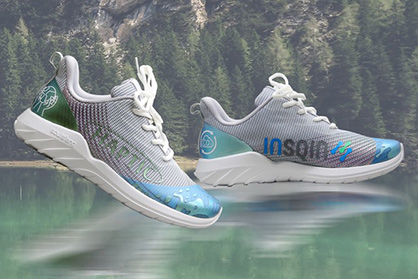
Covestro, Huafeng and Cyclone have developed a material solution to produce high-quality running and athletic shoes much more sustainably than before. © HUAFENG Textile Technologies


"This is good news for anyone who wants to maintain an athletically active, healthy lifestyle in the most environmentally friendly way possible," says Tony Wu, Global Marketing Manager, Textile Coatings, Covestro. He emphasizes that the increased sustainability achieved does not compromise the durability, appearance or comfort of the footwear upper. In combination with Huafeng HAPTIC® printing technology, 3D shapes can be applied to textile fabrics creating trendy designs and high performance in athletic footwear. 


Impranil® eco DLS, as a partially bio-based binder, is part of the INSQIN® range of waterborne textile coating resins. Its use contributes to reduced greenhouse gas emissions with around 60 grams of CO? equivalents per pair of shoes. The value comes from internal calculations verified by independent external experts. It is obvious that the difference in the CO? footprint becomes even greater when solvent-based PU textile coatings are used for comparison. The use of fabric based on recycled PET yarns mitigates greenhouse gas emissions by about 170 grams of CO? equivalent per pair of shoes.
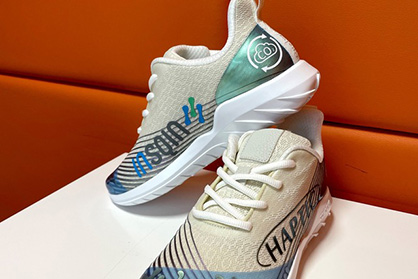
In production, Huafeng uses Covestro's Impranil® eco DLS polyurethane dispersion, half of whose carbon content comes from biomass, as well as recycled PET fibers from Cyclone and its own HAPTIC® technology. © Covestro


To share the experience and findings with the industry, Covestro, Huafeng and Cyclone jointly hosted a webinar globally to introduce the three technologies and the synergy created from this co-development. The recorded webinar can be accessed here:

https://www.bilibili.com/video/BV1v44y1n7RA

"Sustainability is key to our market success at Huafeng. With the help of the partially bio-based PU dispersion of Covestro, we were able to introduce more renewable ingredients into our HAPTIC® coatings, further improving their sustainability," says Dr. Thomas Schmidt, Director of Innovation at Huafeng. Dr. Torsten Pohl, Head of Global Textile Coatings at Covestro, adds, "The combination of our partially bio-based INSQIN® PU coating binder with Huafeng HAPTIC® printing on recycled PET fabric shows how partners in the value chain can work together creating more sustainable products."



More News from Covestro AG

#Textile chemistry

Covestro and Heraeus Precious Metals collaborate to enable safer, more sustainable antimicrobial textile coatings

Laboratory tests reveal that AGXX antimicrobial surface technology from Heraeus Precious Metals is fully compatible with Impranil® PU dispersions which are part of the waterborne INSQIN® textile coating technology from Covestro, paving the way for more sustainable antimicrobial textile coatings. This discovery comes at a key moment for the textile coatings industry. As the sharing economy continues to grow, more people are coming into regular contact with high-use surfaces, creating ideal conditions for bacteria, viruses, and other microorganisms to thrive.

#Textile chemistry

Covestro celebrates decade of innovation and sustainable growth

Covestro celebrates its 10-year anniversary today. Since its carve-out from Bayer in 2015, the company has developed into a global leader in high-performance polymer materials and a pioneer in circular economy solutions. With a strong focus on innovation and sustainability, Covestro’s materials are now embedded in countless applications worldwide – from mobility and construction to electronics, healthcare, and consumer goods.

#Textile chemistry

Covestro extends contract with CTO Dr. Thorsten Dreier ahead of schedule until 2031

Dr. Thorsten Dreier will remain Chief Technology Officer of Covestro for a further five years. The Supervisory Board has extended his contract, which runs until June 2026, ahead of schedule from July 1, 2026 to June 30, 2031.

#Textile chemistry

Suiting up Team Sonnenwagen with more sustainable sportswear created through a three-way partnership

Team Sonnenwagen Aachen, a solar racing collective from RWTH Aachen and FH Aachen, Germany, is on a mission to advance sustainable mobility solutions and become world champions. This August, the student team will participate in the 2025 Bridgestone World Solar Challenge, a biannual 3,000-kilometer race across the Australian outback. During the five-day event, 50 student teams from around the world will compete with solar vehicles that they must design, assemble, and drive themselves.

More News on Textiles & Apparel / Garment

#ITM 2026

The Technology Hub for global denim trends: ITM 2026

The ITM 2026 International Textile Machinery Exhibition, to be held at the Tüyap Fair and Congress Center in Istanbul from June 9–13, 2026, brings together groundbreaking technologies in denim production. From smart production systems to eco-friendly raw materials, from digital washing solutions to laser effect technologies, innovations that will shape the future of denim will be showcased for the first time at ITM 2026.

#Textile processing

YKK receives ISPO Textrends Awards for circular innovations

YKK Corporation (Headquarters: Chiyoda-ku, Tokyo; President: Koichi Matsushima; hereafter, YKK) is pleased to announce that the ISPO Textrends judges have selected YKK's 3D Composite Puller as the Best Product in the Accessories category. They also selected YKK’s NATULON Plus® Fiber Sourced™ zipper with Recycled PET Open Parts as a Top 5 item in the same category. The competition, held twice a year in conjunction with the ISPO trade show, recognizes the most innovative performance textiles, components, and apparel.

#Textiles & Apparel / Garment

Texworld Apparel Sourcing Paris unveils redesigned show layout for 2026

From February 2 to 4, 2026, Texworld Apparel Sourcing Paris will once again bring together all the key players in textiles and clothing at the Paris-Le Bourget Exhibition Center. For 3 days, visitors will discover, compare and select among 1,300 suppliers who will shape the collections of tomorrow, from ready-to-wear to luxury.

#Textiles & Apparel / Garment

Asteks and Nexrone launch global investment initiative

A new joint investment company, Westure Ventures, has been founded by Asteks and Nexrone to focus on the development of next-generation transformative technologies. Türkiye’s long-established industrial powerhouse Asteks and one of the rising innovative forces in Europe’s startup ecosystem Nexrone Global announced the launch of their new investment company built on a shared vision: Westure Ventures.

Latest News

#Heimtextil 2026

Mimaki demonstrates versatile, simple TRAPIS textile printing at Heimtextil 2026

Mimaki’s textile pigment transfer printing system, TRAPIS, is able to print on a diverse range of fabrics - unlike traditional processes - including natural fibres and synthetic fabrics. The full solution will be shown on Mimaki’s booth (Hall 3.0 Stand A97), as the company returns to Heimtextil to showcase its advancements in sustainable, high quality and efficient textile printing.

#Natural Fibers

38th International Cotton Conference Bremen: Let´s Talk about Cotton!

The 38th International Cotton Conference Bremen, to be held on 25-27 March 2026 in Bremen’s parliament building on market square, once again sends a powerful signal for professional excellence and international dialogue. The focus is on the latest market trends and technical innovations throughout the entire value chain – from agriculture and quality assurance to processing and the circular economy. With its high-calibre speakers, the conference remains an indispensable forum for anyone involved in shaping the cotton industry scientifically, technically, or economically.

#Recycled_Fibers

Leading fashion brands step up to unlock the next chapter of Circulose

Since 2024, under new ownership and leadership, Circulose has set a renewed strategic direction focused on securing long-term commitments with partner brands to bring CIRCULOSE® back to market at scale. This strategy has proven successful.

#Research & Development

More safety and comfort for protective clothing thanks to auxetic fabrics

When everyday materials are pulled, they stretch or elongate in the direction of the pull and become narrower in cross-section. We can also observe this property in two-dimensional textiles. Auxetic structures behave differently here. They have the striking property of not changing under tensile stress or even increasing their width or thickness. These properties are advantageous, for example, in protective textiles or textile filter media. The DITF are researching auxetic fabrics for various applications.

TOP