[pageLogInLogOut]

#Textile chemistry

Renewable Carbon Initiative (RCI), CO2 Value Europe (CVE) and nova-Institute publish a study showing the CO2 reduction potential of the chemical industry through CCU

Today, the production of chemicals and derived materials heavily relies on the use of fossil carbon. Industrial processes need hydrocarbons to provide process energy (electricity and heat) for manifold processes and to provide embedded carbon (i.e. the carbon bound in the molecular structure) as feedstock for diverse substances, building blocks, intermediates and derived materials such as polymers or detergents.

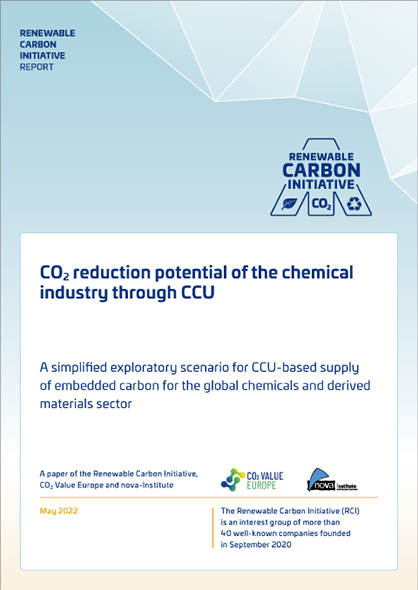
CO2 Reduction Potential of the Chemical Industry through Carbon Capture and Utilisation (CCU)

In an exploratory scenario, the study “CO2 reduction potential of the chemical industry through CCU” investigates the greenhouse gas (GHG) reductions that can be achieved in the global chemical and derived material industries if the entire demand for embedded carbon is met solely and exclusively via CO2 instead of from fossil sources. Major simplifications are used to achieve transparency and comprehensibility of the issue. Methanol (CH3OH) is considered to cover the needs for hydrocarbons for chemicals and derived materials among the various chemical intermediates as a representative pathway for renewable carbon. It is a plausible scenario to assign methanol a central role in supplying the chemical industry of the future.
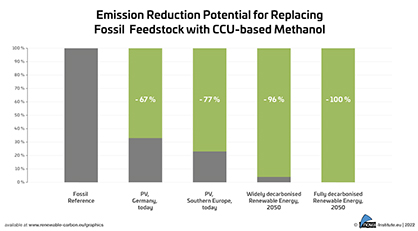
Emission Reduction Potential for Replacing Fossil Feedstock with CCU-based Methanol<br />
Source: nova-Institut GmbH
Emission Reduction Potential for Replacing Fossil Feedstock with CCU-based Methanol Source: nova-Institut GmbH


The examined CCU-based production route includes CO2 capture as a mix of direct air capture (DAC) and capture from different point sources, hydrogen supply and the hydrogenation reaction for methanol synthesis. The GHG emissions related to CCU-based methanol synthesis depend on the emissions of the renewable energy production. Emissions of CCU-based methanol could be 67 to 77% lower compared to emissions from releasing embedded carbon of fossil fuels, when using current energy supply based on photovoltaics. With improvements in renewable energy production, the reduction could increase to levels between 96 and 100%.

The annual global demand for carbon embedded in chemicals and derived materials could rise from 450 million tonnes of carbon (Mt C) today to 1,000 Mt C by 2050. Meeting this demand with CCU-based methanol would cause an immense demand of 29.1 PWh/year of renewable energy. Enormous efforts would have to be made to deploy sufficient renewable energy. If desert photovoltaic is used to produce the hydrogen, theoretically 1.3% of the Sahara area would be required to cover the entire demand. 
cover page
cover page


Yet, with fully decarbonised energy supply, an amount of 3.7 Gt CO2/year can be saved. These GHG emission savings are significant – even in comparison to today’s global emissions of 55.6 Gt CO2 eq/year. The result shows that CCU is a promising technology to reduce GHG emissions related to embedded carbon supply – if sufficient renewable energy is available. CCU-based carbon will be an important pillar of a future build on renewable carbon, complementing carbon from recycling and from biomass. To allow CCU to contribute to a climate-friendly supply of feedstock for the chemical industry global PV and wind capacities must be rapidly expanded.
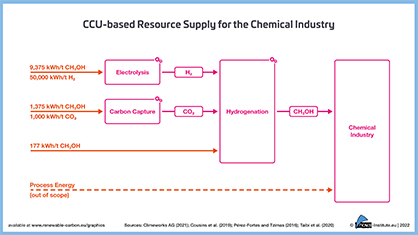
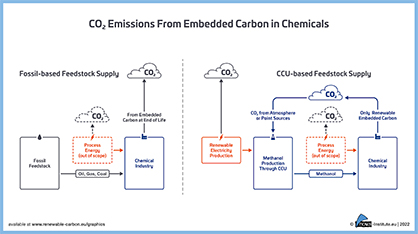
CCU-based Resource Supply for the Chemical Industry<br />
Source: nova-Institut GmbH
CCU-based Resource Supply for the Chemical Industry Source: nova-Institut GmbH


CO2 Emissions from Embedded Carbon in Chemicals<br />
Source: nova-Institut GmbH
CO2 Emissions from Embedded Carbon in Chemicals Source: nova-Institut GmbH


The study “CO2 reduction potential of the chemical industry through CCU” is available for free at http://www.renewable-carbon-initiative.com/media/library


More News from TEXDATA International

#People

Happy Holidays!

Dear reader, the year 2025 is drawing to a close. We are entering what we hope will be a peaceful holiday season, spending time with our families and taking a moment to pause and reflect. We hope we have been able to support you once again this year with relevant news and articles, and we look forward to surprising you with many innovations in the coming year. Enjoy the festive season, stay healthy, and we wish you a happy and joyful holiday season.

#Recycling / Circular Economy

textile.4U publishes special edition “Top 100 Textile Recycling Companies 2025”

With a comprehensive 176-page special edition, textile.4U is dedicating its latest issue entirely to one of the most dynamic and influential topics in today’s textile industry: textile recycling. The new issue, published exclusively in high-quality print, presents the Top 100 textile recycling companies researched and selected by TexData – organizations that already play a key role in the transition to circular textiles or are expected to have a significant impact in the near future.

#Recycling / Circular Economy

Responsible Textile Recovery Act of 2024 signed by Governor

Senator Josh Newman (D-Fullerton) is proud to announce that Senate Bill 707 (SB 707), the Responsible Textile Recovery Act of 2024, has been signed into law by the Governor of California, Gavin Newsom. This groundbreaking legislation establishes the country’s first Extended Producer Responsibility (EPR) textile recycling program, marking a significant step forward in the state’s efforts to combat waste and promote sustainability.

#Textiles & Apparel / Garment

Modtissimo promotes sustainability with 28 coordinates in the Green Circle

Modtissimo is proving more and more to be a textile and clothing show that delivers the latest innovations in the area of sustainability, with the iTechStyle Green Circle being the main showcase for companies' creations. In this 60+4 edition, taking place on 12 and 13 September, 28 coordinates will be exhibited in a section organised by CITEVE and curated by Paulo Gomes.

More News on Textile chemistry

#Textile chemistry

PIGMENTURA by CHT wins the German Sustainability Award in the Products category

On Thursday, December 4, 2025, the German Sustainability Award was granted in Düsseldorf for the CHT Group's state-of-the-art pigment dyeing process PIGMENTURA.

#Textile chemistry

Archroma and Lilienweiss join forces to deliver faster and localized color management services in Europe

Archroma, a global leader in specialty chemicals focused on sustainable solutions, today announced its partnership with Lilienweiss, who will begin offering Archroma Color Management solutions across Europe starting January 2026.

#Man-Made Fibers

Ascend Performance Materials secures court approval for restructuring and appoints new CEO

Ascend Performance Materials has reached a major milestone in its Chapter 11 process: the U.S. Bankruptcy Court for the Southern District of Texas has confirmed the company’s Plan of Reorganization. Ascend expects to emerge from Chapter 11 by year’s end with a significantly improved capital structure. In parallel with the restructuring progress, Ascend announced a leadership change.

#Textile chemistry

Indorama Ventures ranks first globally in ChemScore 2025 for excellence in chemicals management and environmental performance

Indorama Ventures Public Company Limited (IVL), a global sustainable chemicals company, has been ranked first globally with a green card in ChemScore 2025, the internationally recognized benchmark developed by ChemSec, assessing the environmental performance and chemical management of the world’s 40 largest chemical companies. The company has consistently found itself in the top three ChemScore companies and scored twice as high on average as the Asia-based companies taken together.

Latest News

#Weaving

Lindauer Dornier announces leadership transition in weaving machine business

After more than ten successful years at Lindauer DORNIER GmbH, Mr Wolfgang Schöffl will leave the family-owned company at the end of the year to enter well-deserved retirement.

#Heimtextil 2026

Texpertise Focus AI: Messe Frankfurt puts Artificial Intelligence centre stage at its international textile and apparel trade fairs

Under the banner 'Texpertise Focus AI, Messe Frankfurt will place a strong emphasis on Artificial Intelligence (AI) across its international textile and apparel trade fairs from 2026 onwards, setting a future-shaping signal for the industry. The initiative highlights the responsible use of AI along the entire textile value chain, from fibre production to the point of sale. The programme will launch at Heimtextil in Frankfurt in January 2026.

#Technical Textiles

Autoneum and Polestar set new benchmarks for passenger experience and sustainability

As the global market leader in sustainable acoustic and thermal management, Autoneum is a key supplier of interior and exterior components for the highly anticipated Polestar 5 model. The successful collaboration between Autoneum and Polestar marks a significant milestone in sustainable automotive engineering: the electric grand tourer sports car features several innovations in lightweight, fully recyclable polyester-based components that ensure a superior driving experience. Polestar 5 was revealed at the IAA Mobility 2025 in Munich and is available in 24 markets.

#Natural Fibers

Cashmere producers stress the importance of The Good Cashmere Standard®

At the invitation of the Aid by Trade Foundation (AbTF), over 70 experts from the cashmere production and supply chain, as well as other specialists, met at the GCS Unit Meeting in Shanghai, China to discuss the progress and new objectives of The Good Cashmere Standard (GCS). The meeting focused on implementation and verification of the standard, important aspects of animal welfare and the importance of the standard in the global textile market.

TOP