[pageLogInLogOut]

#Textile chemistry

Dress with CO2
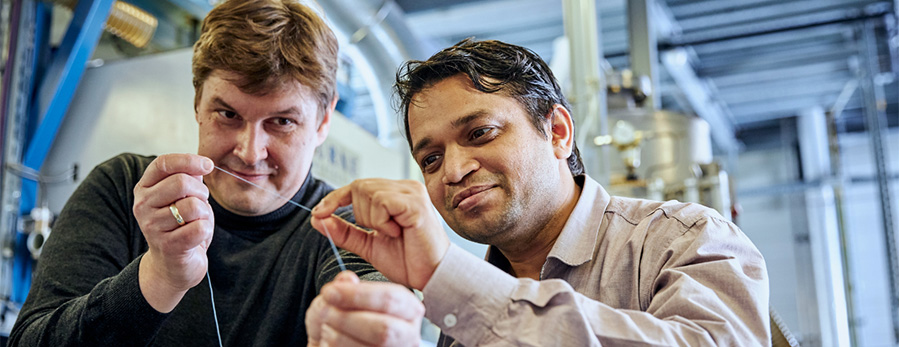
(c) 2019 Covestro
Dress with CO2: Two research projects have succeeded in making elastic textile fibers based on CO2 and so partly replacing crude oil as a raw material.

Elastic textile fibers made from carbon dioxide

Covestro and its partners, foremost the Institute of Textile Technology at RWTH Aachen University and various textile manufacturers, are developing the production process on an industrial scale and aim to make the innovative fibers ready for the market. They can be used for stockings and medical textiles, for example, and might replace conventional elastic fibers based on crude oil. 

The elastic fibers are made with a chemical component that consists in part of CO2 instead of oil. This precursor called cardyon® is already used for foam in mattresses and sports floorings. And now it is being applied to the textile industry.

“That’s a further, highly promising approach to enable ever broader use of carbon dioxide as an alternative raw material in the chemical industry and expand the raw materials base,” says Dr. Markus Steilemann, CEO of Covestro. “Our goal is to use CO2 in more and more applications in a circular economy process and save crude oil.” 

Sustainable production process

The fibers are made from CO2-based thermoplastic polyurethane (TPU) using a technique called melt spinning, in which the TPU is melted, pressed into very fine threads and finally processed into a yarn of endless fibers. Unlike dry spinning, which is used to produce conventional elastic synthetic fibers such as Elastane or Spandex, melt spinning eliminates the need for environmentally harmful solvents. A new chemical method enables carbon dioxide to be incorporated in the base material, which also has a better CO2 footprint than traditional elastic fibers.


“The CO2-based material could be a sustainable alternative to conventional elastic fibers in the near future,” states Professor Thomas Gries, Director of the Institute of Textile Technology at RWTH Aachen University. “Thanks to our expertise in industrial development and processing, we can jointly drive establishment of a new raw materials base for the textile industry.”

Development of the method of producing fibers from CO2-based thermoplastic polyurethane has been funded by the European Institute of Innovation and Technology (EIT). It will now be optimized as part of the “CO2Tex” project, which is to be funded by the German Federal Ministry of Education and Research (BMBF) so as to enable industrial production in the future. “CO2Tex” is part of “BioTex Future,” a project initiative of RWTH Aachen University. The initiative is devoted to developing production and processing technologies to facilitate the future market launch of textile systems from bio-based polymeric materials.

Development partners display interest

What makes the CO2-based TPU fibers so special is their properties: They are elastic and tear-proof and so can be used in textile fabrics. Initial companies from the textile and medical engineering sectors have already tested the CO2-based fibers and processed them into yarns, socks, compression tubes and tapes.

The aim of launching CO2-based textiles on the market is to promote a material cycle in the textile and clothing industry based on sustainable resources.


More News from Covestro AG

#Technical Textiles

Covestro showcases monomaterial concept in autonomous SUE People Mover

UE | STUDIOS has unveiled the fully autonomous electric minibus “Self-driving Urban E-Shuttle” (SUE), placing strong emphasis on sustainable material design. Developed within a project funded by the Federal Ministry for Economic Affairs and Energy (BMWE) and the European Union, the vehicle will begin public road testing this year. At the core of the concept is the consistent use of recyclable monomaterials to improve circularity at end of life.

#Textile chemistry

Covestro and Heraeus Precious Metals collaborate to enable safer, more sustainable antimicrobial textile coatings

Laboratory tests reveal that AGXX antimicrobial surface technology from Heraeus Precious Metals is fully compatible with Impranil® PU dispersions which are part of the waterborne INSQIN® textile coating technology from Covestro, paving the way for more sustainable antimicrobial textile coatings. This discovery comes at a key moment for the textile coatings industry. As the sharing economy continues to grow, more people are coming into regular contact with high-use surfaces, creating ideal conditions for bacteria, viruses, and other microorganisms to thrive.

#Textile chemistry

Covestro celebrates decade of innovation and sustainable growth

Covestro celebrates its 10-year anniversary today. Since its carve-out from Bayer in 2015, the company has developed into a global leader in high-performance polymer materials and a pioneer in circular economy solutions. With a strong focus on innovation and sustainability, Covestro’s materials are now embedded in countless applications worldwide – from mobility and construction to electronics, healthcare, and consumer goods.

#Textile chemistry

Covestro extends contract with CTO Dr. Thorsten Dreier ahead of schedule until 2031

Dr. Thorsten Dreier will remain Chief Technology Officer of Covestro for a further five years. The Supervisory Board has extended his contract, which runs until June 2026, ahead of schedule from July 1, 2026 to June 30, 2031.

More News on Textile chemistry

#Textile chemistry

DyStar Group announces Board transition to drive innovation

DyStar, a leading specialty chemical company with a heritage of more than a century in product development and innovation, announced today the appointment of Ruan Cunfan to its Board of Directors, effective 20 February 2026.

#Textile chemistry

Jeanologia urges industry to accelerate PP Spray phase-out following ZDHC Watchlist update

Potassium permanganate has officially entered the Chemical Watchlist of the ZDHC Foundation, signaling increased scrutiny and potential phase-out of one of the most hazardous chemicals still used in denim finishing. The inclusion confirms an industry shift that Jeanologia anticipated more than a decade ago.

#Textile chemistry

RUDOLF gets the exclusive global distribution rights for Sanitized® textile technologies

With effect from today, RUDOLF officially assumes exclusive global distribution rights for Sanitized® textile technologies from SANITIZED AG. This is the next milestone in the strategic collaboration announced in 2025, with the partnership between the two companies now fully implemented and expanded worldwide.

#Denim

organIQ seek: smart alternative to potassium permanganate

CHT Group announces new technical findings within its organIQ seek platform that significantly advance the transition toward permanganate-free denim bleaching. Through extensive industrial testing and application research, CHT confirms that organIQ seek can now be used with remarkable effectiveness as a substitute for potassium permanganate in spray bleach, while remaining aligned with sustainability expectations and cost realities in the European market. At the COLOMBIATEX in Medellín as well as at the Exintex in Puebla and the Kingpins Show in Amsterdam the CHT Group will present organIQ seek as an alternative to potassium permanganate.

Latest News

#Techtextil 2026

DIENES at Techtextil 2026: Flexible pilot lines for bio-based fiber development

The growing relevance of bio-based materials in technical textiles is accompanied by increasing demands for reproducibility, high-quality data, and scalable process routes. Especially when working with cellulose and its derivatives, chitosan, lignin-based approaches, or bio-based PAN as a carbon-fiber precursor, R&D teams face variable feedstock quality, tighter process windows, and the need for reliable comparability across trials. This calls for flexible, data-driven experimental setups that can be reconfigured efficiently when recipes, solvents, and raw-material batches change.

#Texprocess 2026

Gunold showcases embroidery product range and services at Texprocess

At Texprocess 2026, GUNOLD will present numerous hands-on examples related to embroidery in Hall 8, Booth E20. The focus is on creative embroidery designs as well as the extensive product range of threads, nonwovens, and accessories for embroidery and embellishment. “Trade visitors can once again look forward to many new and creative embroidery designs. Of course, we will also showcase the matching products required to bring these ideas to life,” announces Marketing Manager Stephan Gunold.

#Nonwovens

EDANA and more than 70 industry organisations call for consistent exemptions in EU packaging regulation

EDANA, together with more than 70 industry associations and organisations, has issued a joint statement commenting on the European Commission’s Delegated Act under Article 29 of the Packaging and Packaging Waste Regulation (PPWR).

#Raw Materials

A Powerful Opening: Global thought leaders launch the International Cotton Conference Bremen

The International Cotton Conference Bremen will open on 25 March 2026 in the Parliament building of the Free Hanseatic City of Bremen with a keynote session of exceptional calibre. Distinguished international experts will set the stage for the conference by offering incisive perspectives on the most pressing challenges and the defining trends shaping the future of the global cotton trade. Their insights will span a broad spectrum — from geopolitically driven disruptions affecting global supply chains to the opportunities emerging from innovation-led agriculture capable of supporting a growing world population. Together, these opening keynotes will frame the dialogue of the conference, highlighting both the complexity of today’s market environment and the pathways toward a resilient and forward-looking cotton sector.

TOP