[pageLogInLogOut]

#Techtextil 2022

Opening the door to Bio-based Nonwovens in Reusable Textiles - Kelheim Fibres wins Techtextil Innovation Award
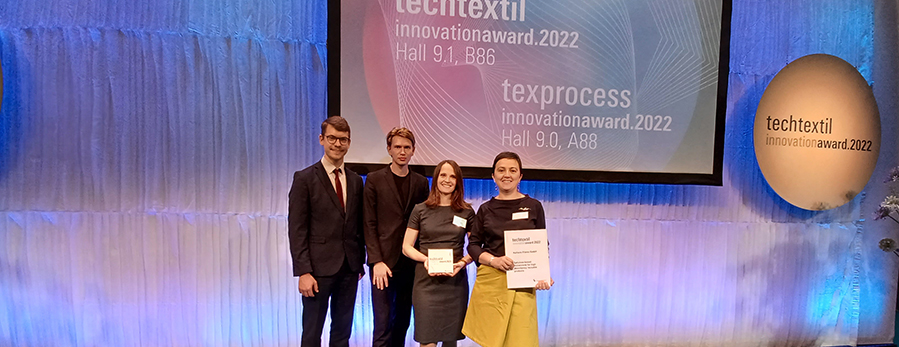
From left Patrick Engel (STFI), Caspar Böhme (Sumo), Ilka Kaczmarek (KF), Dr. Marina Crnoja-Cosic (KF) at the Techtextil Innovation Award Ceremony - © Natalie Wunder
The renowned viscose specialities manufacturer Kelheim Fibres has won the Techtextil Award in the "New Concept" category for their project "Cellulose-based nonwovens for highly absorbent reusable products".

This award is intended to make cutting-edge developments visible, promote unconventional thinking and intensify the dialogue between researchers, manufacturers, and users - and thus exactly matches the philosophy of the fibre expert.

Dr. Marina Crnoja-Cosic, Director New Business Development at Kelheim Fibres: "It is a great honour and pleasure for us to receive the Techtextil Award. We see the award not only as an acknowledgement for the project presented, but also as a recognition of our innovation strategy. Our open innovation concept aims at dialogue and the associated acceleration of the commercialisation of innovative solutions. In this specific example, it has been shown that together with our partners, the Saxony Textile Research Institute STFI and Sumo, we have been able to react faster and more specifically to current trends. Together we achieved a better result. By joining forces, we have developed a product that optimally combines performance and sustainability."

The starting point for the innovation was the search for a washable and thus reusable absorbent pad made of completely bio-based materials for the cloth diaper of the Berlin-based start-up Sumo.

Two main requirements of the application are obvious: A fast and efficient liquid distribution and high absorbency should minimise rewetting and leakage. Both are ensured by speciality viscose fibres from Kelheim, which have been making this essential contribution to absorbent hygiene products such as tampons for many years.

The obvious solution was therefore to optimally utilise the synergies between knitted and woven structures with nonwovens.

In doing so, the advantages of nonwovens in combination with speciality viscose fibres in terms of absorbency (through e.g. more open-pored structures) have been perfectly transferred from the field of disposable to the world of reusable products. For reusable products, however, there is another challenge to overcome: they must remain stable during washing and over several cycles of use. To ensure this, an innovative nonwoven construction was developed in close cooperation with the STFI. These nonwovens can be used as a stand-alone solution or integrated into a textile structure.

In the Sumo cloth diaper, the liquid management of the absorbent pad sets new standards. The new solution combines the worlds of nonwovens and textiles and provides proof that high-performance reusable absorbent products can be developed without fossil materials.





More News from Kelheim Fibres GmbH

#Man-Made Fibers

Kelheim Fibres GmbH informs about the closure of operations

The management of Kelheim Fibres GmbH informs that business operations will be terminated as of 31 March 2026. A continuation of the company beyond this date is not possible. The investor and sales process conducted within the framework of the self-administration did not lead to a positive outcome. The potential strategic investor who most recently entered the process has withdrawn from a potential investment at short notice.

#Man-Made Fibers

Investor withdrawal forces Kelheim Fibres to assess future operations

Kelheim Fibres GmbH has confirmed that the planned transaction within its ongoing self-administered insolvency proceedings has failed. The intended sale to the Munich-based LEO III Fund, advised by the DUBAG Group, could not be completed despite extensive efforts.

#Man-Made Fibers

Kelheim Fibres GmbH: Strategic Realignment and Acquisition by LEO III Fund

Kelheim Fibres GmbH has signed a notarial purchase agreement with Munich-based financial investor LEO III Fonds, exclusively advised by DUBAG Group, as part of its ongoing self-administered insolvency proceedings. The signing took place on November 5, 2025, with the completion of the transaction scheduled for January 1, 2026.

#Man-Made Fibers

Kelheim Fibres on track for the future

Kelheim Fibres GmbH, a global leader in specialty viscose fibre solutions, has successfully completed an internal restructuring and sharpened its focus on core product segments following its October 2024 insolvency filing. This has enabled the company to return to a sustainable business model, with a firm commitment to continue on this path.

More News on Techtextil 2022

Latest News

#Industry 4.0 / Digitalization

Coats Digital launches AI-powered GSD RealMotion for motion analysis

Coats Digital has launched GSD RealMotion, an AI-powered solution designed to provide apparel manufacturers with greater visibility into factory-floor operations. By analysing shop-floor video and applying Coats Digital’s GSD methodology, the solution turns video recordings into structured, motion-by-motion method studies.

#Textile chemistry

Archroma and Lameirinho partner in pioneering deployment of InOneGO single-step dyeing

Archroma, a global leader in specialty chemicals, and Lameirinho, a leading home textiles manufacturer based in Portugal, are collaborating to bring InOneGO by Archroma, a new single-step dyeing process, into commercial production. Lameirinho’s first InOneGo bedlinens collection is now available worldwide.

#Knitting & Hosiery

KARL MAYER launches extra-wide HKS 3-M EL for increased productivity

KARL MAYER has launched a new extra-wide version of its HKS 3-M EL tricot machine, designed to increase productivity particularly in the manufacture of textiles for sports, activewear and athleisure applications.

#Research & Development

Reducing development times for technical textiles by accelerated thermo-oxidative aging in a high-pressure autoclave

Synthetic polymers used in technical textiles can be effectively protected against degradation caused by heat, oxygen, and water through the use of stabilizer systems. This enables service lives of several decades, extending to more than 50 years. As the use of durable technical textiles continues to grow, so does the demand for reliable methods to predict their service life within economically feasible testing periods. For the first time the German Institutes of Textile and Fiber Research Denkendorf (DITF) developed methods for robust service life prediction for textiles in an IGF research project.

TOP