#Techtextil 2022
Technical textiles: the mark of quality and sustainability
Techtextil, the international exhibition for technical textiles and nonwovens, is the ideal platform for Swiss Textile Machinery members to present their innovations. They offer latest technology and great service for the sector, to produce textiles that are `technically´ perfect for a vast range of applications.
Nonwovens: unrivalled and sustainable
Nonwovens are used in various technical textile products, including filtration, geotextiles, automotive, carpets, technical felts, wadding, insulation and hygiene applications and wipes. The best results start from the right conditions in the mill, which is the specialty of Luwa. Is the humidity ideal for optimal processing and pneumatic conveyance of fibers? Is the mill environment free of bacterial contamination, as required for hygiene products? Luwa air engineering has developed a sustainable humidification system – a hygienic solution with high energy-efficiency since its technology is not based on steam. The company also offers unique filters for removal of airborne fibers and additives such as super absorbent powders.
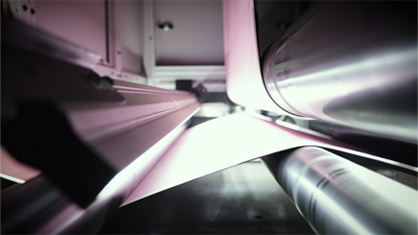
Sustainable manufacturing is also a key goal for Autefa Solutions, with a focus on manufacturing systems which preserve both energy and raw materials. Spunlace processes can require relatively high energy usage, but Autefa’s unique combination of hydroentanglement machine and drum dryer can reduce energy consumption by up to 30%. Customers can also modernize existing production lines with the newest hydroentanglement technology. Product quality in needlepunching lines can be monitored and improved by a sophisticated control system. This results in an excellent uniformity in the fabric by managing weight distribution through accurate settings at the crosslapper and the card feed.
High web quality is also the business of Rieter subsidiary Graf. Its innovative and ingenious design of products such as metallic card clothing help manufacturers consistently produce impeccable webs. Thanks to its precise fiber transfer, 20% fewer failures are produced in the web. Graf’s superior performance increases throughput by up to 10% and results in greater carding efficiency compared to conventional clothing. This applies to both short and long staple fibers bonded by chemical, mechanical, thermal or solvent treatments. The resultant webs hold the fabric together more durably.
Flawless trends in fabric making
Technical textiles are an innovative and fast-moving field – which is ideal for Crealet and its specialized electronic warp thread feed solutions. These highly reliable systems are applicable to various types of weaving machines, with customized solutions also offered. The company’s extensive know-how spans mechanical engineering, drive technology, electronics, software development and textile technology. That is the basis for ensuring yarn tension is exactly right. Yarn tension is a major factor in warp feeding, and Crealet has devised effective solutions which quickly and precisely synchronize the tension of different warp beams, and which connect to an integrated network. The goal is to allow customers to realize creative ideas with impeccable fabrics.
Correct tension is the ideal start for weaving, but fabric quality also depends on other factors at the next stages. Yarn and weft control systems by Loepfe detect the smallest filamentation, fluff and knots, as well as all types of weft faults, during the weaving process. They drive quality assurance to reach zero-defect manufacturing, meeting the high demands of technical textiles. Loepfe solutions are particularly well represented in the automotive industry, where perfect and often flawless end-product is indispensable for a wide range of vehicle components, such as airbags, car glass, seats, carbon materials, and tire cords. Its optical yarn defect sensor provides all-around control over every single millimeter of the running yarn.
Assured satisfaction
Fabric producers need to deliver guaranteed quality reliably. This requires a consistently high rate of fabric defect detection. The Uster quality assurance system ensures this by using automated control during intermediate and final inspection, removing the need for costly manual inspection. The system’s ability to capture any visible defects prevents claims. After final inspection, the fabric will often be cut into smaller rolls, which will then be delivered to various customers. Uster optimized cut control is a software tool for automated cut optimization that can be installed on any existing debatching or cutting line, allowing significantly higher yields.
Swiss Textile Machinery are committed to enabling customers to make the most of their machines and components – from the very start to the very end of the production. “Quality and sustainability are important factors of differentiation and conclusively essential for success. Our members’ innovations aim for satisfied and long-standing customers in the technical textile industry around the world,” says Cornelia Buchwalder, Secretary General of the Swiss Textile Machinery Association. At Techtextil in Germany, 24 Swiss companies will exhibit at the Swiss Association’s Member’s Pavilion or at individual booths.