#Techtextil 2019
Techtextil 2019: the highlights
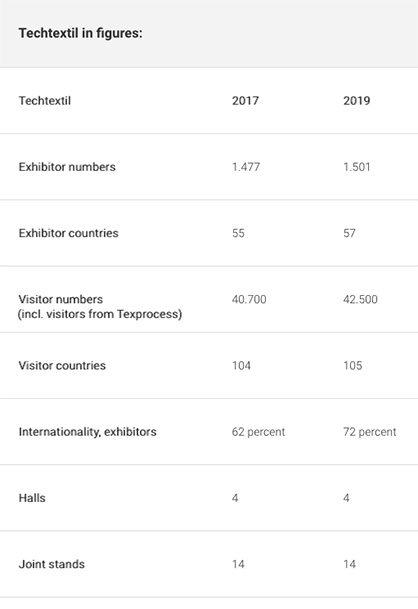
With 1,501 exhibitors from 57 countries, Techtextil, the leading international trade fair for technical textiles and nonwovens, which was held from 14 to 17 May 2019, showcased an even more extensive range of high-tech textiles than ever before. With growth of around 1.6 percent in exhibitor numbers (2017: 1,477 from 55 countries [1]), the trade fair offered its largest event to date, which, with 42,500 visitors from 105 countries, including visitors from Texprocess, and a level of international participation of 63 percent, was also more international than ever before.
“Four days, a full programme and an impressive variety of textile materials for all applications. I am repeatedly impressed at how innovative, creative and successful the technical textiles sector is. And the world knows, too, that this sector exhibits in Frankfurt every two years, in all its concentrated dynamism and energy. Nor has there ever before been such international participation,” says Detlef Braun, Member of the Executive Board of Messe Frankfurt.
Techtextil – the most international edition to date
With some 63 percent of visitors coming from outside Germany (2017: 61 percent) Techtextil has recorded its most international show ever. The leading five countries of origin for visitors were, after Germany, Italy, France, Turkey, the Netherlands and Spain
With 421 exhibitors from within Germany and 1,080 from abroad, the level of international participation amounted to 72 percent. The five most strongly represented countries in terms of exhibitors were, after Germany (421), Italy (134), China (113), France (103), Switzerland (63), Great Britain (62). New among them - or returning after an absence - were Brazil, Sri Lanka, Nepal, the United Arab Emirates, Morocco and Tunisia. Moreover, there were 14 countries that were represented with national pavilions. In spite of a somewhat dismal assessment of the economic climate in the sector on the part of the exhibitors, their satisfaction, in terms of the degree to which they had achieved the targets they had set for their participation in the show, rose by one percentage point to 89 percent.
Textile ideas for life in the cities of tomorrow
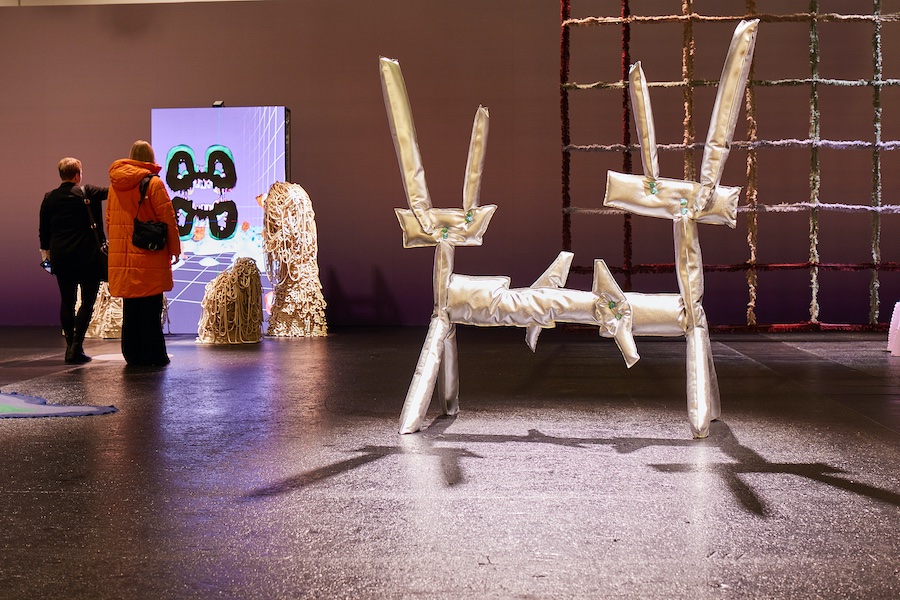
The section dedicated to the theme of “Urban Living – City of the Future” was set up in collaboration with Creative #olland, who represent the Netherlands’ creative economy, and showcased innovative solutions and visionary proposals for urban living in the future.
The content was curated by the Stijlinstituut Amsterdam. The zone’s architectural design was the work of the Dutch architectural practice Refunc, who built a completely demountable structure using around 2,000 interwoven conference chairs.
The upcycling company DenimX demonstrated how textile offcuts can be transformed into bodywork components for motorcycles. With their ‘Colour Moves’, design and engineering consultants Rombout Frieling Lab demonstrated, with the help of various textile elements, how the city of the future will accommodate the travel needs, fashions and wishes of its inhabitants. The Technical University of Delft introduced the capsule they have developed for the Hyperloop, with which they won first prize in the ‘SpaceX Hyperloop Pod’ competition, launched by Elon Musk. In an elaborate installation and exhibition entitled ‘The Ones to Watch’, New Order of Fashion (NooF), an international platform for talented creatives in the fashion industry, presented fashion designs by some young talents, which concentrated on sustainability in the fashion industry. Textile architecture consultants, Samira Boon, created a lot of excitement with a textile-based room scenario, which combined traditional Japanese origami with the digital parameters of web technology.
Some of the installations risked a deliberately exaggerated impression. Artificially created meat products in the form of ice cream or talk of future professions such as that of ‘human organ designer’ and an artificial textile womb for premature babies threw up questions about the limits of the possible, as well as about what is ethically acceptable. The section proved a great stimulus for getting people to think about scenarios and issues for the future, whilst leaving plenty of room for inventiveness in the field of sustainable solutions and for collective initiative.
Moreover, Techtextil exhibitors who had brought sample textiles to display were able to do so in a Materials Gallery.
Sustainability is a major issue for the sector
With the ‘Sustainability at Techtextil and Texprocess’ initiative, both trade fairs put their exhibitors’ approaches to sustainability explicitly on the agenda for the first time. A dedicated trade-fair guide took visitors to the relevant exhibitors.
For the first time, too, 2019 saw two winners of the Techtextil Innovation Award in the sustainability category. The prize winners included the working group from Comfil (Denmark), including Chemosvit Fibrochem (Slovakia), the Fraunhofer Institute for Chemical Engineering - ICT (Germany), Denmark’s Technical University and Centexbel (Belgium), who were chosen for BIO4SELF, completely organically based, self-supporting thermoplastic composites based on PLA fibres. These composites can be used in motor vehicle construction, in the sports industry and in medical technology.
The second award in the sustainability category went to PICASSO, a cooperative project of Portuguese partners in a project to develop a dyeing and treatment process for apparel, based on fungal and plant extracts and enzymes. Partnering the project are the Centre for Nanotechnology and Smart Materials (CeNTI), the Tintex company, which specialises in sustainable textiles, spice and herb producer Ervital, the bio-technology company Bioinvitro Biotecnologia and the Centre for Textile Engineering - CITEVE.
Increasing demand for textiles in architecture and the building sector
Another area of special focus at Techtextil was created by suppliers of fibre-based materials for the architecture and building sector, who were principally targeting architects and building engineers with their products. “With our ATLAS membrane, we introduced a new textile product for architectural use, which we have been developing intensively over the past few years. We were overwhelmed on the first day, particularly by international visitors. On top of our already large proportion of existing customers, a huge number of new ones were added as the show went on,” said Dr. Günther Gradnig, Managing Director at Techtextil exhibitor Sattler PRO-TEX GmbH, Austria. Also amongst the products exhibited was a façade in textile-reinforced concrete, developed by Penn Textile Solutions, together with producers of concrete components Stanecker and the Institute for Textile Engineering at the RWTH University of Aachen. Ettlin Smart Materials presented a lightweight, thin woven architectural fabric to be used as a sunshade, which is at the same time water-resistant, breathable, UV-resistant and transparent.
For what was already the 15th time, Techtextil’s ‘Textile Structures for New Building’ competition rewarded innovative approaches, original thinking and outstanding material solutions from students and young professionals. The student competition is organised jointly by its sponsors, the international association TensiNet and Techtextil, and this year gave awards to eight submissions. One of the awards went to Masa Zujovic, Isidora Kojovic and Nevena Jeremic from the University of Belgrade – Faculty of Architecture (Serbia), who picked up on Techtextil’s 2019 special theme ‘Urban Living – City of the Future’ to create the design for their ‘Voro-Membrane’.
Lightweight and smart: technical textiles for the vehicle industry
According to the industrial association, ‘Finishing – Yarns – Fabrics – Technical Textiles’ (IVGT), there are, statistically, over 40 individual fibre-based components in every car. These include seat covers, head-linings and safety belts, as well as filters, hoses, airbags, instrument panels and body components in fibre-reinforced plastic. That makes Techtextil one of the most popular platforms for developers, design engineers, designers and buyers from OEMs and suppliers.
Around a third of exhibitors at Techtextil showcased textile-based solutions for applications in the motor vehicle manufacturing segment. On show for the first time in Frankfurt was a stitched inductive charging coil, which has been developed by the German Institutes of Textile and Fibre Research in Denkendorf (Deutsche Institute für Textil- und Faserforschung Denkendorf - DITF) together with Daimler, BASF and Bosch. With their new developments, textile suppliers Rökona from Tübingen have brought lighting effects and functions right into the car interior. Roma-Strickstoff-Fabrik Rolf Mayer, who make fabrics for side panels, pillars and parcel shelves for both German and European car manufacturers, exhibited a knitted heating system for the passenger compartment.
Variety: textiles for industrial applications
Around half of the exhibitors at Techtextil also had products for the mechanical engineering sector and for the chemical and electrical industries in their selections and were grouped together under the Indutech banner for industrial applications. Included in this area too, were, amongst other things, smart textiles with lighting and heating circuits, sensors and activators built in in the form of textile pads. In evidence here was the close cooperation between textile specialists and electronics engineers. Similarly, the German Institutes for Textile and Fibre Research in Denkendorf (Deutsche Institute für Textil- und Faserforschung Denkendorf) and the AMOHR company, based in Wuppertal have, together, developed a partially automated process, which ensures that electronic components adhere to elastic conductive strips.
Another development in the field of Indutech applications won the 2019 Techtextil lnnovation Award in the ‘New Technology’ category. The fact that precious metals are flushed away with the waste processing water was the spur for the German North-West Textile Research Centre (Deutsche Textilforschungszentrum Nord-West) to develop new forms of filtration medium under the heading ‘Textile Mining’. If the adsorption filters that have been devised in Krefeld are used, for instance, in galvanic engineering or in the manufacture of conductive discs, then the valuable metals can be separated out in an inexpensive way. There already exist, today, prototypes for industrial applications that will recover palladium from weak concentrations of the wastewater from the electro-plating processes. Around € 1,000 worth of palladium will be left sticking to every kilogramme of textile filter.
Strongly represented: functional apparel fabrics for fashion, sport and outdoor
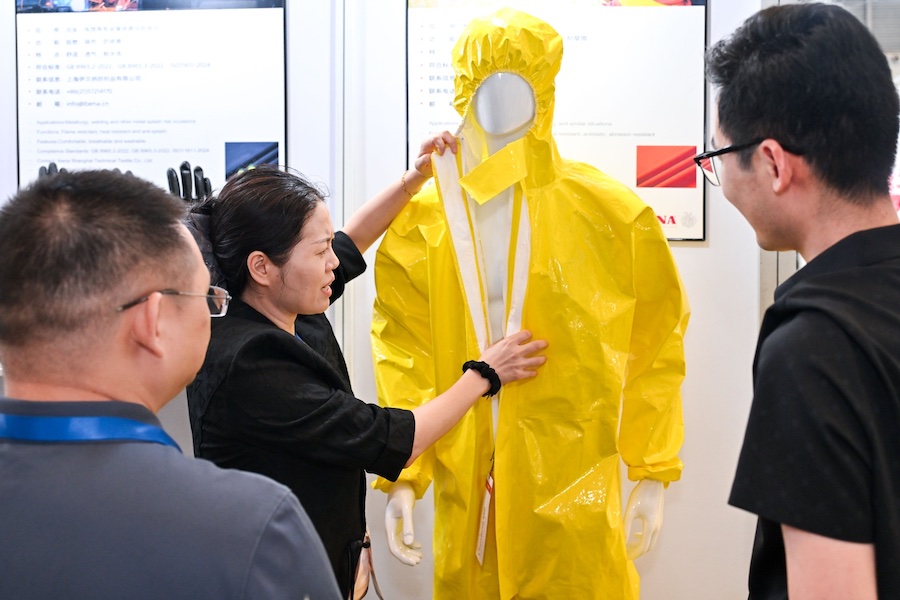
At around a third of all exhibitors, suppliers of functional apparel textiles, smart textiles and accessories, together with sports equipment, fashion items, outdoor clothing and protective workwear, make up the largest single group of exhibitors at Techtextil. At Techtextil 2019 they included, amongst others, companies such as Schoeller, Freudenberg, RUDOLF and Lenzing.
In addition to the extensive range of functional textiles, both visitors and exhibitors at Techtextil – like those at the parallel Texprocess – benefit from the numerous synergies offered by Techtextil, including, for instance, Neonyt, Messe Frankfurt’s global hub for fashionwear, sustainability and innovation at the Berlin Fashion Week (2 to 4 July 2019). In the run-up to the show, Andreas Dorner, Head of Sales for Europe and America at Lenzing, a long-standing exhibitor at Techtextil, observed: “We are seeing a definite increase in demand for our alternative ranges at Techtextil.”
The company has been producing cellulose fibres from wood for over 80 years, and supplies brands such as Levi’s, Asos, Esprit and H&M, where their fibres appear on the shelves in a variety of products, including sustainable T-shirts, skirts and trousers. Their fibres are to be found in, for example, collections from the outdoor brand Bleed, launched in 2009. Bleed will again be exhibiting at the up-coming Neonyt. In turn, Bleed weave on machines and plant produced by Techtextil exhibitor Lindauer Dornier GmbH from Lake Constance. The loom manufacturers, who enjoy a long-standing tradition in the industry, showcased, in Frankfurt, their latest solutions for the (energy)-efficient weaving of clothes, under the heading ‘The Green Machine’.
Attractive complementary programme
The Techtextil Forum, a new, open format for expert discussion accessible to all trade visitors free of charge, was very well received. The focus here in lectures and discussion sessions over the four days of the show was on topics such as sustainability, filtration, smart textiles, composites, textiles in urban contexts, digital transformation and worlds of work, not to mention textiles for medical applications. The Digital Textile Micro Factory is shared by both Techtextil and Texprocess, and, with its ‘Technical Line’, ‘Fashion Line’ and ‘3D Knitting Line’, offered, for the first time, three production lines. It, too, drew a lot of visitors. Again, the Micro Factory grew out of a collaborative venture between the German Institutes for Textile and Fibre Research in Denkendorf (DITF) and a total of 15 partners and sponsors.
Techtextil and Texprocess: an ideal combination
Held in parallel with Techtextil, Texprocess also continued to record positive development. With 317 exhibitors from 34 countries, the leading international trade fair for the processing of textiles and flexible materials drew 1.6 percent more exhibitors to Frankfurt than the previous edition (2017: 312 exhibitors from 36 countries). Altogether 26,400 visitors from 96 countries, including visitors from Techtextil, attended Texprocess (2017: 25,100 visitors from 109 countries). Together, the two shows welcomed 1,818 exhibitors from 59 countries (2017: 1,789 from 66 countries) and 47,000 visitors from 116 countries (2017: around 47,500 trade visitors from 116 countries).
Techtextil and Texprocess: new date for the diary
The next Techtextil and Texprocess will take place from 4 to 7 May 2021 in Frankfurt am Main.