[pageLogInLogOut]

#Sustainability

The Sustainable Apparel Coalition collaborates with The Industry We Want on purchasing practices metric calling on manufacturers to provide feedback on brand partners

The Sustainable Apparel Coalition (SAC), a non-profit organization that brings together around half of the apparel and footwear industry to enable positive social and environmental impact at scale, is collaborating with The Industry We Want (TIWW) on the second cycle of the purchasing practices metric, powered by the Better Buying Institute Partnership Index™ survey. The survey opens from October 3rd – October 31st, 2022 and is calling on manufacturers in the apparel sector to rate their brand partners’ purchasing practices.

Through this annual temperature check, the multi-stakeholder initiative The Industry We Want, in partnership with the Better Buying Institute, aims to collect data to help accelerate change in the garment and footwear industry. The findings will be presented at the OECD Forum on Due Diligence in the Garment and Footwear Sector in February 2023.

The Partnership Index™ survey

The Partnership Index™ survey provides a consistent way to measure the impact of brands’ purchasing practices on production and creates a space for meaningful, two-way dialogue on the topic. The more data collected each cycle, the more robust the industry score and the tracking of change across the industry will be. This allows all actors to hold themselves accountable and inspire progress at large.

“It’s our turn to raise our voices and share experiences as manufacturers to transform the industry. Take 10 minutes to fill out the partnership survey and save months of effort. Give a chance to the brands to evolve with our feedback,” Bulent Alkanli, Managing Director of Meta Sourcing.

The Industry We Want is now encouraging manufacturers in the apparel sector to have their say. Brands, retailers and other stakeholders are invited to share the survey with manufacturers. The survey is an anonymous questionnaire that consists of 15 questions and will take 5 – 10 minutes to fill in for each brand partner.

The information gained from the aggregated results will provide the industry with direct feedback from global suppliers on the state of purchasing practices. This will generate valuable insights that can be used to build better relationships between brands and suppliers, while also mapping what processes need to improve in the sector.

The findings will be aggregated and presented at the OECD Forum, in connection to critical developments since last year’s cycle. Further, the results will inform the purchasing practices metric on www.theindustrywewant.com, alongside wages and GHG emissions, and serve as a basis for a series of supplier seminars in the coming year.

“The survey gives suppliers the safe space to anonymously share feedback. This gives brands and retailers insights to act upon. They can start to find out how problems are occurring and work with suppliers to resolve them,” Leonie Barrie-Abraham, Vice President of Business Development at Better Buying.


Results 2021: The industry needs equal, long-term partnerships

Throughout its first cycle in October 2021, the Partnership Index survey received over 500 responses from suppliers in the garment- and footwear industry.

The first findings of the Index make it clear how much pressure suppliers are facing. Key findings show that brands are failing to provide suppliers with enough time, visibility, or fair financial practices and they do not seek suppliers’ ideas for product and process innovation.

The four most highly rated behaviours are communication, financial practices, the provision of visibility necessary to business operations and buyers doing their part to improve environmental performance and practices in the supply chain.

“BAM decided to share the survey with suppliers last year. We believe input & feedback from suppliers as well as action from brands is absolutely crucial to driving the system change this industry needs to see, and we intend to share the survey with suppliers again this year. The anonymous feedback we received highlighted issues that we’ve since begun to investigate further through follow up surveys and conversations with suppliers; the results of which will inform future strategies,” Merryn Chillcot, Sustainability & Technical Manager at BAM Bamboo Clothing.

According to the responses:

  • 56% of purchasing practices from brands were considered those of a true partner
  • 28% of brand behaviour aligned with that of a collaborator
  • 17% of practices were the behaviours of a detractor.

The percentage of Detractors are subtracted from the percentage of True Partners to calculate the company’s overall BBPI score, using a range of -100 to +100. The Industry We Want’s purchasing practices metric score for 2021 is 39.

Fair Wear and the Ethical Trading Initiative (ETI) were the first Multi-Stakeholder Initiatives to publicly disclose their full reports in an effort to increase commercial transparency in the sector. The data provided through the reports supports Fair Wear and ETI in their work on purchasing practices with their respective members.

The Industry We Want launched the drivers for change industry dashboard earlier this year, with the aim of measuring the garment and footwear industry’s progress on the wage gap, purchasing practices and GHG emissions.

As a strategic partner and lead on the direction of the environmental pillar of TIWW, the SAC works in partnership with Fair Wear and Ethical Trading Initiative to facilitate collective action across the industry toward a 45% greenhouse (GHG) reduction by 2030.

The SAC also coordinates with the Apparel Impact institute to measure yearly the GHG emissions for the industry at large. The partnership falls under TIWW and is geared towards ensuring dignity for workers, thriving businesses along the supply chain, and a positive impact on the planet.




More News from TEXDATA International

#Texprocess 2026

Texprocess 2026: Automation, digitalisation and AI redefine textile processing

Making investment decisions in textile processing has become significantly more demanding. Increasing energy costs, a shortage of skilled labour and ongoing geopolitical uncertainties are compelling companies to focus on technologies that deliver clear gains in efficiency and process reliability. This applies equally to apparel manufacturing and to the processing of technical textiles and high-performance materials. As a result, modernisation initiatives are assessed more carefully – even as the need to upgrade production systems continues to intensify.

#Techtextil 2026

Techtextil 2026: Between innovation pressure & market reality

From 21 to 24 April 2026, Techtextil in Frankfurt am Main will once again become the central meeting point for the international technical textiles and nonwovens industry. Running in parallel, Texprocess will focus on the industrial implementation of textile processing technologies as the leading platform in this field. Together, the two trade fairs form a closely integrated presentation and working platform along the entire textile value chain – from material development to finished applications.

#Techtextil 2026

Between geopolitical pressure and industrial resilience

In this interview, Dr. Janpeter Horn (VDMA) discusses the current challenges facing textile machinery manufacturers, shaped by geopolitical tensions, regulatory developments and subdued investment. He also outlines why innovation strength, integrated solutions and strategic positioning remain key to global competitiveness.

#Texprocess 2026

Between investment restraint and modernization pressure

Texprocess 2026 takes place in a complex market environment shaped by uncertainty and innovation pressure. In this interview, Elgar Straub (VDMA) explains why the trade fair is particularly relevant this year and which technologies are driving efficiency and competitiveness.

More News on Sustainability

#Sustainability

A new standard to combat plastic waste in forests

With DIN SPEC 35808 “Tree Shelter for Forestry Applications,” the testing and research service provider Hohenstein, in collaboration with Rottenburg University of Forestry, as well as forestry authorities and industry partners, has established a clear framework for bio-based and fully biodegradable tree shelters. The pre-standard defines requirements and practical testing methods designed to reduce plastic waste in forests and strengthen the long-term protection of soil and the environment.

#Denim

Denim moves towards sustainability

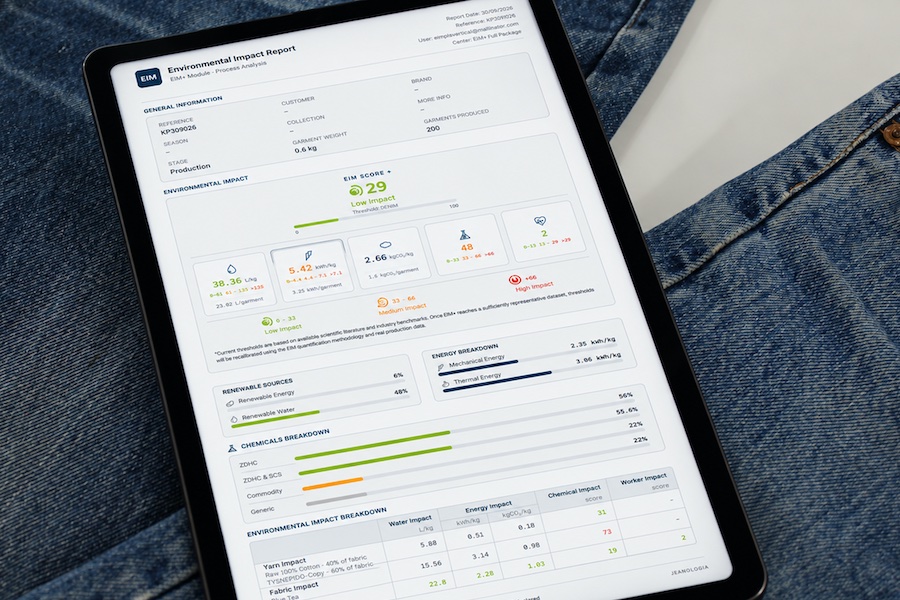
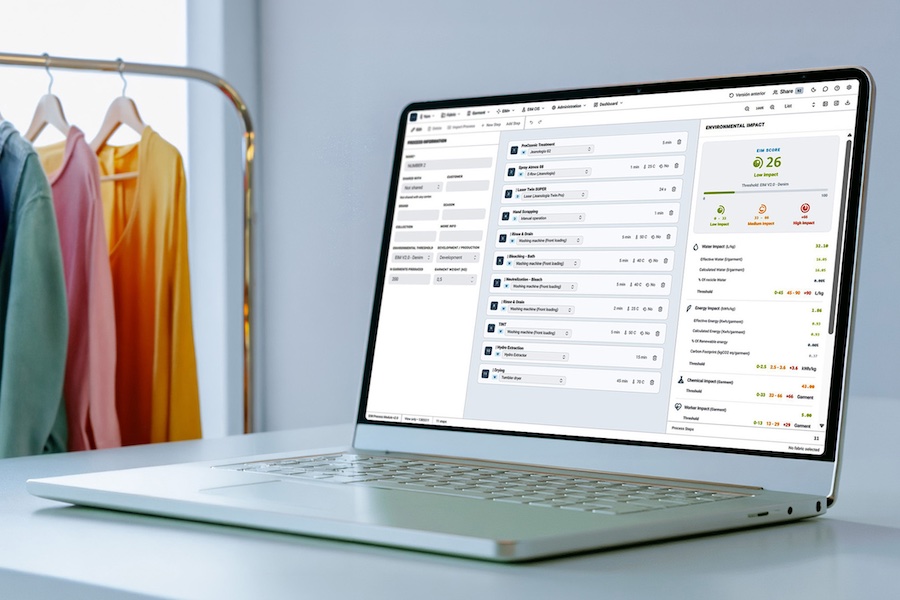
EIM (Environmental Impact Measurement), the global reference platform for measuring the environmental impact of garment finishing, presents the second edition of its annual report Denim Industry Progress & Insights 2025. The study analyses over 100,000 real denim finishing processes, providing an accurate and up-to-date view of the industry’s evolution towards more sustainable models.

#Recycling / Circular Economy

Europe’s textile future at a turning point: New 2030 Circularity Blueprint aims to scale recycling and unlock investment opportunities

The EU textile system is at a critical crossroads. Today, less than 1% of discarded garments are recycled into new garments, despite EU-wide obligations for separate collection. In response, Global Fashion Agenda (GFA) is launching the 2030 Circularity Blueprint, in partnership with ReHubs. This ambitious initiative is designed to support the transformation of the EU textile ecosystem to advance textile-to-textile recycling and drive the transition to a circular economy.

#Sustainability

Number of GOTS-certified facilities grow 15% globally as demand for credible sustainability standards continues to strengthen

Global Organic Textile Standard (GOTS) certification continued to grow in 2025, with nearly 18,000 certified facilities worldwide, despite ongoing geopolitical uncertainty and rapidly evolving regulatory requirements across global textile supply chains.

Latest News

#INDEX 2026

ANDRITZ at INDEX ’26: Driving sustainability with next-generation nonwoven technologies

From May 19-22, ANDRITZ Nonwoven & Textile is presenting its innovative solutions for the nonwoven & textile industry in Geneva, Switzerland. ANDRITZ will focus on technologies for sustainable and durable nonwovens, converting, sustainable fiber processes, textile recycling, and life-cycle services on booth 2114 in hall 02.

#INDEX 2026

INDEX™26: World’s leading nonwovens exhibition presents groundbreaking product launches, exclusive seminars and immersive experiences

From 19 to 22 May 2026, 620 exhibitors from 44 countries will gather in Geneva at Palexpo for INDEX™26. The exhibition aims to demonstrate how the future of technical materials will increasingly be shaped by collaborative supply chains and integrated innovation across the nonwovens industry. This year’s edition focuses not only on individual technological advances, but also on how cooperation throughout the value chain can enhance the performance, sustainability and value of nonwoven solutions.

#INDEX 2026

The LYCRA Company launches LYCRA® ADAPTIV fiber for nonwovens, advancing comfort and fit in disposable hygiene at INDEX™ 26

The LYCRA Company, a leader in innovative and sustainable fibers for apparel and personal care, today announced the official global launch of LYCRA® ADAPTIV fiber for nonwovens at INDEX™ 26, in Geneva, Switzerland, May 19–22. This breakthrough stretch fiber, already trusted by leading global apparel brands, now ushers in a new era of comfort, fit, and performance for baby diapers, disposable hygiene products, adult incontinence, and feminine care.

#INDEX 2026

Innovations for today – solutions for tomorrow: Trützschler Nonwovens at INDEX™ 2026

From 19 to 22 May, Trützschler Nonwovens will present itself at booth 1641 as a long-term partner to its customers. The focus will be on new products for all nonwoven processes, further developments of the digital working environment T‑ONE, and an expanded service portfolio.

TOP