[pageLogInLogOut]

#Yarn & Fiber

Textile Exchange report shows growth of preferred fiber and materials market needs to be accelerated

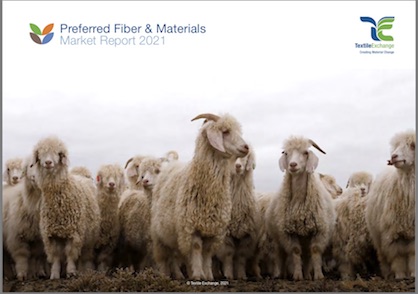
With post-pandemic fiber production increasing, the transition to preferred fibers and materials must be a non-negotiable decision, notes Textile Exchange. According to a new Textile Exchange report, the market share for preferred fiber and materials grew significantly in 2020. The Preferred Fiber and Materials Market Report 2021 outlines the market for plant fibers such as cotton, hemp, and linen; animal fibers and materials such as wool, mohair, cashmere, alpaca, down, silk, and leather; manmade cellulosics (MMCFs) such as viscose, lyocell, modal, acetate, and cupro; as well as synthetics such as polyester, polyamide, and more.

The report is a unique annual publication about global fiber and materials production, availability, and trends, including those associated with improved social and environmental impacts, referred to as ”preferred.” The comprehensive report includes quantitative data, industry updates, trend analysis and inspiring insights into the work of leading companies and organizations as they create material change. 

The results show that between 2019 and 2020 the market share of preferred cotton increased from 24 to 30 percent and recycled polyester from 13.7 to 14.7 percent. Preferred cashmere increased from 0.8 to 7 percent of all cashmere produced while Responsible Mohair Standard certified fiber expanded from 0 to 27 percent of all mohair produced worldwide in its first year of existence in 2020. The market share of FSC and/or PEFC certified MMCFs increased to approximately 55-60 percent. While the market share of recycled MMCFs is only 0.4 percent, it is expected to increase significantly in the following years. 

Brands’ increased interest in the use of preferred fibers and materials was also demonstrated by an impressive 75 percent increase in the total number of facilities (to 30,000) around the world becoming certified to the organization’s portfolio of standards in 2020. These standards include the Global Recycled Standard (GRS), Organic Content Standard (OCS), Recycled Claim Standard (RCS), Content Claim Standard (CCS), Responsible Down Standard (RDS), and Responsible Wool Standard (RWS), Responsible Alpaca Standard (RAS) and the Responsible Mohair Standard (RMS). In early 2021, Textile Exchange launched the Leather Impact Accelerator (LIA) to address the major sustainability challenges throughout the bovine leather supply chain from farm to finished leather, including an Impact Incentives program. 

However, the report also notes that despite the increase, preferred fibers only represent less than one-fifth of the global fiber market. Less than 0.5 percent of the global fiber market was from pre- and post-consumer recycled textiles. 

Indeed, global fiber production has almost doubled in the last 20 years from 58 million tonnes in 2000 to 109 million tonnes in 2020. While it is not yet clear how the pandemic and other factors will impact future development, global fiber production is expected to increase by another 34 percent to 146 million tonnes in 2030 if the industry builds back business as usual. If this growth continues, it will be increasingly difficult for the industry to meet science-based targets for climate and nature.

“Whether for current or post-pandemic business, the production and use of preferred fibers and materials must be a non-negotiable decision,” says La Rhea Pepper, Textile Exchange Founder and CEO. “Now is the time to accelerate a transition to increasingly sustainable practices to reduce conventional fiber and material production’s footprint on the planet.” 

Textile Exchange aims to be the driving force for urgent climate action, and its Climate+ strategy calling for the textile industry to reduce greenhouse gas emissions by 45 percent by 2030 compared to a 2019 baseline in the pre-spinning phase of textile fiber and materials production, while also addressing other impact areas interconnected with climate such as water, biodiversity, and soil health. 

“Increasing the uptake of preferred fibers and materials, proliferating regenerative practices, mitigating land-use change, supporting the transition to renewable energy, and encouraging innovation and circularity are known solutions towards Textile Exchange’s Climate+ goal,” says Liesl Truscott, Textile Exchange Corporate Benchmarking Director. “Acceleration of such solutions have to guide us in the next nine years that are so decisive for the future of our planet and all life on earth.” 

Textile Exchange encourages companies to commit to its 2025 Sustainable Cotton Challenge and/or 2025 Recycled Polyester Challenge which call for the apparel industry to commit to source all their cotton from the most sustainable sources and increase the amount of recycled polyester used from 14 to 45 percent (or 17.1 million metric tons), respectively, by 2025. 

Textile Exchange invites brands, retailers, manufacturers, and suppliers to track and benchmark their progress by participating in the annual Material Change Index (MCI) survey (open through September; email: CFMB@TextileExchange.org). 

Textile Exchange also invites participation in the organization’s 2021 Textile Sustainability Conference in Dublin, Ireland, November 15-19 including the preferred fiber and materials Round Tables Summits, held in conjunction with the event.
(c) 2021 Textile Exchange


https://textileexchange.org/wp-content/uploads/2021/08/Textile-Exchange_Preferred-Fiber-and-Materials-Market-Report_2021.pdf

More News from Textile Exchange

#Sustainability

Textile Exchange evolves its membership structure to unlock the next stage of collective action for climate and nature

Textile Exchange is excited to announce that it is evolving its membership structure to a more action-oriented, impact-driven model designed to provide clearly defined pathways that help organizations respond to the climate and nature crisis.

#Sustainability

Key takeaways from the 2025 Textile Exchange conference

Brands and retailers, suppliers, innovators, recyclers, farmers, non-profit organizations, and academics convened at Textile Exchange’s Annual Conference, held in the Lisbon Conference Centre.

#Sustainability

Textile Exchange announces the winners of the 2025 Climate and Nature Impact Awards

Textile Exchange is pleased to announce the winners of the 2025 Climate and Nature Impact Awards. These awards recognize individuals and partnerships making progress toward a regenerative and equitable raw materials economy.

#Sustainability

Textile Exchange Conference 2025: Setting the course for systemic change

The 2025 Textile Exchange Conference brought together more than 1,600 participants on site in Lisbon and online, marking two days of intense dialogue on the future of sustainable and regenerative material systems. With a focus on collaboration, data-driven progress, and systemic transformation, the sessions highlighted both the challenges and the opportunities in building a truly resilient textile industry.

More News on Yarn & Fiber

#Weaving

Vandewiele Group: Innovation across the textile value chain at ICFE Istanbul 2026

At the 2026 Istanbul Carpet & Flooring Expo (ICFE), Vandewiele Group presents its latest advancements spanning the entire textile value chain. From spinning and weaving to tufting, carpet manufacturing and digital finishing, the Group demonstrates how integrated innovation can boost performance, efficiency and sustainability across all stages of production. As a global technology leader, Vandewiele continues to develop solutions that strengthen processes, enhance product quality and enable smarter, greener manufacturing.

#Man-Made Fibers

Trevira CS® ignites Heimtextil 2026 with "WE CARE" campaign

Indorama Ventures, a global sustainable chemical company, announces its Trevira CS® brand’s powerful and socially responsible presentation at Heimtextil 2026 in Frankfurt, Germany, from January 13 to 16, 2026. The impactful theme of the show: “WE CARE.”

#Recycled_Fibers

CARBIOS and Wankai sign strategic PET biorecycling pact

CARBIOS (Euronext Growth Paris: ALCRB) and Wankai New Materials (“Wankai”), a listed subsidiary of Zhink Group, the 3rd largest PET producer in China and 4th worldwide, announce the signing of the definitive agreement establishing a strategic partnership for the industrial rollout of CARBIOS’s PET biorecycling technology in Asia. The first milestone will be the construction of a PET biorecycling plant in China.

#Yarn & Fiber

Fulgar voice at the Milan Fashion Institute

Daniela Antunes, Marketing Manager at Fulgar, participated as an expert speaker at the XVII edition of the Master in Brand & Product Management of the prestigious Milano Fashion Institute, which trains well-rounded professionals capable of managing both the creative and strategic-managerial aspects of the fashion & luxury sector.

Latest News

#Natural Fibers

38th International Cotton Conference Bremen: Let´s Talk about Cotton!

The 38th International Cotton Conference Bremen, to be held on 25-27 March 2026 in Bremen’s parliament building on market square, once again sends a powerful signal for professional excellence and international dialogue. The focus is on the latest market trends and technical innovations throughout the entire value chain – from agriculture and quality assurance to processing and the circular economy. With its high-calibre speakers, the conference remains an indispensable forum for anyone involved in shaping the cotton industry scientifically, technically, or economically.

#Recycled_Fibers

Leading fashion brands step up to unlock the next chapter of Circulose

Since 2024, under new ownership and leadership, Circulose has set a renewed strategic direction focused on securing long-term commitments with partner brands to bring CIRCULOSE® back to market at scale. This strategy has proven successful.

#Research & Development

More safety and comfort for protective clothing thanks to auxetic fabrics

When everyday materials are pulled, they stretch or elongate in the direction of the pull and become narrower in cross-section. We can also observe this property in two-dimensional textiles. Auxetic structures behave differently here. They have the striking property of not changing under tensile stress or even increasing their width or thickness. These properties are advantageous, for example, in protective textiles or textile filter media. The DITF are researching auxetic fabrics for various applications.

#Recycled_Fibers

Recycling mixed-fibre garments becomes a reality: RadiciGroup, The LYCRA Company and Triumph take circular fashion a step forward

The process, which is both economically and environmentally sustainable, has enabled the production of an underwear set made from 100% recycled nylon and LYCRA® fibre in a closed-loop system.

TOP