[pageLogInLogOut]

#Sustainability

Suominen is offering a wide range of sustainable nonwovens
(c) 2020 Suominen
Sustainability is a multidimensional issue, and different aspects of it are important to different customers. That is why Suominen has developed a wide offering of sustainable nonwovens that meet the different sustainability needs of their customers – and end users.

"Suominen’s vision is to be the frontrunner for nonwovens innovation and sustainability. We want to do our share in addressing the most topical global environmental concerns of our time, including scarcity of resources, climate change and marine plastic pollution. By constantly developing new and innovative solutions with a reduced environmental impact, we are able to provide a wide range of sustainable nonwovens for our customers", the company recently announced.

Innovation and sustainability are certainly nothing new for Suominen. Already ten years ago they launched the compostable and biodegradable BIOLACE® family of products produced solely from renewable raw materials. Since then, they have further developed and expanded their sustainable offering; the comprehensive Sustainable Product Portfolio was created in 2018.

Sustainability categories for Suominen’s nonwovens

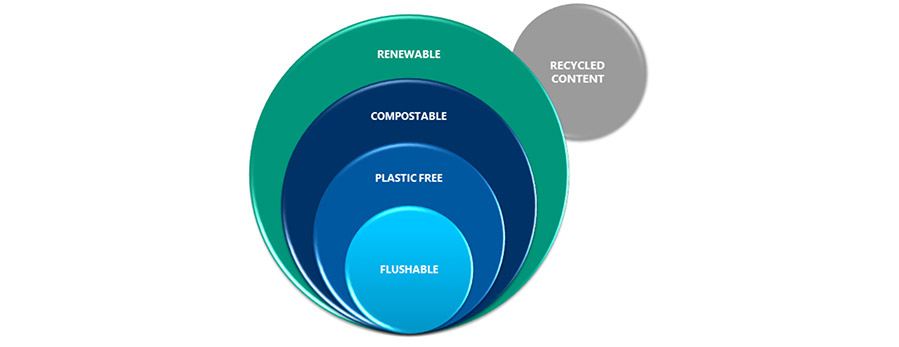
Suominen’s Sustainable Product Portfolio consists of products made from renewable, recycled and/or plastic-free raw materials as well as compostable and totally dispersible nonwovens. By offering solutions in these different sustainability categories, they can meet the varying sustainability-related needs of customers and end uses.


The sustainability categories

  • Recycled content means that the nonwoven contains at least 15% of recycled fibers, such as recycled post-consumer polyester, polypropylene or post-industrial cotton fibers.
  • Renewable means that all the raw materials used are from plant-based sources. We offer nonwovens made from a wide variety of renewable fibers, from biobased plastics to natural fibers.
  • Compostable nonwovens are produced by using fibers from renewable resources that are compostable in industrial composting process as defined by international compostability standards.
  • Plastic-free nonwovens contain raw materials made of biodegradable fibers of a natural origin, such as viscose, pulp and cotton.
  • Flushable products are biodegradable and dispersible in water and comply with or exceed the latest industry flushability standards.

"From our Sustainable Product Portfolio, our customers can choose the sustainability category that is most relevant to them and then decide which of the products in the category are most suitable for their end products. At the same time, we also have a number of sustainable nonwoven alternatives available for various end uses, including baby, household, hygiene, medical, personal care and workplace", the company announced.


More News from Suominen Corporation

#Nonwovens

Suominen AGM 2026: no dividend, Board composition confirmed, share buyback authorized

Suominen Corporation has held its Annual General Meeting (AGM) on April 15, 2026 as a remote meeting without a physical venue. The AGM adopted the Financial Statements for 2025 and discharged the members of the Board of Directors as well as the President and CEO from liability for the financial year. The AGM also approved the Remuneration Report for 2025 in line with the existing Remuneration Policy, with the resolution being advisory.

#Nonwovens

Change in Suominen Leadership Team: Minna Rouru to pursue new opportunities outside the company

Suominen Chief People and Communications Officer (CPCO) Minna Rouru has announced her decision to leave Suominen to take on a role in another company. She will leave Suominen at the latest on August 26, 2026. The CPCO succession process has been initiated and will be announced in due course.

#Nonwovens

Suominen launches three-year profitability improvement program and introduces new operating model and leadership team

Suominen is launching a three-year program to improve the company’s profitability. The Full Potential Program targets 10% EBITDA by 2028. Suominen is also introducing a new functional operating model, with a dedicated focus on customers and factories, designed to strengthen expertise and effectiveness.

#Nonwovens

Suominen reports weaker 2025 results amid market pressure and US supply incidents; no dividend proposed

Suominen Corporation has published its unaudited Financial Statements Release for January 1–December 31, 2025, describing the year as an “unsatisfactory performance in a challenging environment”. Net sales and profitability declined year-on-year, reflecting lower volumes, adverse currency effects and intensified competition, while the company points to two significant incidents at its US facilities that constrained supply and weighed on both sales and profitability in the third and fourth quarters.

More News on Sustainability

#Sustainability

Number of GOTS-certified facilities grow 15% globally as demand for credible sustainability standards continues to strengthen

Global Organic Textile Standard (GOTS) certification continued to grow in 2025, with nearly 18,000 certified facilities worldwide, despite ongoing geopolitical uncertainty and rapidly evolving regulatory requirements across global textile supply chains.

#Sustainability

bluesign technologies introduces bluepass

bluesign technologies ag (www.bluesign.com) today announces the launch of bluepass, a new certification mark and product labeling system created to deliver clear, substantiated, and verifiable sustainability claims at scale.

#Research & Development

Hohenstein publishes 2025 Sustainability Report

The testing and research service provider Hohenstein has published its latest sustainability report, outlining key progress and strategic initiatives. The report focuses on ambitious CO₂ reduction targets, the company’s new mission statement and the systematic expansion of sustainable services for customers worldwide.

#Natural Fibers

Global Standard gGmbH launches second public consultation for GRTS Draft 2 for the textile industry (1–30 April 2026)

Global Standard gGmbH is pleased to announce the release of Draft 2 of the Global Responsible Textile Standard (GRTS) for its second public consultation. The consultation will be open from 1 April 2026 to 30 April 2026, inviting stakeholders across the textile and apparel value chain to provide input and contribute to the further development of this new Standard.

Latest News

#Raw Materials

ECCO introduces first shoe featuring innovative protein-based fibre

ECCO, in partnership with Spinnova, announces the launch of the limited edition ECCO BIOM® 720, a first-of-its-kind shoe utilising an often overlooked leather by-product, transformed into a protein-based fibre. The fibres are produced using patented technology that advances material innovation while reducing waste and supporting full resource use across the leather and textile industry.

#Man-Made Fibers

The LYCRA Company strengthens sustainability leadership, appoints Alistair Williamson as VP of Product Sustainability

The LYCRA Company has appointed longtime executive Alistair Williamson as vice president of product sustainability, reaffirming its commitment to developing sustainable solutions for apparel and personal care products. In this role, he will guide the company’s next chapter of sustainability strategy and oversee all initiatives aimed at reducing environmental impact across products, operations, and innovation platforms.

#Raw Materials

Kraig Biocraft Laboratories reports major progress converting record-setting spider silk cocoon production into reeled silk

Kraig Biocraft Laboratories, Inc. (OTCQB: KBLB) (“the Company”, “Kraig Labs”, or “Kraig’s”), a world leader in spider silk technology*, today announced significant progress in the processing of its recently produced recombinant spider silk cocoons into reeled silk.

#Textile processing

trinamiX mobile NIR spectroscopy: New applications for the footwear and textile industry

trinamiX GmbH expands its solution portfolio for the circular economy, now enabling the identification of materials used in the footwear and textile industries. With its mobile near-infrared (NIR) spectroscopy solutions, trinamiX supports manufacturers, sorters, recyclers, and brand owners in reliably identifying materials and improving transparency across increasingly complex value chains.

TOP