[pageLogInLogOut]

#Spinning

The TC19i: A new benchmark for man-made fiber processing

Man-made fibers are durable, versatile and cost-effective. That’s why they have become indispensable in yarn production over the past decade and now account for more than 40 percent of staple fiber consumption. Truetzschler has supported this trend by developing highly specialized machines for man-made fibers that meet constantly rising expectations for quality and efficiency – and the TC 19i is now winning over customers worldwide.

The intelligent card TC 19i for man-made fibers was launched in 2019 and is now the international benchmark for man-made fiber processing. The results from major textile markets across Asia, Europe and the Middle East speak for themselves: customers were able to increase productivity by between 20 and 100 percent, while also improving quality (IPI) by between 20 and 55 percent.

Turning skeptics into believers

Acarsoy Tekstil, a leading yarn manufacturer based in the Bursa province of Turkey, is a strong example of what can be achieved with the TC 19i for man-made fibers. The company has a daily production capacity of 65 tons of yarn across two production facilities, and manufactures a broad portfolio of cotton, linen, polyester, viscose, modal and lyocell yarns. Its processes include ring, compact, air jet, open end, core spun and siro spun technologies. Experts at Acarsoy Tekstil were initially skeptical when Truetzschler TC 19i cards were installed in the second air jet line for 100-percent viscose yarn (Ne 20 to 28). General manager Bülent De?irmencio?lu, as well as his team of operations and maintenance managers, were unsure whether the required level of quality could be maintained when the TC 19i operated at such high speed. However, they were able to produce 60 percent faster with the TC 19i, and clearer cut numbers were 50 percent lower than the first line. In light of these impressive results, Acarsoy is now considering modernizing its other machines too.

Major improvements across all man-made fiber applications 

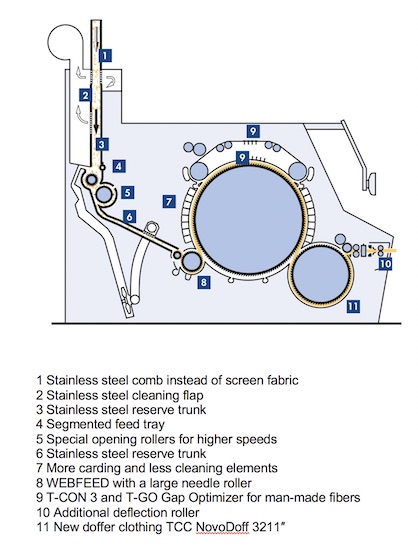
Every single one of the manufacturers that tested the TC 19i for man-made fibers has been able to increase productivity and reduce yarn imperfections compared to predecessor machines. Of course, individual results vary depending on the customer’s specific application, raw material and process – but the TC 19i achieved success every time. This success is largely made possible by the T-GO gap optimizer, which has been specifically adapted to meet the requirements of man-made fiber applications.
(c) 2020 Truetzschler


“For cotton processing, a very narrow carding gap is often advantageous for the carding result – but this doesn’t apply to man-made fibers” says Christoph Leinders, who was responsible for the design of the TC 19i. “Our T-GO gap optimizer uses advanced, intelligent sensor technology to make sure the machine always maintains the best possible carding gap for the man-made fiber material, blend or application that is being processed. This gives the TC 19i a big advantage over machines from our competitors. We always know the exact carding gap and can adjust it during production using algorithms that we specifically developed for man-made fibers. This means changing environmental conditions or differences in the skill level of the individual operator no longer affect the carding gap setting – so quality levels remain constant.” The T-GO gap optimizer for man-made fibers is as easy to operate as its counterpart for cotton. Only a few clicks on the display are required, and there’s no need for time-consuming flat setting work after each maintenance or re-clothing.
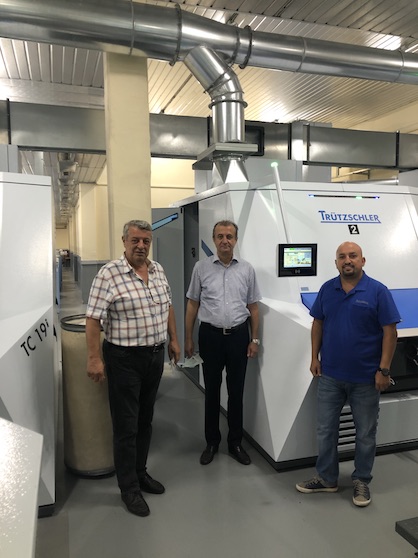


“Cards are the beating heart of the spinning mill,” says Bülent De?irmencio?lu (pictured in the middle). “We know we’ve made the right choice with the TC 19i for man-made fibers because it’s taking our superior quality to the next level – while also cutting waste, reducing energy consumption and saving labor costs.” (c) 2020 Truetzschler


A winning combination of new and proven features

The excellent performance of the TC 19i for man-made fibers is made possible by several new and proven features. The doffer clothing NovoDoff 32, for example, has been specifically developed for man-made fibers by Truetzschler Card Clothing, a subsidiary of Truetzschler that is located in the Black Forest region of Germany. Its engineers invented a new process technology that makes the clothing even more robust and durable, and further improves quality while reducing maintenance requirements. Of course, the new card retains the outstanding features that have proven their performance in man-made fiber applications over many years. All metal sheets in the tuft feeder and the transfer section to the card are made of stainless steel to ensure an optimal flow of man-made fibers. All covering elements for the cylinder and doffer are made of high-precision, eloxated aluminum. A stainless-steel sliver coil tube and coiler plate ensures gentle sliver guidance during sliver coiling. And the pre-opener system of the TC 19i features one large roll with a special needling and surface treatment. This makes it possible to reduce yarn imperfections (IPI) by up to 30 percent compared to rolls with conventional wires, while the average lifetime of the needle roll is twenty times longer than a conventional roll. As man-made fibers gain importance for yarn production, the TC 19i is a powerful new card that delivers valuable performance across a wide range of applications. Customers at spinning mills around the world are taking advantage of this new benchmark for man-made fiber processing – and moving ahead of their competitors by increasing productivity, efficiency and quality.
More News from Truetzschler GmbH & Co. KG

#Spinning

Perfect quality through collaboration: Machinery from Trützschler, Toyota and Murata at Zirve Tekstil

In today’s textile industry, excellence is not achieved by chance – it’s the result of deliberate decisions, technical expertise, and the courage to go beyond conventional paths. The Turkish company Zirve Tekstil has done just that: by combining the best technologies from Trützschler, Toyota and Murata, they’ve created a production setup that delivers outstanding yarn quality – recognized worldwide.

#Spinning

Details matter: How Trützschler cylinder wires boost efficiency in Pakistan’s spinning sector

Pakistan’s textile industry, especially its spinning sector, is the backbone of the national economy and a vibrant hub of innovation. Today’s spinning mills face growing demands for efficiency, quality, and sustainability. From the serene northern valleys to the vibrant port city of Karachi in the south, mills like Suraj Cotton Mills, Liberty, and Nishat Chunian are turning to advanced solutions.

#ITMA Asia + CITME Singapore 2025

T-CAN – Revolutionizing can transport

In virtually all spinning mills, transporting sliver cans is still done manually. Rising labor costs, lack of operators and increasing quality requirements make this a growing challenge. With T-CAN, Trützschler introduces a practical solution: a fully automated can transport system that will be presented live at ITMA ASIA 2025 in Singapore.

#Spinning

Pre-Cleaner CL-X: The future of cotton cleaning

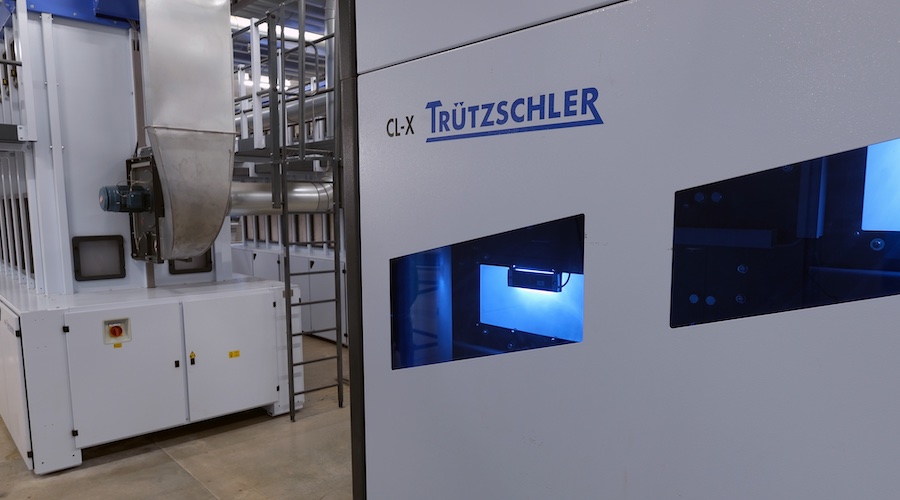
What if the future of cotton cleaning was already here – setting a new standard for cleaning efficiency, productivity and energy savings? That future has a name: CL-X. Since its market launch in 2022, the Pre-Cleaner CL-X has become a true bestseller, proving its value in several hundred customer applications worldwide. Now, new results from Türkiye demonstrate again how the Pre-Cleaner CL-X outperforms the competition.

More News on Spinning

#Spinning

A breakthrough innovation for diaper manufacturers

Developed and manufactured by Mesdan, Italy, the Loop knotter type 093E is a special version of the well-known Loop knotter, specifically designed to join hygiene-grade spandex yarns used in the personal care industry.

#Spinning

Rieter responds to higher raw material prices

Global political and economic developments have been leading to rising raw material and energy costs for some time. The textile machinery industry is also affected by this trend. Rieter machines and components consist to a large extent of steel, copper, aluminum and electronics. These materials in particular have seen higher demand and higher prices in recent months.

#ITM 2026

The hub of smart and sustainable transformation in yarn technologies: ITM 2026

With global fiber production projected to reach 169 million tons by 2030, yarn manufacturing is becoming one of the most strategic fields within the textile machinery industry. Located in Halls 6, 7, and 10, the Yarn Hall at ITM 2026 is set to bring together industry professionals with innovative solutions developed around automation, energy efficiency, digitalization, and circular production.

#Spinning

Barmag: DTY efficiency for the future of fancy yarns

Fancy yarns continue to gain importance in the textile market: Whether in fashion, home textiles or the automotive industry - the trend towards individuality is fueling the demand for textured, haptically differentiated and at the same time comfortable yarns.”

Latest News

#Raw Materials

Esquel Group adds two new extra-long staple cotton varieties approved

Esquel Group’s Xinjiang Research & Development Center has successfully developed two new Sea Island cotton (Extra-Long-Staple cotton, ELS cotton) varieties named “Yuan Loong 37” and “Yuan Loong 42,” which have been officially approved and granted registration numbers. Both varieties have also obtained Plant Variety Rights certificates, marking another significant breakthrough for the Group in cotton breeding and commercial application.

#Weaving

Itema America acquires Palmetto Loom Reed, strengthening local manufacturing and service in the U.S.

Itema America, the U.S. subsidiary of Italy-based Itema Group, has acquired – through an Assets Purchase Agreement – Palmetto Loom Reed, a Greenville, South Carolina-based manufacturer of weaving reeds and one of the last remaining domestic producers of these precision components in the United States.

#Recycled_Fibers

Reju announces site selection for French Regeneration Hub in Lacq advancing Europe’s circular textile infrastructure

Reju, the textile-to-textile regeneration company based in France, announces the site selection for an industrial sized Regeneration Hub, in Lacq, in the Pyrénées-Atlantiques, on the Induslacq platform. Reju, a Technip Energies owned company, is deepening its roots in France through the development of this new Regeneration Hub.

#Functional Fabrics

lululemon introduces Unrestricted Power™ — A new sensation for strength training

lululemon (NASDAQ: LULU) has unveiled Unrestricted Power™, a new innovation platform engineered for heavy lifts and demanding gym sessions. The assortment, which launches in North America, is backed by thousands of hours of research and development, providing secure support without compromising comfort and mobility, enabling a distraction-free fit built to match every move.

TOP