[pageLogInLogOut]

#Spinning

MillMaster Labtrend Simple control of wear and tear
Components & wear and tear parts © 2020 Loepfe
With its “Lab Trend”, MillMaster TOP offers a comprehensive analysis tool for determining deviating yarn properties and their causes.

Deviations in the yarn quality produced may result from the following factors:

  • Raw material change
  • Settings change
  • Wear and tear
  • Dirt
  • Climate changes

The following examples outline how the maintenance interval for wear parts can be planned and the correct selection of components can be made.

Figure 1 shows repeated IPI peaks in the range of 2 - 4 cm IPI Thick. This yarn’s irregularity pattern suggests increased wear and tear of the top roller surface due to e.g. constant friction or small grooves along the roller eventually affecting its surface structure. This is a slow, ongoing wear and tear process, which can easily be tracked with the help of “Lab Trend” in MillMaster TOP. The more the top rollers are suffering wear and tear, the more 2 - 4 cm IPI irregularities there will be in the yarn structure. Once there is an excessive increase in IPI values, it is time to take appropriate action.

MillMaster TOP not only helps in identifying wear and tear but also helps towards the selection of the right machinery components, e.g. to determine the optimal cradle spacer for the top roller.
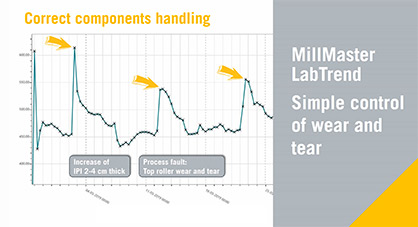
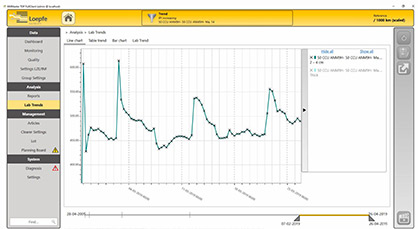
MillMaster LabTrend wear and tear © 2020 Loepfe


Figure 1: Graphic representation © 2020 Loepfe


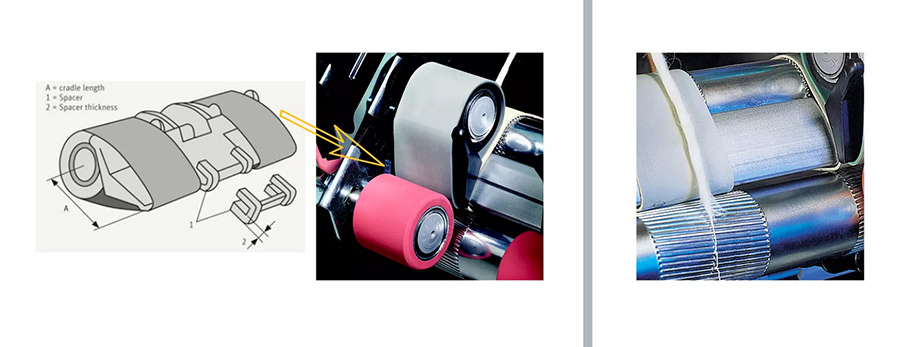
The cradle spacer is used to optimize the main drafting zone of each ring spinning position. The selection of the right cradle spacer sometimes requires a few iterations until the optimum is found.

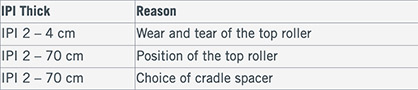
MillMaster TOP’s “Lab Trend” can easily visualize the influence of the used cradle spacer type and in due course contribute to achieving an optimum. This is done in real time by evaluation of 2 - 70 cm IPI Thick events, whereas the different sizes of the cradle spacers directly influence the number of these undesired thick places.

Likewise bottom apron types of various suppliers can be compared in terms of the resulting yarn quality.

Also here “Lab Trend” can easily show how different condition or quality of bottom apron types might affect the yarn irregularity and help finding the best-suitable option.

Solutions & benefits:

MillMaster TOP “LabTrend” significantly helps to identify the reasons for quality deviations and their causes without much effort. Following table provides a brief overview of the IPI influencing factors mentioned in above outlined examples.

MillMaster TOP "LabTrend" not only allows comprehensive monitoring and evaluation of the yarn quality, but also supports maintenance planning, monitoring of the machine settings and the selection of the best-suitable machine accessories.

More News from LOEPFE BROTHERS LTD.

More News on Spinning

#ITM 2026

EVENEXT & BURSTMATIC II to headline Mesdan S.p.A. presentation at ITM 2026

MESDAN S.p.A. will once again participate in ITM 2026, Turkey’s most important textile trade fair. The Italy-based leading manufacturer of yarn joining solutions and textile testing equipment,will be exhibiting at the booth of their local agent for the spinning, SARTEKS MAKINA at Hall 7, Stand 701A.

#ITM 2026

BB Engineering unveils new, patented “Val-uePack” spin pack at ITM

At the upcoming ITM in Istanbul, taking place June 9–13 at the Tüyap Fair Convention and Congress Center in Hall 7, Booth 702B, BB Engineering will once again be represented at a joint booth with its parent company, Barmag, and its representative, Tekstil Servis. The German machine manufacturer will show-case its expertise in man-made fiber and recycling technology, presenting its entire product portfolio, which includes compo-nents such as extruders and filters, as well as complete sys-tems for spinning synthetic fibers, air-texturing, and PET recy-cling.

#Spinning

Specialist in fine counts: New type 2777 ceramic oiler

With the new Type 2777 ceramic oiler, Barmag has added a solution for fine titers and microfilaments to its portfolio of original parts.

#Techtextil 2026

FET’s revolutionary gel spinning system wins Techtextil Innovation Award

FET has received the prestigious Techtextil Innovation Award 2026 in the New Production Technology category. The Techtextil Innovation Award honours outstanding ideas in textile technology, sustainability, AI and the creation of technical textiles, selected by an international jury of experts. Ranging from new materials to new production technologies, this award recognises progressive ideas that are driving forces for numerous industries, such as automotive, medical and construction.

Latest News

#INDEX 2026

“We clearly see that reliability, flexibility, service and total cost of ownership are becoming increasingly important again.”

The nonwovens industry continues to face a challenging market environment. Nevertheless, AUTEFA Solutions reports successful projects, new line sales and growing demand for energy-efficient and flexible solutions. In this interview, André Imhof of AUTEFA Solutions talks about competitiveness against Chinese suppliers, new service and recycling concepts, the growing importance of application development and the opportunities created by countercyclical investments.

#INDEX 2026

“Needle punching technology is more universal and sustainable than ever!”

Needle punching technology was long regarded as a rather traditional and comparatively slow technology within the nonwovens industry. In this interview, Johann Philipp Dilo explains why needle punching is more relevant than ever today – ranging from energy efficiency and resource conservation to hygiene applications, new machine concepts and design-oriented nonwoven solutions.

#Research & Development

Textile climate control system in workwear – exhibition at the 2026 SME Innovation Day!

Conventional protective workwear often reaches its limits during strenuous physical activity. In particular, the transport of sweat and excess body heat poses a problem. The German Institutes of Textile and Fiber Research (DITF) conducted research on flow-optimized, air-conducting textile structures that enable targeted climate control directly on the body. These structures can be integrated straight into protective work garments. The textile climate control system supports the body’s natural thermoregulation. This contributes to improved workplace safety and comfort.

#Nonwovens

PET spunbond from China – EDANA welcomes imposition of provisional anti-dumping measures

On 13 May 2026, after eight months of investigation, the European Commission imposed provisional anti-dumping duties of 45.6-50.0% on imports of PET spunbond from China. EDANA welcomes this expression of the Commission’s clear determination to protect EU industries from the unfair trade practices of Chinese producers.

TOP