[pageLogInLogOut]

#Spinning

Lucrative automation for sewing thread producers

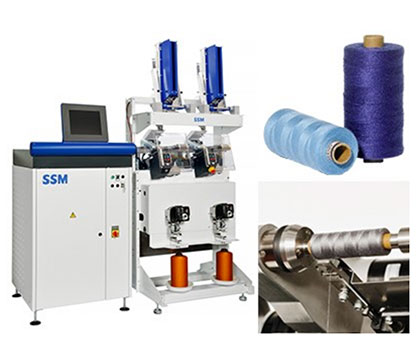
For the most part, sewing thread producers still rely on machines on which the tubes must be changed manually. This means that, in the sewing thread sector in particular, both productivity and profit can be increased by using semi-automated sewing thread finish winders from SSM. The story of an Asian sewing thread producer that switched from manual tube changing to the semi-automated SSM TK2-20-TT clearly shows how fast this innovation pays for itself and how the company is benefitting in the long term.

Until now, searching for fully automatic finish winders for sewing thread on the market has proved futile. The variety of yarns to be processed is too large and there are too many different tube dimensions and applications: This makes it impossible to produce a standardized design for a fully automatic machine, meaning that an extremely costly custom machine would be the customer’s only option. But this does not mean that machines on which the tubes are changed manually are the best solution in the sewing thread sector.

Sewing thread producers still use many older machines that require a lot of manual intervention because these machines are primarily what a large proportion of winding machine manufacturers offer. A few manufacturers do produce semi-automated machines as well, but only SSM finish winders offer reliable, efficiency-boosting functions such as length measurement, tuck-in, automatic changing of full packages, and package winding. This is crucial because with sewing thread, the decisive factors are above all its appearance, the winding, and the unwinding characteristics of the sewing thread package in the subsequent process. The machines in the SSM TK2-20 series are real profit makers in this regard. They are proven to be a reliable piece of equipment for meeting the high requirements of SSM customers in the sewing thread industry.

For these reasons, an Asian sewing thread producer decided to replace its “manual machines” with a 284-spindle SSM TK2-20-TT. This enabled the company to increase its production capacity by 100 tons per month to reach its target of 300 tons per month. And that’s not all: At the same time, it was possible to reduce the number of production spindles required by 50 spindles and reduce the number of personnel needed to operate the entire system by around 60%. The labor costs alone could be decreased by around CHF 30 000 per year thanks to the investment – which is especially impressive since the company is in a newly industrialized country.

(c) 2020 SSM
(c) 2020 SSM


As the machines had already paid for themselves after just 14 months, the customer is earning an extra CHF 150 000 per year thanks to the very precise length measurement and the lower power consumption of the entire TK2-20-TT system.
More News from SSM Schärer Schweiter Mettler AG

More News on Spinning

Latest News

#Dyeing, Drying, Finishing

Orthopac RVMC-20 plus: German Engineering for Smarter Weft Straightening

In times of rising cost pressure and growing quality demands, textile producers worldwide are searching for solutions that combine precision, efficiency, and sustainability. With its latest innovation, the Orthopac RVMC-20 plus, Mahlo once again demonstrates the strength of German engineering: improving proven technology to meet today’s challenges.

#Knitting & Hosiery

KARL MAYER and Lenzing partner to advance warp knitting with scalable cellulose fiber solutions

The Lenzing Group, a leading supplier of regenerated cellulosic fibers for the textile and nonwovens industries, together with KARL MAYER, the global market leader in warp knitting machines and warp preparation systems, debut a joint innovation project during Premiere Vision, Paris.

#Textile chemistry

RUDOLF gets the exclusive global distribution rights for Sanitized® textile technologies

With effect from today, RUDOLF officially assumes exclusive global distribution rights for Sanitized® textile technologies from SANITIZED AG. This is the next milestone in the strategic collaboration announced in 2025, with the partnership between the two companies now fully implemented and expanded worldwide.

#Europe

ICAC to support European Commission on pending PEF legislation

The International Cotton Advisory Committee (ICAC) is proud to announce that it has been included as a member of the European Commission’s Technical Advisory Board (TAB) on the Product Environmental Footprint methodology. The Commission developed the Product Environmental Footprint (PEF) to assess and communicate the life cycle environmental performance of products and organizations.

TOP