[pageLogInLogOut]

#Recycling / Circular Economy

First automated textile waste sorting and recycling line in France inaugurated
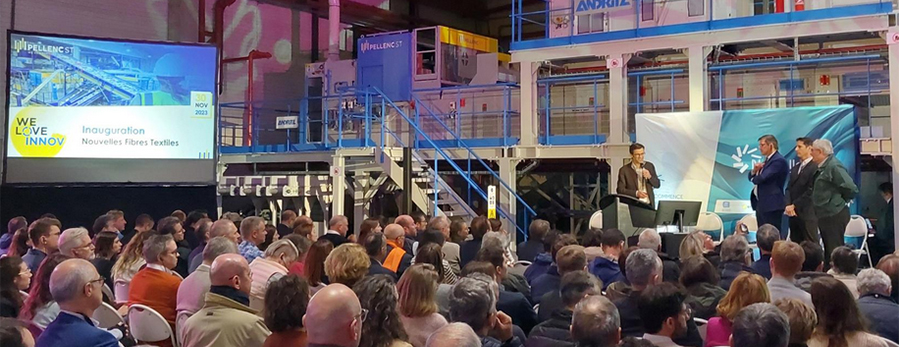
Inauguration of automated textile waste sorting and recycling plant at Nouvelles Fibres Textiles © ANDRITZ
Partnership between Nouvelles Fibres Textiles, Pellenc ST and ANDRITZ promotes circular economy for textiles.

France’s first industrial plant for automated sorting and recycling of textile waste was officially inaugurated at Nouvelles Fibres Textiles, Amplepuis, on November 30, 2023. The plant is the result of an ambitious partnership between textile recycling company Nouvelles Fibres Textiles, waste sorting specialist Pellenc ST and international technology group ANDRITZ, a specialist in textile recycling machinery and processes.

This partnership is a clear contribution to tackling the challenge of textile waste in the EU. The EU's strategy for sustainable and circular textiles aims to ensure that by 2030 textile products are made to a great extent of recycled fibers and incineration and landfilling of textiles are minimized.

Capable of automatically sorting garments by composition and color, the new line meets the needs of both post-consumer and post-industrial waste markets. The line also removes hard parts such as buttons and zippers to prepare the material for further processing in an ANDRITZ tearing machine.

The automated textile sorting line at Nouvelles Fibres Textiles is dedicated to industrial-scale production, customer trials and projects, and the R&D activities of the partners. It will process textile waste to produce recycled fibers for the spinning, nonwovens, and composites industries.

Automated sorting was the last missing link needed to develop a complete ecosystem in France, where the fashion industry, social and solidarity economy actors, waste management companies, and textile producers from different sectors are working together towards a textile circular economy.


Eric Boel, General Manager, Nouvelles Fibres Textiles: “The opening of the new line marks a milestone in our efforts to turn textile waste into resources. And we are already laying the foundations for a second material preparation plant with a capacity to process 25,000 tons of post-consumer textiles per year.”

Alexandre Butte, General Manager, ANDRITZ Laroche: “We are proud to be part of the sustainable transformation. With our technologies and our close partnership with Nouvelles Fibres Textiles and Pellenc ST, ANDRITZ is making a significant contribution to a circular economy for textiles.”



More News from Andritz Küsters GmbH

More News on Recycling / Circular Economy

#Recycling / Circular Economy

Solving the Feedstock Gap: Unlocking Post-consumer Feedstocks for Textile-to-Textile Recycling in Europe

Fashion for Good launches Project FAE (Feedstock Activation Europe) to develop the sorting and pre-processing infrastructure needed to channel non-rewearable post-consumer textiles into textile-to-textile (T2T) recycling at scale. The project is a practical response to one of the most pressing problems in textile circularity: making post-consumer waste a viable, commercially competitive raw material for recyclers.

#Techtextil 2026

BASF at Techtextil 2026: Helping to shape the future of the textile industry with tangible solutions

At the leading international trade fair for technical textiles and nonwovens from April 21 to 24, 2026 at the Messe Frankfurt, BASF will present numerous solutions and new projects in the textile sector to customers and partners at booth B 68 in hall 11.0. The focus is on product innovations and future-oriented technologies.

#Recycled Fibers

RE&UP partners with Madewell and ISKO on textile-to-textile denim capsule

RE&UP Recycling Technologies is accelerating the shift toward a closed-loop textile economy through a collaboration with American denim brand Madewell and global fabric manufacturer ISKO. By transforming approximately 20,000 pairs of post-consumer jeans into recycled feedstock for a textile-to-textile denim capsule, RE&UP demonstrates the commercial viability of circular systems in the denim sector.

#Recycled Fibers

Syre and JEPLAN Announce Strategic Partnership to Accelerate Textile-to-Textile Recycling

JEPLAN, INC. the Japanese pioneer developing and operating chemical recycling technologies for circularity in packaging and textiles, and Syre, the textile impact company on a mission to hyperscale textile-to-textile recycling, announced today a strategic partnership. Together, the companies aim to extensively accelerate the timeline towards commercialization of next generation textile-to-textile polyester recycling technology.

Latest News

#Heimtextil 2027

Heimtextil celebrates Milan Design Week honoring partnerships with Patricia Urquiola and Alcova Milano

Heimtextil is represented at Milan Design Week with its strong design partners Patricia Urquiola and Alcova. At Villa Pestarini, the leading trade fair spotlighted its dynamic collaborations with acclaimed designer Patricia Urquiola and Alcova Milano.

#Texprocess 2026

Kornit Digital expands digital production into footwear and technical textiles with Presto MAX PLUS

Kornit Digital (NASDAQ: KRNT) (“Kornit” or the “Company”), a global pioneer in sustainable, on-demand digital fashion and textile production, today unveiled the Kornit Presto MAX PLUS, a new roll-to-roll system expanding digital manufacturing into footwear, automotive interiors, military camouflage, high-performance sportswear, and high-end furnishings. Debuting at Texprocess 2026 in Frankfurt, Presto MAX PLUS enables entirely new applications for on-demand textile production.

#Textile processing

NATULON® zipper series surpasses 50% of YKK’s global zipper sales

YKK Corporation (Headquarters: Chiyoda-ku, Tokyo; President: Koichi Matsushima; hereafter, YKK) announces that the global sales share of its NATULON® zipper series—zippers that incorporate recycled materials—has exceeded 50%.

#Smart Textiles

Covestro, FILK Freiberg, and OUT e.V. develop flexible, conductive polymer smart textile system

As the smart textiles market continues to grow across healthcare, personal protection, sportswear, and automotive applications, developers are seeking new ways to integrate electronic functionality directly into textiles, without the rigidity and complexity of conventional wiring. To address this challenge, FILK Freiberg Institute, an independent research institution with expertise in polymer coatings for textile applications, collaborated with Optotransmitter-Umweltschutz-Technologie (OUT) e.V. The joint project, funded under the German Industrielle Gemeinschaftsforschung (IGF) program of the Bundesministerium für Wirtschaft und Energie (BMWE), focused on developing flexible, conductive polymer surfaces for next-generation smart textiles.

TOP