[pageLogInLogOut]

#Recycling / Circular Economy

Plastic Energy announces final investment decision and start of construction works for advanced recycling plant in France

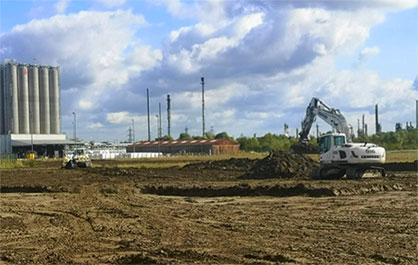
Plastic Energy has today announced the final investment decision and start of construction for its advanced recycling plant in northern France. The large-scale recycling plant will have a capacity of 25,000 tonnes of plastic waste per annum, with plans to scale-up to 33,000 tonnes in the near future, and will be adjacent to ExxonMobil’s Notre Dame de Gravenchon petrochemical complex.


  • FID for advanced recycling project near Le Havre, France, has been reached after announcement of initial collaboration agreement with ExxonMobil in March 2021
  • Civil works have begun on the large-scale 25,000 tonne/annum recycling plant for end-of-life plastics, with start-up anticipated for 2023
  • Plans were finalised after the project was awarded the necessary environmental permits to begin construction in July


The announcement of the FID and start of civil works comes after the granting of environmental permits for the project in July of 2021. These permits ensure that the Plastic Energy plant will abide by all European environmental regulations from construction to continuous operation.

Earlier this year, Plastic Energy signed an offtake collaboration agreement with ExxonMobil. As per the agreement, TACOIL (or recycled oils) from this Plastic Energy plant will be used by ExxonMobil to create virgin-quality certified circular polymers and other high-value products. Start-up of the advanced recycling plant is anticipated in 2023.

Plastic Energy is a global leader in advanced recycling, specialising in recycling end-of-life plastics that would otherwise be destined for landfill, incineration or end up in the environment. The company’s patented, innovative technology transforms plastic waste into raw materials that can be used as a substitute for fossil oils in the manufacturing of virgin- quality food-grade packaging.


“We are excited to announce that construction is going ahead for our large-scale advanced recycling plant in France, which will recycle mixed post-consumer plastic waste,” said Carlos Monreal, Founder and CEO of Plastic Energy. “Through our collaboration with ExxonMobil, we are working towards making plastics more sustainable for the future.”
© 2021  Exxon Mobil
© 2021 Exxon Mobil


“ExxonMobil is investing in projects around the world that help society address the challenge of plastic waste in the environment,” said Loic Vivier, senior vice president of Performance Derivatives, ExxonMobil Chemical Company. “With the addition of well- designed policies and collaboration across industries, the advanced recycling opportunities we are evaluating and executing have the potential for large-scale, game-changing improvements to the circularity of plastic products.”

The construction of this plant will benefit the circular economy in France by diverting plastic waste from linear treatments, and reducing both plastic waste in the environment, and the depletion of natural resources.

This project has received financial support from the French government as part of their Plan de Relance and Regional Planning Grant Scheme.




More News from TEXDATA International

#Recycling / Circular Economy

textile.4U publishes special edition “Top 100 Textile Recycling Companies 2025”

With a comprehensive 176-page special edition, textile.4U is dedicating its latest issue entirely to one of the most dynamic and influential topics in today’s textile industry: textile recycling. The new issue, published exclusively in high-quality print, presents the Top 100 textile recycling companies researched and selected by TexData – organizations that already play a key role in the transition to circular textiles or are expected to have a significant impact in the near future.

#Recycling / Circular Economy

Responsible Textile Recovery Act of 2024 signed by Governor

Senator Josh Newman (D-Fullerton) is proud to announce that Senate Bill 707 (SB 707), the Responsible Textile Recovery Act of 2024, has been signed into law by the Governor of California, Gavin Newsom. This groundbreaking legislation establishes the country’s first Extended Producer Responsibility (EPR) textile recycling program, marking a significant step forward in the state’s efforts to combat waste and promote sustainability.

#Textiles & Apparel / Garment

Modtissimo promotes sustainability with 28 coordinates in the Green Circle

Modtissimo is proving more and more to be a textile and clothing show that delivers the latest innovations in the area of sustainability, with the iTechStyle Green Circle being the main showcase for companies' creations. In this 60+4 edition, taking place on 12 and 13 September, 28 coordinates will be exhibited in a section organised by CITEVE and curated by Paulo Gomes.

#Europe

The EU and Egypt team up to mobilise private sector investments at Investment Conference and sign a Memorandum of Understanding underpinning €1 billion in macro-financial assistance for Egypt

At the EU-Egypt Investment Conference, co-organised by the EU and the Government of Egypt on 29-30 June, the EU and Egypt are teaming up to intensify private sector investments in Egypt. They are also signing a Memorandum of Understanding (MoU) for the disbursement to Egypt of up to €1 billion in Macro-Financial Assistance.

More News on Recycling / Circular Economy

#Recycling / Circular Economy

Reju announces site selection for first U.S. industrial sized facility regeneration hub in Rochester, New York

Reju, the textile-to-textile regeneration company, today announced it has selected the site for its first U.S.-based industrial facility marking a significant milestone in its efforts to scale globally. This future Regeneration Hub will be in Rochester, New York, reinforcing Reju’s commitment to the adoption of circular textile system across key regions worldwide.

#Business

Canopy introduces a first-of-its-kind $2 billion USD investment blueprint to decarbonize global materials supply chains

Today, the global, solutions-driven not-for-profit Canopy joined partners at Davos to introduce a new finance model designed to accelerate the growth of low-carbon materials and transform the paper, packaging, and textile supply chains. The event was anchored by a keynote speech from Sri A Revanth Reddy, Hon’ble Chief Minister of Telangana, with India set to host the first iteration of the new investment blueprint.

#Recycled_Fibers

Borealis invests EUR 49 million in Burghausen, Germany to accelerate design for circularity

Borealis announces a EUR 49 million strategic investment to scale up production of Borstar® Nextension polypropylene (PP) at its manufacturing site in Burghausen, Germany. This will expand commercial production of next-generation single-site polypropylene (ssPP) grades that deliver enhanced purity, processability, and performance - supporting customers in key sectors including packaging, healthcare, mobility, and fibers, to meet evolving market and regulatory demands.

#Recycling / Circular Economy

From local actions to industrial innovations: SOLSTICE shares mid-project results

Since its launch in May 2024, the SOLSTICE project is accelerating the transition from linear models to circular regional ecosystems in the textile industry, focusing on four key territories: Grenoble-Alpes Métropole (France), Berlin (Germany), Prato (Italy), and Catalonia (Spain). By mid-project, SOLSTICE has already revealed both regional disparities and promising solutions to strengthen textile repair, reuse, and recycling infrastructure.

Latest News

#Fabrics

MUNICH FABRIC START: Between Attitude and Sensuality

The future begins where we reimagine it. After seasons of restraint, Spring.Summer 27 marks a conscious counter-trend: optimism, sensuality, and creative freedom are replacing pragmatism and neutrality. Physical presence and individuality are regaining importance – as a response to uncertainty, exhaustion, and algorithmic predictability. The overarching theme of PLEASURE stands for fashion as an emotional space, as an expression of attitude and cultural reflection. Colours, surfaces, and materials become vehicles for self-confidence and joie de vivre.

#Denim

organIQ seek: smart alternative to potassium permanganate

CHT Group announces new technical findings within its organIQ seek platform that significantly advance the transition toward permanganate-free denim bleaching. Through extensive industrial testing and application research, CHT confirms that organIQ seek can now be used with remarkable effectiveness as a substitute for potassium permanganate in spray bleach, while remaining aligned with sustainability expectations and cost realities in the European market. At the COLOMBIATEX in Medellín as well as at the Exintex in Puebla and the Kingpins Show in Amsterdam the CHT Group will present organIQ seek as an alternative to potassium permanganate.

#Functional Fabrics

PERFORMANCE DAYS: Focus topic shifts to the beginning of the value chain

Following the last Focus Topic in October 2025, which placed Textile-to-Textile Recycling at its core, PERFORMANCE DAYS continues to drive the conversation around circularity – this time with an expanded and more upstream perspective. The upcoming Focus Topic, “Textile to Textile: The Role of Collectors and Sorters,” presented during the spring edition on March 18–19, will spotlight one of the most essential yet often overlooked components of a functioning circular textile system: the efficient collection and sorting of post-consumer textiles.

#Knitting & Hosiery

Proven performance, optimised costs – the new RE 6 EL

Nowadays textile companies increasingly need to produce small production runs and respond to market changes with instantaneous pattern changes in order to operate profitably – meaning they require machines that offer maximum flexibility, reliability and cost efficiency. KARL MAYER understands the challenges of the market and is launching its new RE 6 EL. The Raschel machine offers the core strengths of the classic RSE 6 EL and essentially the same performance parameters, but has been further cost-optimised largely due to local production advantages. This makes the newcomer an efficiency champion in production, especially when it comes to frequent pattern changes.

TOP