#Recycling / Circular Economy
Three advanced recycling technologies, a CO2-based cleaner, plant leather and a hemp chair are nominated for the innovation award "Renewable Material of the Year 2021"
The choice was harder than ever for the advisory board of the conference. This time they had to choose between 36 innovative and excellent submissions from all over the world. All of them sought to win the award "Renewable Material of the Year 2021" and all of them would have deserved to be nominated. Six of them have now been elected to present their new technologies and applications to a wide audience at the "Renewable Materials Conference" (18–20 May online event), which is looking for sustainable materials solutions. The award winners will be chosen by the conference participants online on the second day of the conference. The innovation award is sponsored by Covestro (Germany).
Please find more information on:
http://www.renewable-materials.eu/award-application.
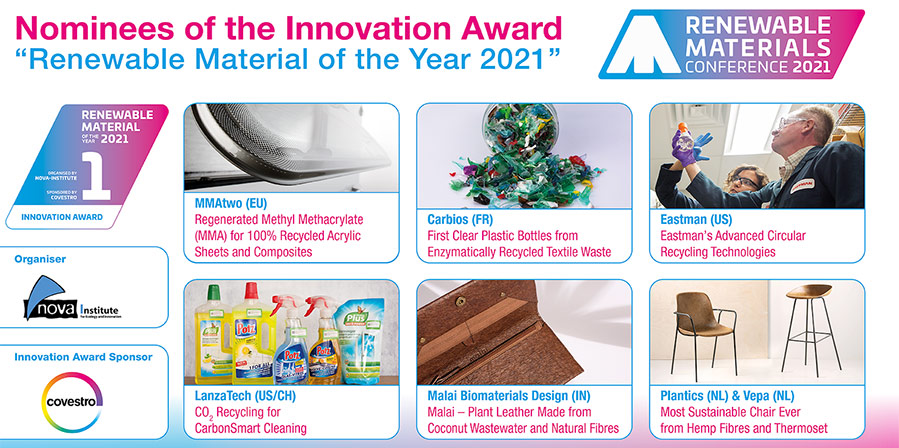
The six nominees convinced the advisory board with brand-new applications that aim to avoid or substitute fossil-based virgin materials. They are already on the market or are close to getting there. And the nominees in detail are:
MMAtwo (European Union): Regenerated Methyl Methacrylate (MMA) for 100 % Recycled Acrylic Sheets and Composites
New polymers are obtained from the regenerated MMA, leading to 100 % recycled-content products, such as new acrylic sheets and composites. Demonstrators have been produced such as a caravan window and kitchen sinks. The regenerated MMA is produced by a new innovative process, developed in the EU funded project MMAtwo, and will enter the market soon. It is obtained through depolymerisation of PolyMethylMethAcrylate – PMMA, also known as acrylic glass or plexiglas. In the recycling process, PMMA has been heated, and MMA unzips selectively from the polymer chain. Crude MMA is further purified to reach very high purity (99.8 wt % obtained on large batches).
More information: http://www.mmatwo.eu
Carbios (France): First Clear Plastic Bottles from Enzymatically Recycled Textile Waste
Carbios is the first and only company that develops biological processes to revolutionise the end-of-life of plastics and textiles. The mission is to provide an industrial solution to the recycling of PET plastics and textiles. This enzymatic recycling technology deconstructs any type of PET plastic waste into its basic components (monomers) which can then be reused to produce new PET plastics of virgin quality. In 2020, the first transparent plastic bottle from enzymatically recycled polyester textile waste was produced. Mechanical recycling technologies cannot recycle textile waste efficiently. In contrast, this new enzymatic process enables polyester fibres to be "upcycled" to a high-quality grade of PET suitable for the production of clear bottles.
More information: http://www.carbios.com/en/enzymatic-recycling
Eastman (USA): Eastman’s Advanced Circular Recycling Technologies
Circularity is a path to repair and prepare our world for future generations, which is why Eastman is dedicated to advancing a circular economy. The new molecular recycling technologies can lead to an infinite lifespan – a truly circular solution – for waste materials that were previously destined to end up in landfills or incinerators. Eastman's Advanced Circular Recycling Technologies, break down plastic waste into molecular building blocks and rebuild them into new materials like carpets and textiles, thus creating a truly circular solution. By 2030, Eastman expects to recycle up to 225,000 tonnes of waste plastic annually.
More information: http://www.eastman.com/Company/Circular-Economy/Solutions/Pages/Overview.aspx
LanzaTech (USA/Switzerland): CO2 Recycling for CarbonSmart Cleaning
In 2020, Switzerland’s largest retail company, Migros, and its subsidiary, Mibelle Group, launched a range of liquid cleaning products containing LanzaTech CarbonSmart Ethanol as part of Migros Plus Oeco Power and Potz cleaning ranges. These products are now on sale in Migros supermarkets in Switzerland. The CarbonSmart Ethanol is produced from recycled carbon from steel emissions. The new pathway reduces greenhouse gas emissions and keeps additional fossil resources in the ground, protects biodiversity and avoids land use change. The significant contribution to sustainability was validated through an independent life cycle analysis and the approach received support from experts at WWF in Switzerland.
More information: http://www.lanzatech.com
Malai Biomaterials Design (India): Malai – Plant Leather Made from Coconut Wastewater and Natural Fibres
Malai is a novel biocomposite material based on bacterial cellulose cultivated on wastewater from mature coconuts blended with fibres from banana stem, hemp and sisal. It is made without any oil-based or toxic substances, is bio-based and home compostable. Similar to leather in its properties and appearance, the material is used for accessories such as bags and purses. Malai works with wastewater from coconut processing plants in Southern India. A small coconut plant disposes of about 4,000 litres of this water per day. Such wastewater is usually discharged into the environment, where it acidifies the soil. Malai collects and sterilises the water, which can then be used as feed for the bacteria. This bacterium produces nano cellulose sheets, which are further enriched with natural fibres to obtain the final material.
More information: http://www.malai.eco
Plantics (The Netherlands) & Vepa (The Netherlands): Most Sustainable Chair Ever from Hemp Fibres and Thermoset Bioresin
Dutch furniture manufacturer Vepa is the first in the world to launch a collection of chairs with a shell of a unique biomaterial. The used materials hemp fibre and bioresin are both fully biological, plant-based and recyclable. The unique bio-based resin and material are part of a new family of bio-based materials that has been developed by Plantics and is patented worldwide for many different applications. Plantics and Vepa collaborated intensively for two years to turn the biomaterial into a high-quality seat shell. The collection is produced entirely in the Netherlands and currently includes chairs and bar stools. The production process absorbs more CO2 than it emits. In addition, the chairs are designed in such a way that the various parts are easy to separate and materials can be reused endlessly.
More information: http://www.vepa.nl or http://www.plantics.nl
About the Renewable Material Conference
Which renewable materials are solutions that meet the needs of future societies? As a response to this challenging question, nova-Institute has decided to unite all relevant industries in the new "Renewable Materials Conference" on May 18–20, 2021. There is a growing market demand for advanced and ready-to-use renewable material solutions with a low carbon footprint – that are fossil-free.
For the first time, nova-Institute jointly presents all renewable material solutions: bio-based, CO2-based and recycled. Highlights and innovations of bio- and CO2-based chemicals and materials and chemical recycling will be presented. Or in other words: All material solutions based on renewable carbon – avoiding the use of additional fossil carbon.
Already 220 participants registered, between 300 and 400 are expected. An excellent opportunity to build new networks and present your solutions to other industries. One-on-one meetings can easily be arranged by an advanced online conference system.
More information here: http://www.renewable-materials.eu