[pageLogInLogOut]

#Recycling / Circular Economy

First automated textile waste sorting and recycling line in France inaugurated
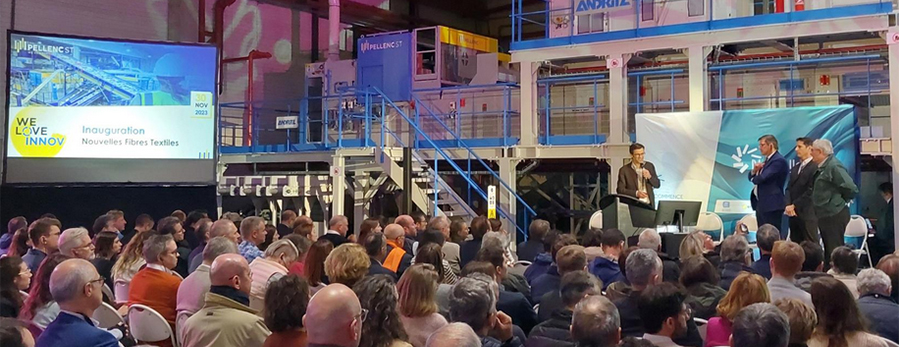
Inauguration of automated textile waste sorting and recycling plant at Nouvelles Fibres Textiles © ANDRITZ
Partnership between Nouvelles Fibres Textiles, Pellenc ST and ANDRITZ promotes circular economy for textiles.

France’s first industrial plant for automated sorting and recycling of textile waste was officially inaugurated at Nouvelles Fibres Textiles, Amplepuis, on November 30, 2023. The plant is the result of an ambitious partnership between textile recycling company Nouvelles Fibres Textiles, waste sorting specialist Pellenc ST and international technology group ANDRITZ, a specialist in textile recycling machinery and processes.

This partnership is a clear contribution to tackling the challenge of textile waste in the EU. The EU's strategy for sustainable and circular textiles aims to ensure that by 2030 textile products are made to a great extent of recycled fibers and incineration and landfilling of textiles are minimized.

Capable of automatically sorting garments by composition and color, the new line meets the needs of both post-consumer and post-industrial waste markets. The line also removes hard parts such as buttons and zippers to prepare the material for further processing in an ANDRITZ tearing machine.

The automated textile sorting line at Nouvelles Fibres Textiles is dedicated to industrial-scale production, customer trials and projects, and the R&D activities of the partners. It will process textile waste to produce recycled fibers for the spinning, nonwovens, and composites industries.

Automated sorting was the last missing link needed to develop a complete ecosystem in France, where the fashion industry, social and solidarity economy actors, waste management companies, and textile producers from different sectors are working together towards a textile circular economy.


Eric Boel, General Manager, Nouvelles Fibres Textiles: “The opening of the new line marks a milestone in our efforts to turn textile waste into resources. And we are already laying the foundations for a second material preparation plant with a capacity to process 25,000 tons of post-consumer textiles per year.”

Alexandre Butte, General Manager, ANDRITZ Laroche: “We are proud to be part of the sustainable transformation. With our technologies and our close partnership with Nouvelles Fibres Textiles and Pellenc ST, ANDRITZ is making a significant contribution to a circular economy for textiles.”



More News from Andritz Küsters GmbH

More News on Recycling / Circular Economy

Latest News

#Heimtextil 2026

Mimaki demonstrates versatile, simple TRAPIS textile printing at Heimtextil 2026

Mimaki’s textile pigment transfer printing system, TRAPIS, is able to print on a diverse range of fabrics - unlike traditional processes - including natural fibres and synthetic fabrics. The full solution will be shown on Mimaki’s booth (Hall 3.0 Stand A97), as the company returns to Heimtextil to showcase its advancements in sustainable, high quality and efficient textile printing.

#ITM 2026

The Technology Hub for global denim trends: ITM 2026

The ITM 2026 International Textile Machinery Exhibition, to be held at the Tüyap Fair and Congress Center in Istanbul from June 9–13, 2026, brings together groundbreaking technologies in denim production. From smart production systems to eco-friendly raw materials, from digital washing solutions to laser effect technologies, innovations that will shape the future of denim will be showcased for the first time at ITM 2026.

#Natural Fibers

38th International Cotton Conference Bremen: Let´s Talk about Cotton!

The 38th International Cotton Conference Bremen, to be held on 25-27 March 2026 in Bremen’s parliament building on market square, once again sends a powerful signal for professional excellence and international dialogue. The focus is on the latest market trends and technical innovations throughout the entire value chain – from agriculture and quality assurance to processing and the circular economy. With its high-calibre speakers, the conference remains an indispensable forum for anyone involved in shaping the cotton industry scientifically, technically, or economically.

#Research & Development

More safety and comfort for protective clothing thanks to auxetic fabrics

When everyday materials are pulled, they stretch or elongate in the direction of the pull and become narrower in cross-section. We can also observe this property in two-dimensional textiles. Auxetic structures behave differently here. They have the striking property of not changing under tensile stress or even increasing their width or thickness. These properties are advantageous, for example, in protective textiles or textile filter media. The DITF are researching auxetic fabrics for various applications.

TOP