[pageLogInLogOut]

#Raw Materials

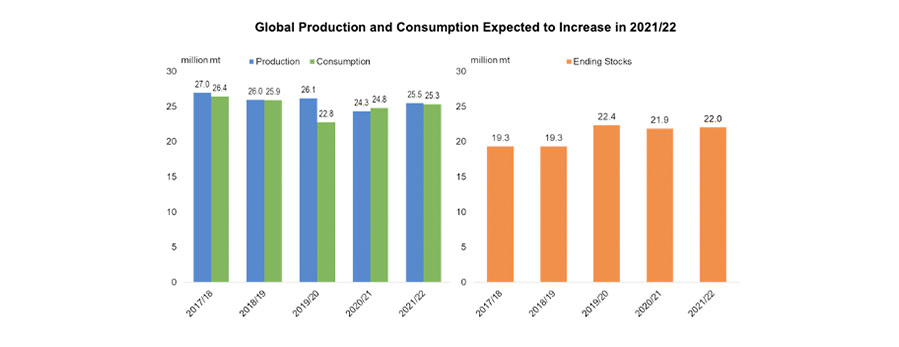
Production, consumption and trade - are all expected to make gains in 2021/22
© 2021 ICAC
Decreases in Brazil, India and the USA have caused a reduction in the 2020/21 global production estimate but cotton production — along with consumption and trade — are all expected to increase in 2021/22.
  • Production is expected to increase by 5% to 25.5 million tonnes with increases in planted area in the United States and West Africa.
  • Consumption is expected to increase by 2% to 25.3 million tonnes as the global economy continues to recover.
  • Trade is expected to increase by 2% to 10 million tonnes with import increases expected in all major consuming countries.

Global ending stocks are also expected to increase to 22 million tonnes as the stocks-to-use ratio declines to 0.87, although China’s stock is expected to decrease as the rest of the world’s expands slightly.


In terms of prices, The Secretariat’s current projection for the year-end 2019/20 average of the A Index has been revised to 81.9 cents per pound this month. The price projection for the year-end 2020/21 average of the A Index is 87.1 cents per pound this month.

Cotton This Month is published at the beginning of the month with the Cotton Update published mid-month. The Cotton Update, which is included in the Cotton This Month subscription, is a mid-month report with updated information on supply/demand estimates and prices. The next Cotton Update will be released on 15 June 2021. The next Cotton This Month will be released on 1 July 2021.

Highlights from the June 2021 Cotton This Month about the 2021/22 season include:

• Global production is expected to increase by 5.5%

• Global consumption is expected to increase by 2%

• Global trade is expected to increase by 2%

• Global ending stocks are expected to increase as stocks-to-use ratio declines


More News from International Cotton Advisory Committee (ICAC)

#Raw Materials

The 83rd Plenary Meeting: Reports from the ICAC Secretariat

Every year, one of the most anticipated sessions at the International Cotton Advisory Committee's (ICAC) Plenary Meeting is the Reports from the Secretariat — and the 83rd edition in Bremen, Germany, did not disappoint.

#Raw Materials

ICAC projects slight decline in production, relative stability for consumption

Global cotton production is projected to decline by 4% in the 2026/27 season to 24.8 million tonnes, while consumption is expected to remain relatively steady at 25.0 million tonnes, according to the March 2026 edition of Cotton This Month.

#Europe

ICAC to support European Commission on pending PEF legislation

The International Cotton Advisory Committee (ICAC) is proud to announce that it has been included as a member of the European Commission’s Technical Advisory Board (TAB) on the Product Environmental Footprint methodology. The Commission developed the Product Environmental Footprint (PEF) to assess and communicate the life cycle environmental performance of products and organizations.

#Natural Fibers

ICAC to collaborate with Uzbekistan and Bizpando on regenerative agriculture

The Government of Uzbekistan has allocated 55,000 hectares of land to implement a regenerative agriculture program for cotton as part of a collaborative project with the International Cotton Advisory Committee (ICAC) and Bizpando, a company with a a blockchain-based internet platform designed to ensure supply chain compliance.

More News on Raw Materials

#Raw Materials

Textile Exchange publishes cotton Life Cycle Assessment study to strengthen impact data

Textile Exchange has published the first in a series of seven Life Cycle Assessment (LCA) studies designed to improve the quality and robustness of environmental impact data for raw material production across the fashion, textile, and apparel industry. The first LCA study focuses on cotton and addresses critical data gaps and methodology variability through new high-quality data across key producing countries. The study includes organic, regenerative, recycled, and country averages for conventional cotton production systems, providing a clearer picture of the associated environmental impact.

#Raw Materials

Fashion for Good mobilises industry to adopt mass balance attribution and accelerate decarbonisation

Fashion for Good launches today the Mass Balance Demonstrator project, a collaborative industry initiative to implement and scale the mass balance attribution (MBA) chain-of-custody model for biomass-attributed PET in textile applications. The project represents a concrete step toward accelerating brand-driven decarbonisation across the apparel value chain.

#Raw Materials

A Powerful Opening: Global thought leaders launch the International Cotton Conference Bremen

The International Cotton Conference Bremen will open on 25 March 2026 in the Parliament building of the Free Hanseatic City of Bremen with a keynote session of exceptional calibre. Distinguished international experts will set the stage for the conference by offering incisive perspectives on the most pressing challenges and the defining trends shaping the future of the global cotton trade. Their insights will span a broad spectrum — from geopolitically driven disruptions affecting global supply chains to the opportunities emerging from innovation-led agriculture capable of supporting a growing world population. Together, these opening keynotes will frame the dialogue of the conference, highlighting both the complexity of today’s market environment and the pathways toward a resilient and forward-looking cotton sector.

#Raw Materials

Lenzing Group positions bio‑based materials as a strategic asset for Europe’s economic security

The Lenzing Group, a leading supplier of regenerated cellulose fibers for the textile and nonwovens industries, hosted a high‑level roundtable in Brussels to discuss how bio‑based materials can strengthen Europe’s economic security and support the shift toward a fossil‑free future. Organized in cooperation with Euractiv, the event brought together representatives of the European Commission, the UK Mission to the EU, academia, civil society, and industry.

Latest News

#Spinning

Graf at EXINTEX – Strengthening presence in Latin America

Graf successfully participated in EXINTEX, one of the leading textile exhibitions in Latin America, together with its local agent Eurotecnica. The exhibition provided an excellent platform to engage with customers, partners and industry experts across the region.

#Techtextil 2026

Techtextil 2026: Freudenberg Performance Materials presents Mehlerheytex and Filc

Freudenberg Performance Materials will showcase textile innovations that increase efficiency, performance and sustainability in industry and mobility at Techtextil 2026. For the first time since the merger of Mehler Texnologies and Heytex, the MehlerHeytex brand will make its debut as a leading expert in coated technical textiles. Moreover, Freudenberg Performance Materials Filc (Filc), specialist for advanced needlepunch nonwovens and laminated materials, will present its groundbreaking solutions for automotive applications. Filc customers can benefit from the perfect combination of functionality, comfort and sustainability. The Freudenberg Performance Materials experts are looking forward to welcoming visitors to the trade fair at Stand A11 in Hall 11.0 from April 21 – 24, 2026.

#Recycling / Circular Economy

Advanced Recycling Conference 2026 to showcase innovations – Call for abstracts

The call for abstracts is now open for the Advanced Recycling Conference (ARC) 2026, taking place on 17–18 November 2026 in Cologne, Germany, and online. Europe’s leading platform for advanced recycling brings together hands-on solutions and cutting-edge research on recycling technologies for various waste streams like plastics, polymers, textiles or automotive, highlighting progress towards a circular renewable carbon economy.

#Sustainability

Practical toolkit to drive coordinated climate action launched

An open-access workshop toolkit enables brands, suppliers, policymakers and investors across the textile industry to apply the System Map in their own work, identifying leverage points to halve emissions and enable a just transition.

TOP