[pageLogInLogOut]

#Raw Materials

Brazil sees huge jump in share of China’s import market but most countries will see ranging from 7% to 73%

The COVID-19 pandemic has turned the cotton world upside down, but not everything has changed in the past six months. China and the United States, for example, have suffered from the virus like every other country recently — and continued to batter each other with tariffs, as well — but they will remain the world’s largest cotton importer and exporter, respectively.

Highlights from the July 2020 Cotton This Month include:

  • China and the USA will remain the world’s top importer and exporter
  • Brazil’s share of China’s import market increased 170% in 2018/19 as US exports to China wilted under the 25% tariff
  • Through the August – April period of the 2019/20 market year, US exports to China are up significantly but most countries will see their shipments to China decrease between 7% and 73%
  • The Secretariat’s current projection for the year-end 2019/20 average of the A Index has been revised to 71 cents per pound this month
  • The price projection for the year-end 2020/21 average of the A Index is 58 cents per pound this month

Although Phase One of their trade agreement went into effect on 20 February, the cotton industry had already seen several changes as a result of the troubles:

  • Brazil has been the prime beneficiary of the USA’s losses in China, as the South American country saw its share of the Chinese import market increase by 170% in 2018/19.
  • The news isn’t all bad for the USA, which is still expected to export 3 million tonnes globally in 2019/20 and from August through April saw its shipments to China reach 277,000 tonnes, up 29% from the previous period.
  • For the 2019/20 season, most other countries are expected to find their shipments to China decrease, with West Africa’s exports declining by 48% and other countries that export to China seeing contractions ranging from 7% to 73%.
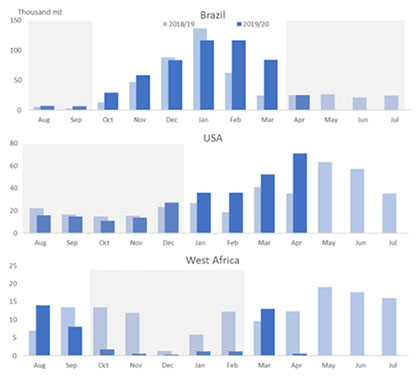

Imports from China to Brazil and the United States increase as imports from West Africa decrease. (c) 2020 ICAC


In terms of prices, The Secretariat’s current projection for the year-end 2019/20 average of the A Index has been revised to 71 cents per pound this month. The price projection for the year-end 2020/21 average of the A Index is 58 cents per pound this month.

Cotton This Month is published at the beginning of the month with the Cotton Update published mid-month. The Cotton Update, which is included in the Cotton This Month subscription, is a mid-month report with updated information on supply/demand estimates and prices. The next Cotton Update will be released on 15 July 2020. The next Cotton This Month will be released on 3 August 2020.

More News from International Cotton Advisory Committee (ICAC)

#Europe

ICAC to support European Commission on pending PEF legislation

The International Cotton Advisory Committee (ICAC) is proud to announce that it has been included as a member of the European Commission’s Technical Advisory Board (TAB) on the Product Environmental Footprint methodology. The Commission developed the Product Environmental Footprint (PEF) to assess and communicate the life cycle environmental performance of products and organizations.

#Natural Fibers

ICAC to collaborate with Uzbekistan and Bizpando on regenerative agriculture

The Government of Uzbekistan has allocated 55,000 hectares of land to implement a regenerative agriculture program for cotton as part of a collaborative project with the International Cotton Advisory Committee (ICAC) and Bizpando, a company with a a blockchain-based internet platform designed to ensure supply chain compliance.

#Natural Fibers

Bangladesh becomes World's largest importer in 2024/25 after China cuts imports by 65% to 1.1 million tonnes

As we prepare to turn the calendar on 2025, world cotton lint production currently is estimated to be about 25.4 million tonnes — roughly the same as the last season — surpassing the world cotton lint consumption by 392,000 tonnes.

#Natural Fibers

ICAC announces postponement of the 83rd Plenary Meeting in Tanzania

Due to unforeseen circumstances arising from the recent developments in Tanzania, the ICAC has announced that its upcoming 83rd Plenary Meeting has been postponed. Scheduled for Nov. 17-20 in Mwanza, the delay was recommended by Tanzania, and the decision was made out of an abundance of caution, prioritizing the safety and well-being of all participants.

More News on Raw Materials

#Raw Materials

Esquel Group adds two new extra-long staple cotton varieties approved

Esquel Group’s Xinjiang Research & Development Center has successfully developed two new Sea Island cotton (Extra-Long-Staple cotton, ELS cotton) varieties named “Yuan Loong 37” and “Yuan Loong 42,” which have been officially approved and granted registration numbers. Both varieties have also obtained Plant Variety Rights certificates, marking another significant breakthrough for the Group in cotton breeding and commercial application.

#Raw Materials

Aid by Trade Foundation reaches new milestones in supply chain transparency

The Aid by Trade Foundation (AbTF) is reaching new milestones as it leads the way towards greater physical traceability for Cotton made in Africa® (CmiA) cotton. With around 700 suppliers and producers in a total of 25 countries, the Aid by Trade Foundation has reached a new record number of partners who can trace CmiA cotton from the product back to its origin. This is more than double the previous year’s figure.

#Raw Materials

Modern testing methods for raw cotton

The 38th International Cotton Conference Bremen will take place from 25 to 27 March 2026 at the Bremen Parliament. This conference has traditionally stood for in-depth expertise and international exchange. The program will focus on technical innovations, market trends, and regulatory frameworks across the entire value chain – from agriculture to the circular economy. With high-profile speakers, the conference is regarded as the key meeting point for the global cotton industry. Today’s focus: Cotton quality and testing methods.

#Raw Materials

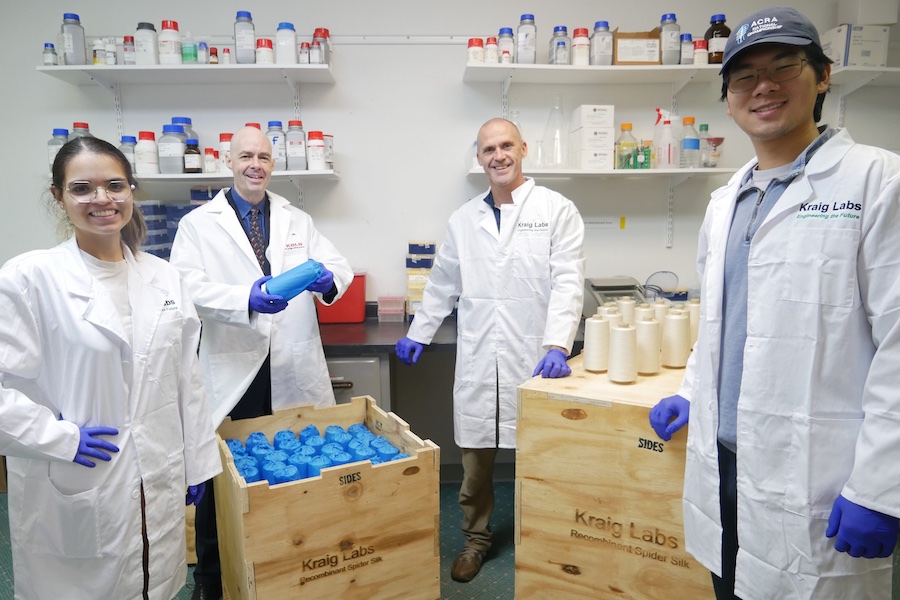
2026 production plan set for a record 10 metric tons of recombinant spider silk cocoon per month

Kraig Biocraft Laboratories, Inc. (OTCQB: KBLB) (“the Company”, “Kraig Labs”, or “Kraig’s”), a world leader in spider silk technology*, today announced its 2026 production plan that will drive explosive growth and establish a new global benchmark for spider silk manufacturing.

Latest News

#Weaving

Itema America acquires Palmetto Loom Reed, strengthening local manufacturing and service in the U.S.

Itema America, the U.S. subsidiary of Italy-based Itema Group, has acquired – through an Assets Purchase Agreement – Palmetto Loom Reed, a Greenville, South Carolina-based manufacturer of weaving reeds and one of the last remaining domestic producers of these precision components in the United States.

#Recycled_Fibers

Reju announces site selection for French Regeneration Hub in Lacq advancing Europe’s circular textile infrastructure

Reju, the textile-to-textile regeneration company based in France, announces the site selection for an industrial sized Regeneration Hub, in Lacq, in the Pyrénées-Atlantiques, on the Induslacq platform. Reju, a Technip Energies owned company, is deepening its roots in France through the development of this new Regeneration Hub.

#Functional Fabrics

lululemon introduces Unrestricted Power™ — A new sensation for strength training

lululemon (NASDAQ: LULU) has unveiled Unrestricted Power™, a new innovation platform engineered for heavy lifts and demanding gym sessions. The assortment, which launches in North America, is backed by thousands of hours of research and development, providing secure support without compromising comfort and mobility, enabling a distraction-free fit built to match every move.

#Natural Fibers

Merino wool moves into China’s high-performance sportswear market

China’s leading sportswear brands are beginning to treat Merino wool not as a lifestyle material, but as a performance input as natural fibres move from the margins of sportswear into elite technical applications. That shift is increasingly evident in the material strategies of major domestic groups such as ANTA.

TOP