[pageLogInLogOut]

#Nonwovens / Technical Textiles

ANDRITZ starts up extra-wide carding machine for Italian nonwovens producer

International technology group ANDRITZ has successfully started up the new carding machine and opening/blending line it delivered to Albis in Roasio, Vercelli, Italy.

This investment represents an important step for Albis in meeting new demands and producing innovative nonwoven products for hygiene and medical applications.
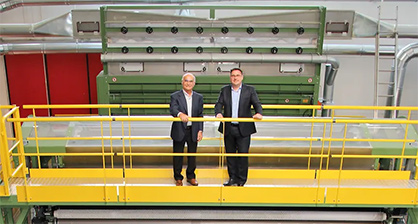
From left to right: Mr. Gianni Boscolo, CEO of Albis, and Mr. Fabien Ravier, Managing Director of ANDRITZ Asselin-Thibeau © ANDRITZ


With its large working width of 5.10 meters, the machine allows for the production of nonwoven fabrics tailored to specific customer requirements while maintaining excellent properties and consistent quality. One example is Albis Curacell ®, a multilayer composite nonwoven fabric in a weight range between 35 and 70 gsm that is produced with a fully water-free patented process and is able to absorb liquid flows of over seven times its own weight. The production line also includes an advanced upstream opening and blending system from ANDRITZ.


Albis CEO Gianni Boscolo says: "ANDRITZ has both the expertise and innovativeness we are looking for in a partner to realize our vision. The reliability of their machinery was another important factor in our decision to partner with them. Our new installation will help us meet our clients’ demands and enable us to continue creating nonwoven products that set new standards in the hygiene and medical sectors."

Albis, a privately owned group founded in Italy in 1995 by Gianni Boscolo, has been a major player in the nonwoven market for over three decades. Through continuous research and development, the company offers innovative, high-quality nonwoven solutions across various sectors, including hygiene, medical, personal care, textiles, filtration, and agriculture.

More News from Andritz Küsters GmbH

More News on Nonwovens / Technical Textiles

#ITMA Asia + CITME Singapore 2025

ANDRITZ sets focus on textile recycling and durable nonwoven production technologies at ITMA Asia 2025

International technology Group ANDRITZ will be presenting its innovative nonwovens production and textile solutions at ITMA ASIA + CITME 2025 in Singapore, from October 28 to 31, 2025 (Hall 2, D106). ANDRITZ will showcase its MMCF production plants, textile sorting and recycling, bast fiber processing, needlepunch, airlay, and life-cycle service technologies, with a focus on sustainable solutions. Discover how these innovations can grow your business opportunities and support a greener future.

#ITMA Asia + CITME Singapore 2025

Dilo Group at ITMA ASIA Singapore 2025

At ITMA ASIA Singapore, the Dilo Group will exhibit at Booth No. H2 – D202. Together with Kansan Materials, Izmir, the company will present its latest developments and looks forward to welcoming visitors to exchange ideas and explore innovations in needling technology.

#Nonwovens

OUTLOOK™ 2025: Charting a sustainable and innovative future for the Nonwovens Industry

EDANA concluded its flagship event, OUTLOOK™ 2025, last week, marking it as a major success and addressing the biggest questions facing the industry. The three-day conference highlighted the urgent need for a unified approach to sustainability, regulation, and innovation in the absorbent hygiene and wipes sectors.

#Nonwovens

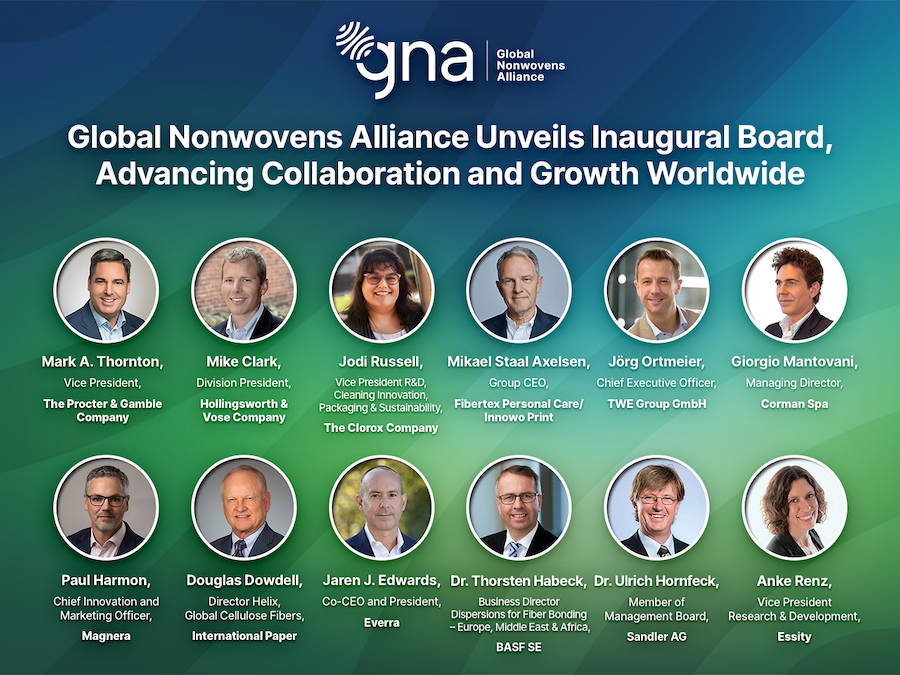
Global Nonwovens Alliance unveils Inaugural Board, advancing collaboration and growth worldwide

The Global Nonwovens Alliance (GNA), a tax-exempt federation jointly founded by INDA, the Association of the Nonwoven Fabrics Industry, and EDANA, the Voice of Nonwovens, announces the appointment of its founding Board of Directors. This group of leaders represents some of the most influential executives across the nonwovens value chain and reflects GNA’s mission to foster global collaboration, innovation, and growth in the industry.

Latest News

#Composites

KARL MAYER strengthens partnerships in the composites industry at JEC World 2026

KARL MAYER further strengthened its role as a reliable and competent partner to the composites industry at JEC World 2026. The global market leader in textile machinery manufacturing used the trade show to meet key customers, establish numerous new contacts, and engage in in-depth technical discussions.

#Recycling / Circular Economy

ABB and Syre partner to explore technologies for industrial-scale textile recycling

ABB has signed a Memorandum of Understanding (MoU) with Swedish textile impact company Syre to jointly explore technologies to support the development of Syre’s first textile-to-textile recycling plant in Vietnam. The agreement establishes a framework for collaboration to investigate how ABB’s automation, electrification and digital technologies could contribute to safe, efficient and scalable operations. It will also explore how these capabilities could further optimize process and quality control performance as Syre advances its ambition to produce circular polyester at industrial scale.

#Techtextil 2026

From Nature Performance to Circular Economy: Techtextil 2026 focuses on the future market for technical textiles

Alternative materials and recycling technologies are one of the most important future segments and drivers of innovation in technical textiles. Sustainability goals and regulatory requirements increase their relevance, while advances in performance and economic viability enhance their market competitiveness. Taking place from 21 to 24 April 2026, Techtextil reflects this key industry trend with a growing number of specialised exhibitors. With the new “Nature Performance” label, the leading global trade fair bundles relevant market offerings and facilitates access to new solutions – from natural fibres and yarns to bio-based materials and circular approaches.

#Research & Development

Textile cascade filter for removing microplastics from wastewater

Microplastics are now found almost everywhere, even in remote regions of Antarctica. They enter the human body through the food chain. Studies indicate that microplastics may have negative effects on the human health.

TOP


