[pageLogInLogOut]

#INDEX 20

ANDRITZ to supply a neXline wetlace hybrid line to Albaad, Israel
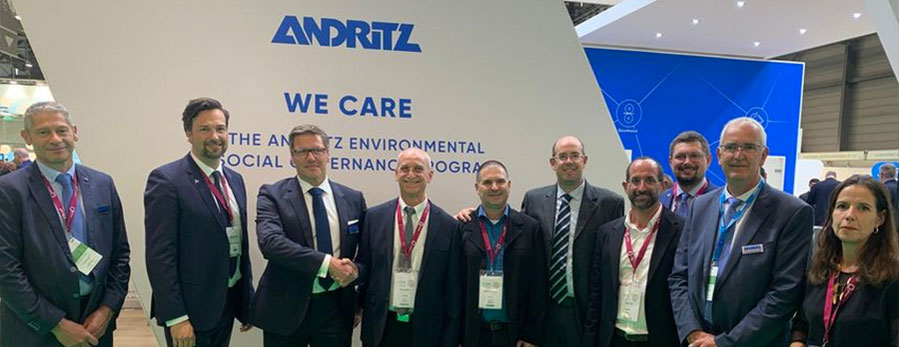
Albaad orders neXline wetlace hydrid - handshake at INDEX show © ANDRITZ
International technology group ANDRITZ has received an order from Albaad Massuot Yitzhak Ltd. to supply a neXline wetlace hybrid line for their Dimona facilities, Israel.

The line will produce a wide variety of pulp-based wet wipes and is scheduled for start-up during the third quarter 2023.

The state-of-the-art neXline wetlace hybrid is the perfect combination of inline drylaid and wetlaid web forming with hydroentanglement and drying, including quality control equipment and a Metris Industry 4.0 package. All components will be delivered by ANDRITZ and are designed to produce first-class fabrics, including biodegradable, carded-pulp and flushable/dispersible nonwovens for end uses as wipes.

Tobias Schäfer, Vice President Sales at ANDRITZ Nonwoven, comments: “Our innovative production line gives Albaad enormous flexibility in the production of wipes. In addition, the Metris digitalization package by ANDRITZ will provide Albaad with highly efficient and smart operation.”

Dan Mesika, CEO and President of Albaad, says: “We are dedicated to developing new products – such as eco-friendly, biodegradable wipes. As pioneering manufacturers of our Hydrofine® flushable wipes, we are committed to environmental sustainability. Thanks to the new ANDRITZ line, we will enlarge the product portfolio at our Dimona production site with innovative fabrics and high efficiency.


Gadi Choresh, President of the Nonwovens Division at Albaad, says: “Our knowledge and experience in drylaid and wetlaid technology, together with the state-of-the-art equipment supplied by ANDRITZ, will enable us to provide the market with natural-source nonwovens and the best answer to the market demand.”

Albaad is one of the world’s three largest wet wipe manufacturers and is committed to delivering excellent wipes for every need. The company runs world-leading production facilities on three continents, each equipped with the latest technologies. Albaad produces spunlace and flushable fabrics in its facilities as well as purchasing from other roll goods suppliers in order to support production of a wide variety of wipes.

More News from Andritz Küsters GmbH

More News on INDEX 20

Latest News

#Textile processing

YKK develops concept EXCELLA® zipper tape using nonwoven fabric partially derived from used clothing

YKK Corporation has developed a concept version of its premium EXCELLA® zipper series made from nonwoven fabric sheets created by fiberizing used clothing and other textile materials. Based on a proposal by fashion designer Yuima Nakazato, this item was created as a result of collaboration between Nakazato, Seiko Epson Corporation and YKK. The concept zipper was incorporated as a material component for pieces in the newest YUIMA NAKAZATO Couture Collection, “INFERNO,” which was unveiled in Paris, France on July 8, 2026.

#Textiles & Apparel / Garment

Texworld Apparel Sourcing Paris highlights evolving global sourcing landscape

From 31 August to 2 September 2026, Texworld Apparel Sourcing Paris will bring together more than 1,000 international exhibitors at Paris-Le Bourget Exhibition Centre. This edition reflects the new global balance of textile and apparel sourcing, highlighting a strong diversity of sourcing countries — some unexpected.

#Textile processing

Dedicated car seat model of SHIMA SEIKI’s P-CAM® R Cutting Machine unveiled

Leading Japanese textile solutions provider SHIMA SEIKI MFG., LTD. of Wakayama, Japan, showed a special version of its P-CAM® R multi-ply computerized cutting machine dedicated to the production of car seats for the first time, at a private exhibition held over two days on Thursday, July 2nd and Friday, July 3rd at the Kariya City Industrial Promotion Center in Aichi Prefecture.

#Research & Development

ALADIN paves the way for circular and demand-driven textile production in Europe

Textile production can be organized sustainably by utilizing short supply chains and preventing overproduction. This can already be achieved today by intelligently connecting and efficiently utilizing existing infrastructure. At the same time, production becomes circular when innovative technologies and materials are used that enable high-quality recycling. The ALADIN research project, launched in May 2026 and co-funded with five million euros under the EU Horizon Europe program, is creating the conditions for this.

TOP