[pageLogInLogOut]

#Natural Fibers

2026 ICAC report projects World cotton trade to reach 10.3 million tonnes by 2028/29

The International Cotton Advisory Committee has released the 2026 World Cotton Trade Report, which provides analysis of global cotton trade patterns, key trading relationships, import and export trends, and the geopolitical and policy developments shaping cotton trade flows.


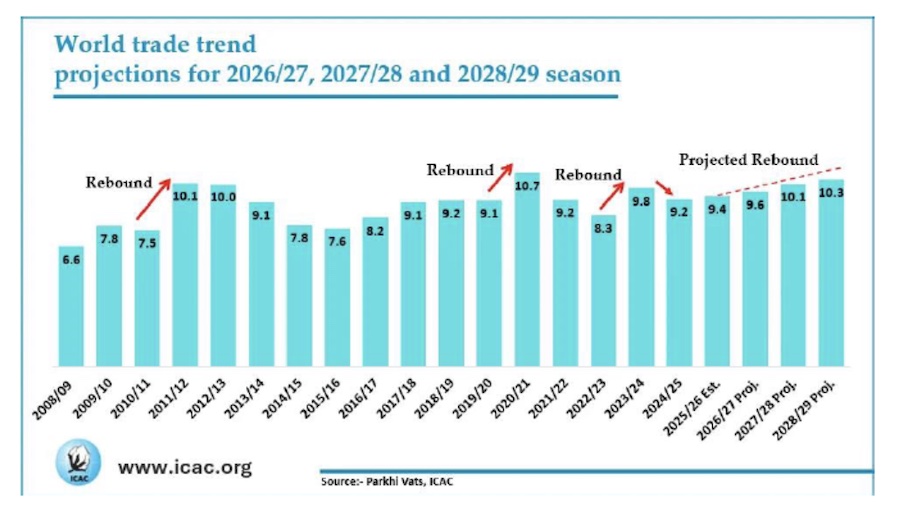
According to the publication — which is available free through the end of 2026 — global cotton trade is expected to remain on a positive trajectory over the medium term despite increasing supply-side pressures. Trade in the 2025/26 season is estimated at 9.4 million tonnes, representing a 2% increase over the previous season. It is projected to rise further to 9.6 million tonnes before reaching approximately 10.3 million tonnes by the end of the 2028/29 season.

The report identifies the increasingly tight balance between global production and consumption as a primary driver of future trade growth. In the 2026/27 season, global cotton production is projected to decline by 2% to 25.8 million tonnes, while consumption is expected to remain relatively robust at 25.5 million tonnes.

As the gap between production and consumption narrows, global markets are expected to become increasingly dependent on inventories held by major exporting countries. Any additional increase in demand would require exporters to draw down ending stocks, increasing the volume of cotton moving through international trade channels.

Demand developments in China, the world’s largest cotton-consuming country, will be particularly important in determining future trade patterns. Sustained growth in China’s textile manufacturing and consumer demand could push global consumption beyond current projections, increasing imports and providing additional support for international cotton trade.
© 2026 ICAC
© 2026 ICAC


Among the major trends addressed in the report:

  • Global cotton trade is estimated at 9.4 million tonnes in 2025/26 and projected to reach 10.3 million tonnes by 2028/29.
  • Brazil remained the world’s largest cotton lint exporter in 2025/26, supported by record production, competitive pricing, expanded market access, and reduced availability of U.S. cotton in international markets.
  • U.S. exports declined in 2025/26 but are projected to increase by 3% in 2026/27, supported by higher ending stocks.
  • China’s imports are expected to recover strongly in 2025/26 after falling sharply in the previous season.
  • Bangladesh remains one of the world’s leading cotton importers, although consumption and imports have been affected by economic disruption, energy constraints, and logistical challenges.
  • Vietnam continues to expand its role as a major cotton importer, supported by its growing textile and apparel sector and strengthening trade relationships.
  • India’s cotton import and consumption patterns are being shaped by policy changes, tariff measures, and expanding domestic textile demand.

“Global cotton trade is entering a period in which supply constraints, inventory levels, policy decisions, and consumption trends will play an increasingly important role,” said Parkhi Vats, ICAC Principal Statistician and Data Architect and author of the World Cotton Trade Report. “While production challenges and geopolitical uncertainty remain significant, the medium-term outlook points to continued growth in trade as markets respond to stable consumption and shifting sourcing relationships.”

The report also highlights how tariffs, trade agreements, logistical bottlenecks, energy costs, and changing supplier relationships are adding uncertainty to cotton value chains and purchasing decisions. Disruptions affecting shipments through the Strait of Hormuz are identified as one particularly important logistical concern.

The 2026 World Cotton Trade Report is available free of charge until January 2027 on the ICAC website here:

World Cotton Trade Report 


More News from International Cotton Advisory Committee (ICAC)

#Raw Materials

World Cotton Day 2026 to bring global cotton and textile community to Tashkent on October 7

The Government of Uzbekistan and the International Cotton Advisory Committee (ICAC) will host the official World Cotton Day 2026 Partners Conference at the Hyatt Regency in Tashkent, Uzbekistan, on October 7.

#Natural Fibers

"Review" examines the outlooks for seven major cotton producers

The newest issue of Cotton: Review of the World Situation provides an in-depth look at how seven important cotton-producing countries are responding to changing markets, rising production costs, climate pressures, evolving technologies, and growing demands for quality and sustainability.

#Natural Fibers

Global cotton trade poised for recovery as India and China drive import demand

The July 2026 issue of Cotton This Month highlights a changing global cotton market, with consumption and trade expected to strengthen despite a modest decline in production during the 2026/27 season. The next issue of Cotton This Month will be released on August 1, 2026.

#Natural Fibers

Organic cotton at the crossroads: Ideology, evidence, and the road ahead

Organic cotton occupies one of the most contentious spaces in global agriculture. While praised by brands and consumers for its environmental ideals, it also faces persistent questions about yield stability, certification integrity, and scalability. The current edition of The ICAC Recorder cuts through the ideology to deliver a rigorous, evidence-based assessment of both sides of the debate.

More News on Natural Fibers

#Man-Made Fibers

Dornbirn GFC 2026 expands conference program with new thematic sessions

For 65 years, Dornbirn GFC has stood for innovation and is one of the world’s leading conferences in the fiber industry. From September 16 to 18, 2026, the international fiber community will meet in Dornbirn, Austria, to discuss current trends, technological developments, and forward-looking solutions. More than 600 experts from industry and academia from over 30 countries are expected to attend. With around 100 presentations by renowned speakers, a 2,5-day conference program, and three parallel presentation rooms with moderated sessions, Dornbirn GFC provides a first-class platform for knowledge exchange, networking, and international collaboration. Together, participants will generate ideas and impulses that will sustainably shape the future of the global fiber industry.

#Raw Materials

Cotton Brazil Dialogues field trip brings international stakeholders closer to Brazil’s cotton production chain

How do you build trust across the global textile value chain? By opening the farm gates. This is the principle behind the Cotton Brazil Dialogues. At the end of July, the programme welcomed its first group of international participants for a five-day immersion into Brazilian cotton production, combining field visits with technical workshops to showcase the quality, sustainability, innovation and traceability behind one of the world’s leading cotton origins.

#Natural Fibers

The Woolmark Company showcases Australia's commitment to India's textile industry at Bharat Tex 2026

Reinforcing more than five decades of commitment to India's wool textile and apparel industry, The Woolmark Company, alongside Austrade and the Australian High Commission, marked a strong presence at Bharat Tex 2026, one of the world's largest textile and apparel trade platforms. Through industry engagement, strategic collaborations, technical innovation and knowledge exchange, the participation underscored Australia's continued commitment to supporting the growth and transformation of India's textile ecosystem while highlighting the versatility and value of Australian Merino wool.

#Spinning

Rieter sees Barmag integration on track as orders and sales rise

The first half of 2026 was shaped by the successful completion of the largest acquisition in Rieter’s history. The Man-Made Fiber Division enables entry into the growth segment of man-made fibers and sustainably strengthens Rieter’s market position in the Asia region. The expanded Group is now the world’s leading system supplier for the processing of natural and man-made fibers. In the first half of the year, initial cost savings in material costs and operating expenses have already been realized. The targeted synergies are expected to amount to at least CHF 20 million by the end of the 2028 financial year. Due to the completion of the acquisition on February 2, 2026, the first half of the year for the Man-Made Fiber Division only amounts to five months.

Latest News

#Weaving

More patterns, less effort: the MULTI-MATIC® at Rohleder

Rohleder is one of Europe’s most modern weaving mills. For over 80 years, the family-owned company has been developing and manufacturing premium fabrics for brands, retailers and private customers – 100% Made in Germany. This success is made possible by a consistent focus on design, quality, and functionality, as well as by continuous investment in state-of-the-art production facilities. Rohleder also relies on innovative technologies in warp preparation and has been collaborating with KARL MAYER for many years. As recently as 2023, a MULTI-MATIC® was delivered to the company’s headquarters in Konradsreuth.

#Nonwovens

BASF opens global diaper and superabsorbents performance lab in Mumbai

BASF has officially inaugurated its new Performance Lab for diapers and superabsorbents (SAP) in Mumbai on August 18, 2026, which will provide technical and application services to superabsorbent customers globally. The new lab of BASF’s Hygiene Solutions business has been established in less than a year and is part of BASF’s Innovation Campus Asia Pacific in Mumbai, BASF’s second largest R&D site in Asia Pacific established in 2017 under BASF Chemicals India Private Limited.

#Recycled Fibers

Naia™ from Eastman strengthens western hemisphere textile connections at Apparel Sourcing Show Guatemala

As brands and retailers explore more diversified and responsive sourcing networks, the Naia™ brand from Eastman is strengthening its engagement with the textile and apparel value chain across the western hemisphere. From August 18–20, the company will participate for the first time in Apparel Sourcing Show Guatemala, a regional meeting point for apparel sourcing, manufacturing and nearshoring.

#Research & Development

Europe is committed to recycling end-of-life wind turbine blades

Starting in 2026, Europe’s wind energy industry has committed itself to ensuring that wind turbine blades do not end up in landfills once they reach the end of their service life. The EU-funded research project REWIND is exploring ways to reuse this composite waste. The German Institutes of Textile and Fiber Research Denkendorf (DITF) are one of 13 project partners from seven countries.

TOP