[pageLogInLogOut]

#Natural Fibers

Global cotton trade poised for recovery as India and China drive import demand

The July 2026 issue of Cotton This Month highlights a changing global cotton market, with consumption and trade expected to strengthen despite a modest decline in production during the 2026/27 season. The next issue of Cotton This Month will be released on August 1, 2026.

According to the report, global cotton production for the 2025/26 season is estimated at 26.5 million tonnes, up 3% from the previous season, while consumption is projected to reach 25.3 million tonnes, an increase of 1.6%. Looking ahead to 2026/27, global production is forecast to decline slightly by 2% to 25.9 million tonnes, while consumption is expected to continue growing, rising approximately 1% to 25.5 million tonnes. Global cotton trade is projected to increase by 2.6% to 9.6 million tonnes.

The report identifies several key trends shaping the market:

  • Improving global demand for cotton consumption despite tighter production prospects.
  • Continued pressure on cotton acreage as growers respond to weaker profitability, rising production costs, and competition from alternative crops.
  • Climate-related challenges, including heat, unreliable rainfall, and increasing pest pressures, which continue to affect production decisions.
  • A significant shift in global import demand, led by India and a recovering Chinese market.
  • India emerges as a major demand center

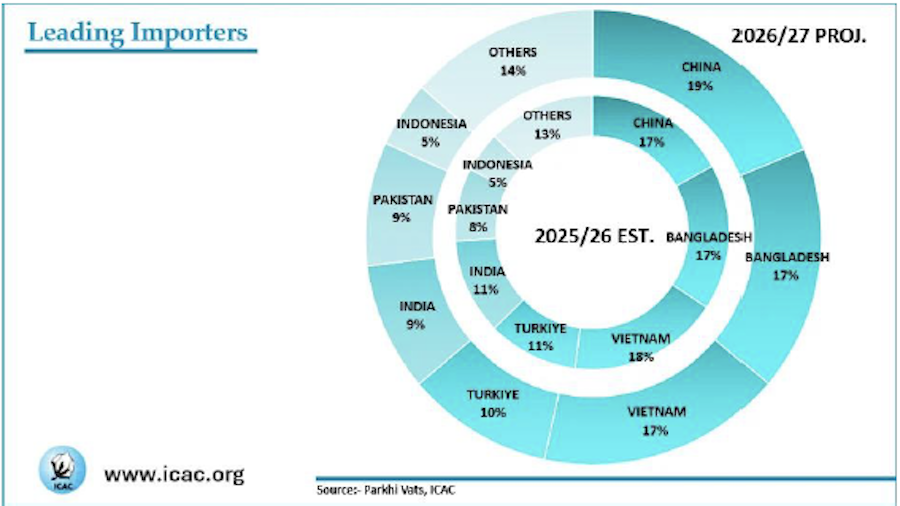
India has become one of the most important drivers of global cotton demand. Cotton lint imports are projected to reach approximately 1 million tonnes in the 2025/26 season, a 42% increase over the previous season and the highest level ever recorded by the country.

The surge follows a series of policy changes, including temporary reductions in import duties and exemptions for extra-long staple cotton, which improved access to imported fiber and supported domestic consumption growth.
© 2026 ICAC
© 2026 ICAC


China’s cotton imports recover

China is expected to regain its position as the world’s largest cotton importer during the 2026/27 season, accounting for an estimated 19% of global imports.

Following an eight-year low in imports during the previous season, China’s cotton lint imports are projected to increase by approximately 42% in 2025/26, supported by additional import quotas, higher domestic cotton prices, and the need to sustain consumption levels.

Changing trade relationships

Brazil has consolidated its position as China’s largest cotton supplier, accounting for approximately 52% of China’s cotton imports during the current season. Australia has emerged as China’s second-largest supplier, while U.S.-China trade policies continue to influence global cotton trade flows and competitiveness.

The report also examines the implications of recent policy developments, including China’s suspension of tariffs introduced since March 2025 and new commitments to purchase U.S. agricultural products.

US cotton policy initiatives

The July issue highlights the launch of the Great American Cotton Plan by the U.S. Department of Agriculture. The initiative aims to increase domestic demand for American-grown cotton and cotton products, strengthen the cotton value chain, and improve returns for growers.

The plan includes the “Plant Not Plastic” initiative, which promotes cotton-based products as sustainable alternatives to synthetic fibers, as well as support for the proposed Buying American Cotton Act.

ICAC’s price projections

Based on current supply and demand projections, the Secretariat forecasts the Cotlook A Index for the 2026/27 season to range between 66 and 85 cents per pound, with a midpoint of 75.7 cents per pound.

ICAC’s statistical data portal

For the most current statistics, users are encouraged to consult ICAC’s Statistical Data Portal, which is updated continuously throughout the month.

The author of Cotton This Month is Parkhi Vats, Principal Statistician & Data Architect at ICAC.


To subscribe to Cotton This Month, please click here:

https://icac.org/publications/cotton-this-month


More News from International Cotton Advisory Committee (ICAC)

#Raw Materials

Global cotton production projected to outpace consumption, but risks remain

Global cotton production is projected to reach 26.2 million tonnes in the 2026/27 season, marginally outpacing estimated consumption of 25.9 million tonnes. However, early-season production risks — including weather volatility and pest pressures — could narrow that buffer as the crop progresses, according to the September 2026 issue of Cotton This Month, published by the International Cotton Advisory Committee (ICAC).

#Natural Fibers

Global garment trade nears USD 550 billion as competition intensifies

The global garment industry has undergone a dramatic transformation over the past two decades, with knit and woven garments together accounting for nearly 60% of world textile exports in 2025, according to the August 2026 issue of The Textiles Observer, a free publication from the International Cotton Advisory Committee (ICAC).

#Raw Materials

ICAC International Seminar in Taipei to explore strategic synergies across the textile supply chain

The International Cotton Advisory Committee (ICAC) — together with the Taiwan Textile Federation (TTF), under the guidance of the Ministry of Economic Affairs and the Ministry of Foreign Affairs of Taiwan — will bring international cotton and textile leaders together in Taipei on September 10 for the ICAC International Seminar 2026.

#Raw Materials

World Cotton Day 2026 to bring global cotton and textile community to Tashkent on October 7

The Government of Uzbekistan and the International Cotton Advisory Committee (ICAC) will host the official World Cotton Day 2026 Partners Conference at the Hyatt Regency in Tashkent, Uzbekistan, on October 7.

More News on Natural Fibers

#Raw Materials

Cotton Brazil Dialogues 2026 concludes with 50 international participants immersed in Brazilian cotton production

The Cotton Brazil Dialogues concludes its 2026 edition after a series of technical visits to farms, cotton gins and reference centers, as well as workshops focused on Brazilian cotton production. A total of 50 participants from 14 countries took part in the field trips. The initiative is led by the Brazilian Association of Cotton Growers (Abrapa) and the National Association of Cotton Exporters (Anea), with support from the Brazilian Trade and Investment Promotion Agency (ApexBrasil).

#Raw Materials

Brazil sets new cotton export record and consolidates global leadership

Brazil ended the 2025/26 commercial year with a new record, consolidating its position as the world’s largest cotton exporter. Between August 2025 and July 2026, the country shipped 3,373,941 tonnes of the fiber, 19% more than in the previous cycle, and reached record revenue of US$5.3 billion. The result represents a milestone in Brazil’s expansion in the international market and reinforces the country’s role as a strategic supplier to the global textile industry.

#Raw Materials

Better Cotton Initiative partners with Avalo in AI plant breeding for climate-resilient cotton

The Better Cotton Initiative (BCI) has partnered with agriculture solutions company Avalo, whose platform accelerates the speed at which plants with key resiliency traits may be developed.

#Natural Fibers

Plastic-free stretch technologies drive new direction for denim innovation

As the denim industry looks for ways to reduce its reliance on synthetic fibres, plastic-free stretch technologies are gaining momentum. Developments based on mechanical fabric construction and natural rubber are demonstrating that comfort and stretch can be achieved without conventional elastane, supporting both recyclability and circular product design.

Latest News

#Weaving

Lindauer DORNIER GmbH welcomes new apprentices and dual-study students

For 22 new “DORNIER Talents”, these days mark the beginning of a new chapter at Lindauer DORNIER. For the family-owned company, in-house training is a key pillar in developing skilled professionals and retaining them within the company for the long term.

#Research & Development

Novel flame-retardant and recyclable fiber-reinforced composite

Airplanes and passenger trains must meet strict safety requirements, including fire safety standards. This calls for materials that are flame-retardant, lightweight, robust, and scalable. Empa researchers, in collaboration with their industry partner Elantas, have now succeeded for the first time in making such a material – a composite – fully recyclable.

#Composites

WHILL selects Teijin’s tough, lightweight Carbon Fiber Composite for new last-mile mobility

Teijin Limited announced today that WHILL Inc., a global leader in inclusive mobility technology, has selected Sereebo® P CFP series, a carbon fiber-reinforced thermoplastic (CFRTP) material, for key structural components of the upcoming WHILL Model C Lite. Sereebo® P CFP series provides high strength, light weight, design flexibility and system cost advantages to the Model C Lite, which is a battery powered, single-seat, last-mile device. This new model combines maneuverability with light weight and one-handed folding to ensure ease of handling and operation.

#Textile chemistry

ZymoChem secures $4 million in renewed federal funding to advance U.S. biomanufacturing of critical materials and their supply chains

ZymoChem, the specialty chemicals company dedicated to bringing decarbonization, sustainability, and supply chain resiliency to the chemical industry through innovative biological manufacturing, today announced the resumption and expansion of its federal research portfolio. The company has been notified that previously paused work under a $5 million U.S. Department of Energy (DOE) program is officially back on, to be joined by continuing collaborations with three of the nation's premier national laboratories.

TOP