[pageLogInLogOut]

#Recycling / Circular Economy

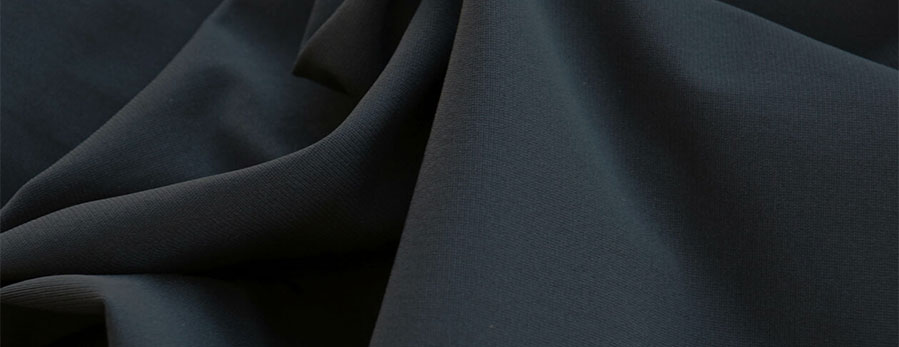
Polyester-based tricot fabric with elasticity – a new development from KARL MAYER
© 2021 KARL MAYER
If, for example, discreet comfort stretch for the clothing sector is required, KARL MAYER’s new fabric offers an ecological alternative.

Elastic yet still recyclable

The textile industry is responsible for huge mountains of waste in Europe: in Germany alone, 390,000 tonnes of textile waste are produced every year. Only Italy tops this figure with almost 466,000 tonnes per year, as shown by a study on waste disposal behaviour in 15 EU countries commissioned by the fashion label Labfresh. According to further study results, every German person produces 4.7 kilograms of textile waste, of which only 0.5 kilograms are recycled and 0.4 kilograms are reused without treatment. The rest is incinerated or dumped. /1/

A key reason contributing to the low recycling rate is the purity of the material. Many clothing textiles consist of fibre or yarn mixtures that cannot be separated for the treatment process or can only be separated with great difficulty. If, for example, discreet comfort stretch for the clothing sector is required, KARL MAYER’s new fabric offers an ecological alternative. The textile is made from yarns of different polyester polymers: a semi-dull version for a soft look and a bicomponent fibre that offers moderate mechanical elasticity with a well-thought-out structure. The elements of the stretchable fibre consist also of different polymers and show different shrinkage behaviour: when heated, a spiral crimp is formed. As the bulky deformation is not mechanically induced – unlike in textured yarns – it produces a more permanent and pronounced elongation in comparison.


The two polyester yarns were processed into a dense fabric on a high-performance HKS 3-M tricot machine in gauge E 32. The fabric weighs 202 g/m². It stands out thanks to its dense, rich feel and a heavy drape. Clothing made from it is comfortable to wear, easy to wash, does not need to be ironed and can be recycled – after removing accessories such as buttons and buckles.


More News from KARL MAYER Textilmaschinenfabrik GmbH

#Knitting & Hosiery

The new RJ 4/2 EL revolutionizes body mapping and expands creative possibilities – from smart lingerie to sporty athleisure designs

With the addition of another member to its successful RASCHELTRONIC® family, KARL MAYER is opening up new possibilities for creative product development for warp knitting mills and brands. The RJ 4/2 EL offers with two stitch-forming Jacquard bars entirely new design options for functional sportswear and bi-elastic lingerie. Available in gauges E 28 and E 32, this new model helps manufacturers set their collections apart from the competition. The fine E-32 gauges, in particular, impress with their clean surface, a pleasantly soft feel, and an exceptionally elegant look.

#Knitting & Hosiery

Driving footwear innovation

How innovative spacer fabrics are transforming the athletic footwear market, and why KARL MAYER’s new TEXTILE INNOVATION CENTER is set to become a driving force behind the next generation of performance footwear.

#Knitting & Hosiery

The new RDJ 7/3 defines the design footprint of modern athletic shoes

Stylish, functional, and efficient to produce – spacer fabrics are the all-arounders among textile materials. These versatile fabrics are particularly in demand in the sports and casual footwear sector, as they combine comfort, breathability, and design freedom. At the same time, this industry is trend-driven, dynamic, and price-sensitive like few others. Innovations are therefore a decisive factor for success. With the RDJ 7/3, KARL MAYER offers a solution specifically tailored to these requirements. The particular strength of the new double raschel machine: its exceptional flexibility, thanks to its three jacquard bars.

#Knitting & Hosiery

Significantly greater versatility and productivity with the HKS 4-S EL from KARL MAYER

With the new HKS 4-S EL, KARL MAYER is introducing an innovation to the market that impresses in two ways: with outstanding speed and maximum flexibility.

More News on Recycling / Circular Economy

#Recycling / Circular Economy

Managed workwear services are providing a blueprint for the circular textile economy

Managed workwear service providers are demonstrating how commercial success and circularity can go hand in hand by extending garment lifespans through repair, laundering, reuse and recycling, according to “Managed workwear services—a circular textile economy ahead of the game”, a new 14‑page report from the global business information company Textiles Intelligence.

#Recycling / Circular Economy

Eco-design as the foundation of circular textiles

Based on the results of an extensive European analysis, the Erasmus+ project Skills4Circularity is currently developing three practice-based training modules covering recycling technologies, eco-design for the circular economy and sustainable manufacturing. This was preceded by a comprehensive company survey and a joint analysis conducted by the project partners under the leadership of IVGT. The results show that the greatest challenges lie not so much in a lack of technology as in skills gaps.

#Recycled Fibers

Usha Yarns secures growth equity investment from Fullerton Carbon Action Fund

Usha Yarns Limited (“Usha Yarns”), a producer of high-quality recycled yarns with advanced, well established production processes, announced a growth equity investment from the Fullerton Carbon Action Fund (“Fullerton”), a private equity strategy managed by Fullerton Fund Management that backs established mid-market companies across Emerging Asia to accelerate decarbonisation.

#Recycling / Circular Economy

German 'ZOLL' turns end-of-life uniforms into valuable raw materials

Together with CWS Workwear, the German Customs Administration is extending the life cycle of service uniforms through reuse, recycling and material recovery, demonstrating how circular economy principles can be successfully implemented in the public sector while delivering significant savings.

Latest News

#Functional Fabrics

PERFORMANCE DAYS announces new focus topic & forums for October 2026

With its upcoming October 13–14, 2026 edition, PERFORMANCE DAYS is placing the spotlight on one of the textile industry’s most important transformations: “Bio-Based Materials – From Fiber to Fabric”, a two-part Focus Topic exploring the future of bio-based innovation across the textile value chain. Part 1, presented in October 2026, will focus on fibers and next-generation material developments, while Part 2 at the March 2027 edition will shift the perspective toward dyeing, finishing, additives, and processing technologies.

#Nonwoven machines

MENANG rapidly resumes production with new ANDRITZ airlay line after major fire

MENANG, a Malaysian manufacturer of nonwoven automotive components, has resumed production after a major fire severely damaged its airlay line in mid-March 2026. A new airlay line supplied by ANDRITZ enabled production to restart within only four months.

#Exhibitions & Events

Febratex 2026 to be the largest edition of the leading textile trade fair in the Americas with 10 exhibition halls

Febratex 2026 will be the largest edition in the history of the leading textile trade fair in the Americas. Dedicated to the textile and apparel manufacturing industries, the event will take place from August 18–21, 2026, in Blumenau, Santa Catarina, Brazil, with a strong focus on technology, sustainability, and business generation.

#Raw Materials

Cotton Brazil Dialogues field trip brings international stakeholders closer to Brazil’s cotton production chain

How do you build trust across the global textile value chain? By opening the farm gates. This is the principle behind the Cotton Brazil Dialogues. At the end of July, the programme welcomed its first group of international participants for a five-day immersion into Brazilian cotton production, combining field visits with technical workshops to showcase the quality, sustainability, innovation and traceability behind one of the world’s leading cotton origins.

TOP